|
Getting your Trinity Audio player ready...
|
On March 3, 2025, a short video went viral on TikTok, captioned “Get ready with me to go for stranger removal.” The two-minute clip amassed more than 90k+ views, likes, comments, and shares. The video documented a young woman preparing for an abortion without ever mentioning the word.
The phrase “stranger removal” is a part of a growing digital code. It is ‘algospeak’—coded language used to evade automated content moderation systems that flag posts containing words like abortion.
In Kenya, the phrase has quickly entered online slang. But its spread reflects something more significant. Behind the coded language is an expanding underground abortion market shaped by legal ambiguity, high costs, and limited access to safe services. Increasingly, that market is taking shape online.
Abortion in Kenya exists in a legal grey zone. It is permitted under the 2010 Constitution in specific circumstances. Article 26(4) of the 2010 Constitution permits abortion when a trained health professional determines that there is a need for emergency treatment, or the life or health, including mental health, of the mother is in danger.
At the same time, sections of the Penal Code, inherited from the colonial era, continue to criminalise abortion. Health workers are legally required to provide post-abortion care, yet access to safe procedures remains unclear, and in many cases, inaccessible.
This contradiction creates uncertainty for both patients and providers, pushing many women away from formal healthcare systems and towards informal options. What was once largely dependent on word-of-mouth referrals is now expanding through social media, where access is faster, more discreet, and often unregulated. The result is a largely unregulated underground market, often run by unqualified providers.
Platforms like TikTok have widened the reach of these informal networks. While the platform prohibits the sale or promotion of regulated medical products, enforcement appears uneven, particularly where sellers rely on coded language. Content that would otherwise be flagged can remain visible, allowing sellers to reach potential buyers while operating with little accountability.
What remains less clear is how the platform’s recommendation systems shape this environment. It is not known whether videos using algospeak are pushed to users already searching for reproductive health information, or whether moderation systems are less effective at detecting local slang and euphemisms. It is also unclear whether enforcement is applied consistently across regions.
TikTok says most violating content is removed before it is reported, but this does not account for content that is never detected. In practice, the platform not only hosts these interactions; it may also influence how widely they spread.
Rita (not her real name) found out she was pregnant while in her final year of university.
“I was scared,” she recalls. “I knew I had the option of terminating the pregnancy, but the clinic I knew was too expensive for me.”
She says the clinic required an ultrasound to confirm gestational age. At around 10 weeks, she was quoted Sh26,000 for the procedure, on top of the Sh3,500 already spent on consultation and scans.
“I simply couldn’t raise that amount,” she says. “That’s when I decided to look elsewhere.”
Her experience reflects a broader pattern. The World Health Organization defines unsafe abortion as a procedure carried out by someone lacking the necessary skills or in an environment that does not meet minimum medical standards.
In Kenya, unsafe abortion remains a significant public health concern. According to a 2023 policy brief by the African Population and Health Research Centre, about 2,600 women die each year from it, while roughly 21,000 are hospitalised annually with related complications, according to the Kenya Obstetrical and Gynaecological Society.
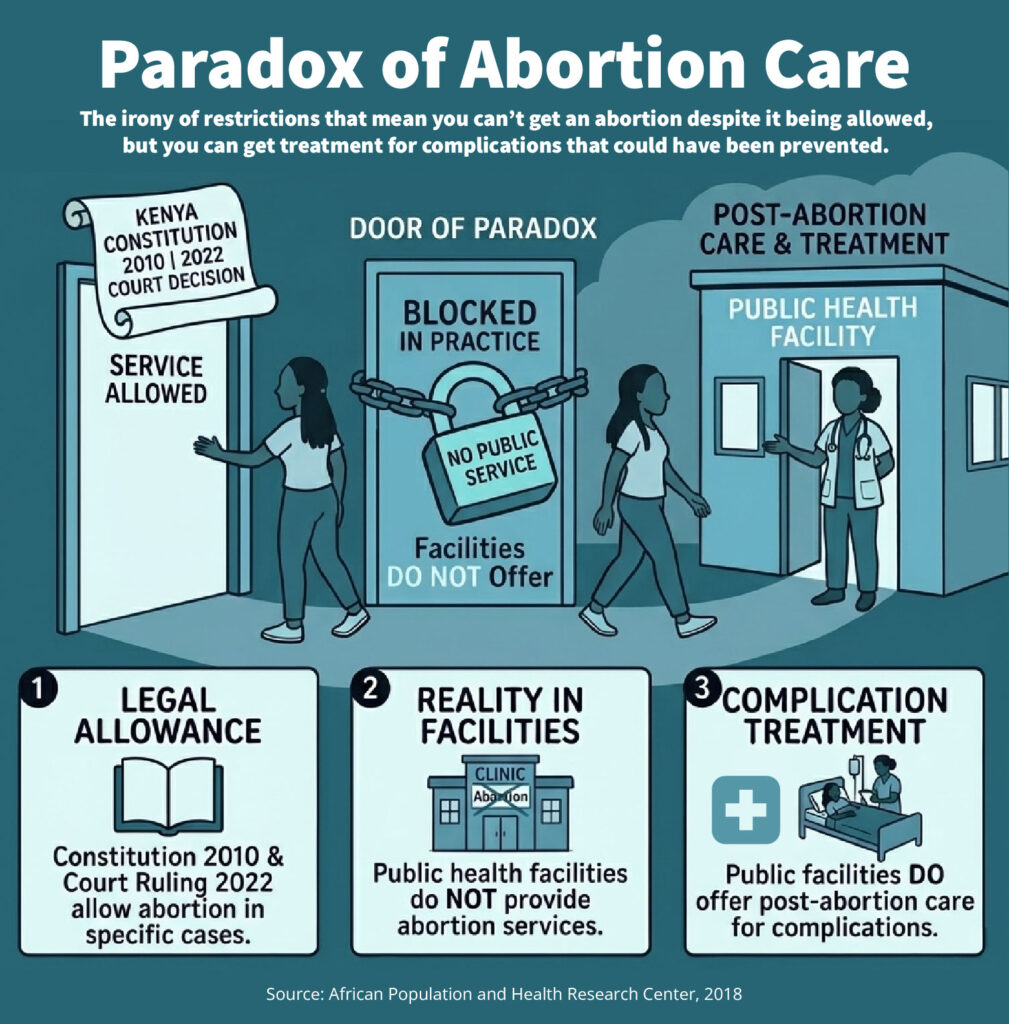
In South Africa, where abortion is legal and available in public health facilities, abortion-related deaths fell by more than 90% following legalisation. But access remains uneven, with some women still turning to informal providers due to distance, stigma, or gaps in the health system.
For many women, cost is the tipping point. Reliable data on the cost of abortion services in Kenya is scarce, partly because much of the market operates informally. Prices range from as low as Sh1,000 to as high as Sh30,000, depending on the provider and gestational age.
This gap in affordable care has created space for informal providers, many of whom now operate online. TikTok sellers offering what they call “stranger removal kits” told this writer they charge between Sh3,000 and Sh5,000, marketing the pills as suitable for home use for pregnancies under eight weeks.
Rita says a friend referred her to a man who sold her pills for Sh3,500.
“He delivered them in town and gave me very vague instructions,” she says. “He mentioned he was rushing to make other deliveries in Buruburu and Rongai.”
When the pills failed to work as described, the seller told her to go to the hospital, then blocked her.
Even before the rise of digital platforms, unsafe abortion providers operated in plain sight. TikTok, however, has expanded their reach, allowing them to connect with women who lack trusted referrals or feel unable to discuss abortion openly. Since the viral video, at least 10 TikTok accounts have openly advertised and sold so-called stranger removal packages and services.
For women like Vivian, these platforms offer both access and risk. She says she purchased abortion pills through TikTok in October last year, negotiating the price down from Sh4,500 to Sh3,500.
This writer attempted to engage two TikTok sellers advertising abortion pills. Both directed the conversation to WhatsApp after initial contact via direct messages, with one quoting a price of Sh4,500. For ethical reasons, including avoiding participation in potentially unsafe or illegal services, the interaction was not pursued beyond TikTok.
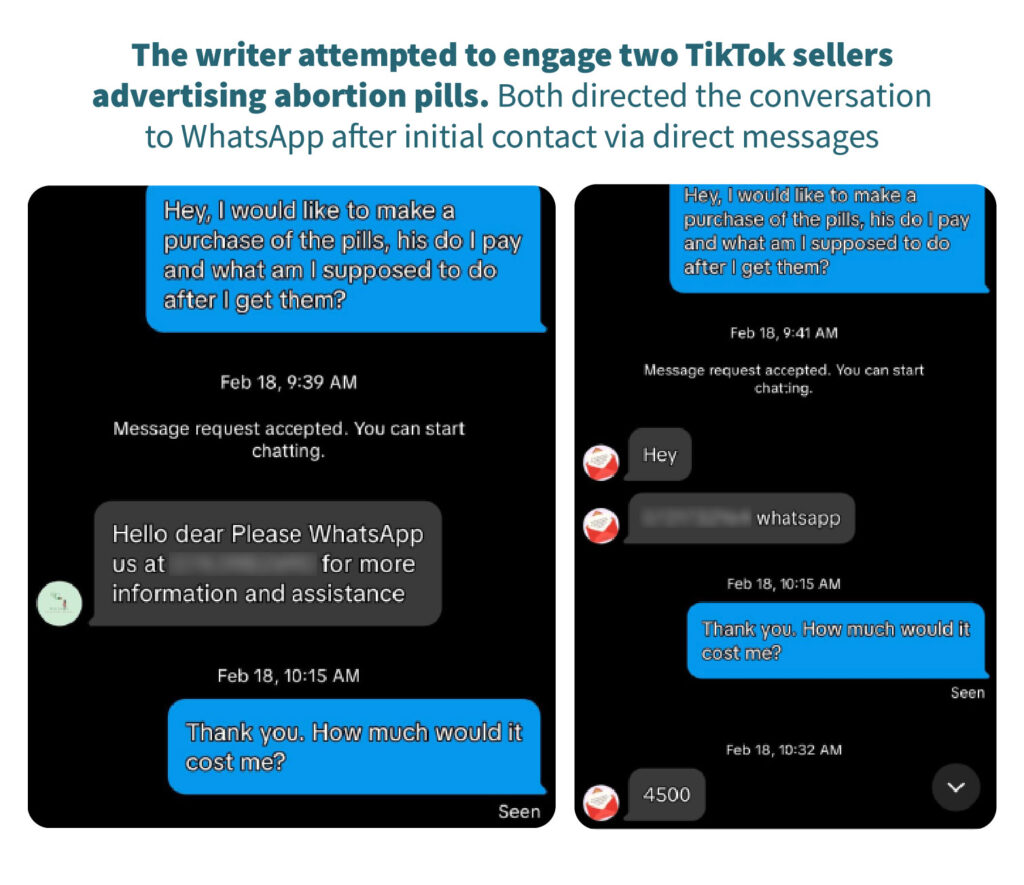
The appeal of these online transactions lies in their speed and anonymity. Sellers prioritise profit, while buyers value discretion and quick access. In cases of complications, women can still seek post-abortion care at health facilities, as provided by law.
For Rita, that moment came a week later when she sought medical attention from a gynaecologist and learned that the abortion had been incomplete. She had to raise more money for post-abortion care and prescribed medication.
“I feared for my life and felt too ashamed to speak to anyone about it,” she recalls. “My partner later offered to take me to Marie Stopes, where I finally received the help I needed.”
According to Mark Okundi, a communications officer at MSI Reproductive Choices (formerly Marie Stopes International), many patients who arrive at the clinic present with abortion-related complications, often linked to information they encountered online.
“Due to data privacy regulations, I cannot disclose exact figures without infringing on our patients’ rights,” he explains.
While patient data is protected under Kenya’s Data Protection Act (Kenya), limited publicly available data on abortion complications continues to make it difficult to fully assess the scale of the problem.
“However, comprehensive abortion services are essential in addressing the underground market that continues to thrive at the expense of women,” says Okundi.
Taken together, his observations on patient complications and the role of informal providers point to a broader pattern. Information spreads quickly on platforms such as TikTok, including misleading videos by unqualified providers promoting unsafe products. Limited access to safe services pushes many women toward these informal providers, who often sell incomplete dosages and later refer clients to public hospitals for post-abortion care.
The impact is reflected across the health system. Unsafe abortions place a heavy and largely preventable burden on Kenya’s public health system, with thousands of women requiring treatment each year. A joint report by the Ministry of Health, APHRC, and Guttmacher found that nearly a third (28.5%) of women experienced moderate complications, while 16% faced potentially life-threatening conditions, with some going into comas or dying. The report also found that two in 10 facilities expected to provide post-abortion care were unable to do so, while others struggled with stockouts and limited contraceptive options.
The risks are also visible in the same online spaces where these services are marketed. In an August 16, 2025, video, the creator who popularised the term “stranger removal” warned that many women had contacted her after buying ineffective pills online.
“The pregnancy stops progressing but is not expelled,” she said, citing medical advice that some pills sold online and in pharmacies have been proven ineffective. She urged women to seek trained health professionals and cautioned against repeating failed doses.
“Many people are posing as healthcare providers,” she said. “When things go wrong, they block you. They thrive on the shame associated with abortion.”
The risks described are not inherent to abortion itself but to unsafe conditions.
According to the World Health Organisation (WHO), unsafe abortions can lead to serious health complications, particularly where access to safe and timely care is limited. These include incomplete abortion, heavy bleeding (haemorrhage), infection, uterine perforation, and damage to the genital tract or internal organs. These risks are significantly higher when procedures are carried out by untrained providers or in unsafe conditions.
These risks are increasingly linked to the same digital spaces where such services are marketed. In response to our inquiry, TikTok said its policies prohibit the trading, marketing, or promotion of regulated, prohibited, or high-risk goods and services on the platform. A spokesperson said the platform enforces these rules through automated detection and human moderation, adding that most violating content is removed before it is reported by users. The company also requested details of accounts identified in this investigation for further review. These details were not shared before publication to protect the integrity of the reporting process.
The language may be coded, the sellers anonymous, and the transactions hidden in private messages. But the consequences are visible, in hospital wards, in emergency rooms, and in stories of women navigating complications. As more people turn to online platforms for information and services, these platforms are increasingly shaping how abortion services are accessed, who finds information, what they find, and how reliable it is. In that space, access and risk are becoming harder to separate.
–
This article was produced as part of the Gender+AI Reporting Fellowship, with support from the Africa Women’s Journalism Project (AWJP) in partnership with DW Akademie. The journalist used AI tools as research aids to review and summarise relevant policy and research documents and extract key statistics. All analysis, editorial decisions and final wording were done by the reporter, in line with The Elephant’s editorial standards.