|
Getting your Trinity Audio player ready...
|
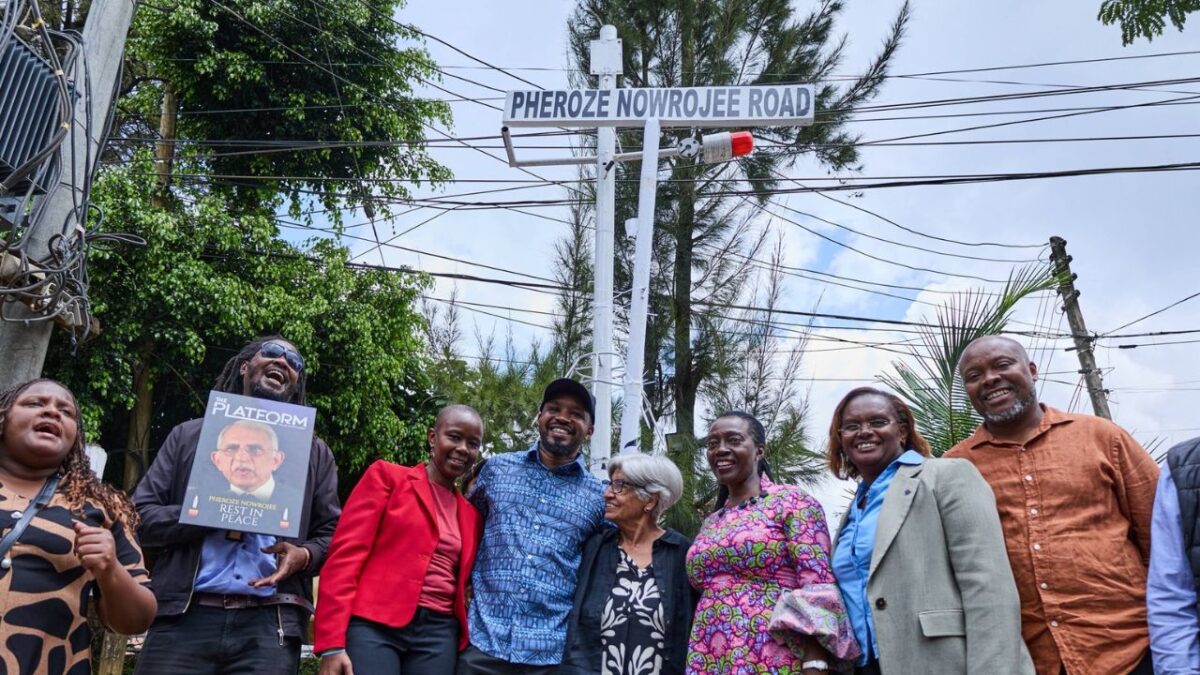
Two weeks ago, Nairobi city authorities renamed Galana Road to Pheroze Nowrojee Road to honour Nairobi lawyer Pheroze Nowrojee, who died a year ago at the age of 84. While Nowrojee was a once-in-a-generation personality whose impactful life as a lawyer, university lecturer, author, poet, and political activist earned him great public admiration, he was still an unlikely candidate for a road rename, given the profiles of the people that the city authorities have recently named roads after.
In September 2015, Nairobi City County renamed Limuru Road after the late Nobel Peace Prize winner Wangari Maathai. Little public consultation preceded the renaming of the road after Maathai, who died in 2011. The then city governor, Evans Kidero, explained that “if it were not for her efforts in environmental conservation, Karura Forest [a major forest in the city] and Uhuru Park [the largest park in the city] would have been a thing of the past”. The name change preceded the formality of a motion that was put before the County Assembly to seek approval.
A month later, the city authorities renamed Milimani Road after Tanzania’s then-president Jakaya Kikwete. Elected in 2005, Kikwete was making a valedictory state visit to Kenya as he was retiring that year. While the official explanation for the name change was to honour the close relationship between Kenya and Tanzania, the renaming was really an expression of Kenya’s gratitude to Kikwete, who had played a leading role in mediating Kenya’s 2008 political crisis.
A charismatic figure, Kikwete became president in 2005, after a long stint as Tanzania’s foreign minister, a role that had seen him cultivate regional ties and visibility. When Kenya’s crisis erupted at the end of 2007, Kikwete initially dispatched his predecessor, the late Benjamin Mkapa, to join the Kofi Annan-led Kenyan mediation of the crisis. Following a deadlock in the mediation, Kikwete flew into Nairobi, arriving late when the parties had exhausted themselves in disagreement. His personal prestige and relatability as a neighbour brought new energy to the mediation and was a key factor in unlocking the deadlock. The iconic image of President Mwai Kibaki and his challenger, Raila Odinga, shaking hands on the terrace of the Office of the President at Harambee House also included Annan, Mkapa, and Kikwete, then 57 years old and a rising star in East African politics.
A more recent name-change concerns Mbagathi Way in the city. This road was renamed Raila Odinga Way in 2021, after the now-deceased former prime minister. As minister for roads, Odinga had overseen the repaving of the road with concrete, a novel venture pioneered by the cement industry to demonstrate the viability of concrete as an alternative to asphalt in road construction. More than 20 years later, the road remains in perfect shape, proof of the success of the experiment. Odinga was alive when the road was renamed for him and would die four years later. While the authorities justified the change of name as an honour to Odinga for his leadership in the road sector, it was also a tribute to his lifetime contribution to political leadership in Kenya, including as a leading presidential candidate in elections he was controversially adjudged to have lost. The tumultuous reaction that his death elicited, which some compared to reactions to the deaths of such global figures as Nelson Mandela and the Ayatollah of Iran, helps to explain how this renaming was implicitly popular and accepted, even though, beyond the debate at the Nairobi County Assembly, little public consultation preceded it.
Not all attempts to rename roads have been successful or without controversy. In 2021, the city authorities attempted to rename Dik Dik Road in the city after Francis Atwoli, the longstanding leader of Kenya’s compromised trade union federation and a stalwart of the political establishment. However, residents of the neighbourhood resisted, felling the new road sign, a rejection of the unilateral attempt to rename a road in their neighbourhood after an unpopular public figure. The city authorities re-erected the signage, with Atwoli coming out to rebuke the vandalization as “impunity and primitiveness”. Warning that the county government had placed CCTV cameras at the site to protect against vandalism, Atwoli dared anybody to interfere with the road sign, and, indeed, when political activist Boniface Mwangi and the area residents tried to pull it down, they were attacked by armed goons hired to guard the road sign. This was not the end of the matter, however; the road sign was soon burnt down during the night and was never replaced.
Nelson Havi, the president of the Law Society of Kenya at the time, tweeted that the failed renaming of Dik Dik Road was a sign that “Kenyans have low tolerance levels for mediocrity”. For his part, Mwangi posted on X, “Kenyans are RISING UP! We shall protect our roads and streets from vile road signs!”
It was John Khaminwa who had proposed the naming of a road after Nowrojee as he paid his tribute during Nowrojee’s memorial. Now in his eighties and an influential figure within Kenya’s legal fraternity, Khaminwa has, like Nowrojee, a history of activism. In 1982, and again in 1990, Khaminwa faced detention without trial in the backlash that followed difficult political moments in Kenya. Residents of the Kilimani area, where the Nowrojee family has lived for decades, later followed up Khaminwa’s suggestion. As required by Nairobi City County regulations, there followed a lengthy process of public consultation during which 93 per cent of those polled expressed support for the renaming of the road in honour of Nowrojee and as a demonstration of neighbourhood pride in having had such an upstanding resident in their midst. At County Hall, the motion to rename the road after Nowrojee received the unanimous support of the entire assembly.
On the morning of the renaming ceremony, Ankole Grill, a neighbourhood restaurant specializing in Ugandan cuisine that is situated along the targeted road, provided a free meeting space and free breakfast for those gathered for the ceremony. Martha Karua, former Justice Minister and a senior figure in Kenya’s legal and political circles, read a tribute to Nowrojee, characterizing him as “a remarkable Kenyan patriot, a man who devoted his life to the pursuit of justice, especially for the vulnerable”. Tanzanian Professor Issa Shivji, with whom Nowrojee had taught at the University of Dar es Salaam, also read a tribute. Willy Mutunga, Kenya’s former Chief Justice, introduced Shivji. Villoo Nowrojee spoke last, saying that even though her husband had not set out to gain the recognition that his work has attracted, the family was nevertheless grateful for the honour and the friendship of the many people that were now part of the Nowrojee family.
In having a road named after him, Nowrojee is in the happy company of a former president, the towering Odinga, who is Kenya’s foremost statesman, and a Nobel laureate. However, there is a difference in how Nowrojee got there. The decision to rename a road after each of the three came from the establishment, from the top. In the case of Nowrojee, that decision was the result of civic demand, agitation from the bottom. In her tribute on the morning of the renaming ceremony, Gina Din, a friend of the family, remarked that the city county government that so often forgets real heroes had, for a change, “chosen well. It has chosen courage; it has chosen integrity. It has chosen to remember a man who stood when it would be easier not to”.
The city government revealed that more than 40 name-change applications are currently pending before the Nairobi County Assembly. The fast-tracked decision regarding the Galana Road name change reflects both the merits of the case and the effectiveness of the civic demand.
Before he had a road named after him, Nowrojee had already been the posthumous recipient of the Order of the Burning Spear, Kenya’s highest national honour that was awarded by President William Ruto in December 2025. In life, Nowrojee was no favourite of the political establishment to which he often fearlessly spoke truth. The fact that, in death, they all fell in line, with President Ruto sending an effusive message of condolence to the family, reflects the views of George Bernard Shaw that “death is a necessary condition for sainthood”, that while “Life levels all men; death reveals the eminent.”