|
Getting your Trinity Audio player ready...
|
Foreign policy observers were struck with bewilderment when Tanzanian President Samia Suluhu reprimanded President William Ruto for announcing regional plans to build an oil refinery in Tanga.
In that moment, it became apparent that Ruto’s comments at the Africa We Build Summit in Nairobi had been received as a slight on Tanzania’s sovereignty because the Samia administration had no knowledge of such plans.
In a hard-eyed moment, President Ruto was quick on his feet – as always. Doubling down in his response, Ruto placated the Tanzanian public by telling them how lucky they were to have their country be considered for such investments while still signalling Kenya’s desire to host the facility in Mombasa.
Nevertheless, the damage to the Kenyan psyche was done, and despite Aliko Dangote (Africa’s richest man and the Nigerian business magnate who is keen to invest in an East African refinery) stating his preference for Mombasa, Kenyans still feel embarrassed by the whole affair.
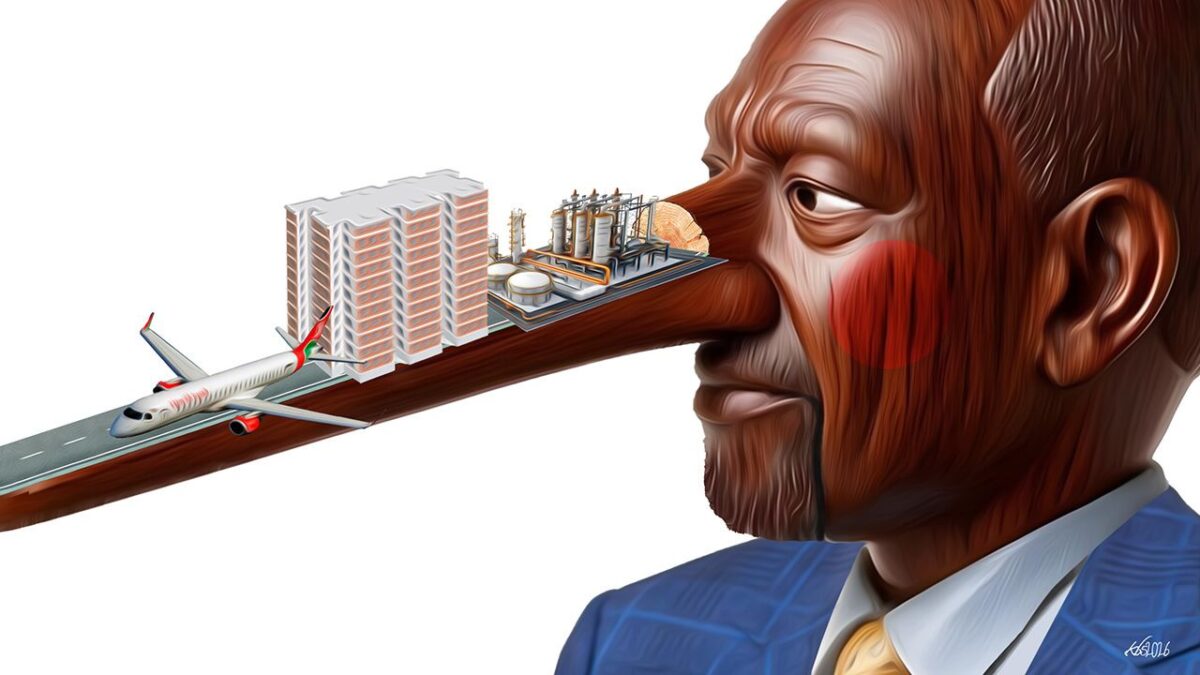
This is because they can’t seem to understand why their president would lie so openly on the diplomatic stage. A masterly two-faced performance. What was the diplomatic bait-and-switch strategy at play here? Was having an oil refinery in Mombasa the endgame of some hocus-pocus negotiation tactic that was simply not well understood, or well executed?
Why does the world keep feting President Ruto at various fora despite his numerous goofs and gaffes? Shouldn’t he be a pariah, shunned especially following the police killings and abductions of Gen Z protesters during the June 2024 tax riots?
As diplomatic watchers review President Ruto’s attendance of the Group of Seven (G7) meeting, it would help to read a small 140-page book by John Mearsheimer titled Why Leaders Lie: The Truth About Lying in International Politics.
Mearsheimer’s theory of offensive realism – that international politics is primarily driven by a state of anarchy, where states maximise their power in ways such that the ends justify the means in achieving dominance within the global system – has been highly controversial, if not broadly unpopular.
However, in a post-American, multipolar world in poly-crisis – following the rise of China, the Russo-Ukrainian War, and the conflict in Iran – Mearsheimer’s analysis has become all the rage in trying to understand the transactional behaviour of buck-passing, self-promotion, or global balancing being adopted by various actors.
The book provides frameworks, justifications, and evidence of lying in foreign affairs for either strategic or selfish interests. Mearsheimer further provides the logic, opportunities, and context in which this happens, so much so that one cannot ignore how diplomacy, duplicity, and deception are all nine-letter words of the same feather.
Lying for strategic interests, Mearsheimer states, comprises spinning and concealment.
Spinning – what lawyers do for their clients – is the advancement of certain facts or linking of arguments to obtain a favourable advantage on an issue. On the other hand, concealment is the withholding of information to either advance one’s own position or weaken an opponent’s position.
Tactics herein include fearmongering, strategic cover-ups, mythmaking, and normative lies that are socially accepted or expected, and institutionalized falsehoods – better known as white or necessary lies.
Meanwhile, social imperialism, as opposed to spinning and concealment, is considered a selfish falsehood. A good example of this is the use of social media for political manipulation, best demonstrated by the work of Cambridge Analytica, among other communication operatives in Kenya.
Selfish lies only benefit an individual or a privileged group network, while strategic lies are told in service of a country’s interests. Both are frowned upon because there is no justification for them in maintaining the republic as a commonwealth; they have a corrupting influence on the polity character of a country, and they endanger broader collective interest(s) in policymaking.
Conversely, strategic lies provide the sleight of hand to legitimately advance the general welfare. They are the velvet gloves that cover iron fists. There is obviously a thin line in that strategic cover-ups are supposedly aimed at hiding failed, foolish, and controversial policy from the public or other states to protect the country from harm.
On the other hand, dishonourable (immoral or shameful) cover-ups are supposed to hide blunders and policy failures for selfish reasons that usually amount to shielding individuals from punishment or from exposing their incompetent involvement in matters such as the ignoble circumstances of the alleged Sudanese Rapid Support Forces (RSF) links to Kenya.
Mearsheimer uses Kenyan history to explain the tactics of lying by political actors, citing the mid-1950s controversy concerning the UK government’s cover-up of atrocities committed at a gulag in Kenya where Mau Mau independence fighters were held. Reports of systematic torture by whistleblower politicians and journalists were dismissed as “subversive propaganda” to silence, discredit, destroy information, or to erase archives.
This could be viewed as the original sin, the seed for the later cover-ups and other violent actions that contemporary Kenyan authorities adopted from previous administrations as tools of statecraft.
Thus, President Ruto becomes a form of Loki (the cunning trickster god of Norse mythology) as opposed to an Anansi (the legendary trickster spider from Akan folklore in Ghana) as he governs from a point of a trust deficit not only based on a culture of non-inclusive officialdom or association with historical injustices but also as a means to navigate existing political disappointment.
Of the total 243 manifesto promises made by his Kenya Kwanza administration, only 26 have been honoured so far. This accounts for only 11 per cent, yet there are about 400 days left in his term.
Global leaders, who may have come to realize that he is a hyperbolic communicator, must then parley with him up close to understand his real intentions, but also parlay with him for purposes of securing trade, security, technological, health or even energy and natural resource interests such as critical minerals.
By way of illustration, the president has recounted how the country is rethinking his overhyped plan to establish a US$1 billion data centre facility in collaboration with G42 of the United Arab Emirates and Microsoft, which was signed in the US under the Biden Administration. The deal seems to be falling through the cracks and the government is working hard to salvage it.
Lately, this type of dealmaking that doesn’t seem to make sense to the average Kenyan is exemplified by the establishment of a US Ebola quarantine facility in Kenya “built”, or rather officially designated as such by the Ministry of Health (MOH) together with 22 other facilities, to the chagrin of the public.
But remove the pomp and pageantry, and President Ruto could be in the right company. Indeed, while Canada, Germany, Italy, and Japan have generally lower levels of civil unrest or political violence, daily world news coverage of France, the UK and the US cannot hide the domestic pressures with worldwide consequences manifesting as vandalism and deteriorating civic conduct.
Mearsheimer contends that despite knowing full well how lying can corrode the political culture, democracies tend to lie more than autocracies. He cites a famous quote by Kemal Atatürk to explain how African leaders are well aware of the negative domestic ramifications resulting from external bargaining and bandwagoning, because they’re ultimately working “for the people, despite the people”.
Democratic leaders, therefore, tend to have no qualms raising public anxiety, misinforming citizens, crippling statecraft with high transactional costs that waste service delivery time, undermining the rule of law, and eventually alienating the public and provoking apathy for their own personal short-term goals.
While domestically lying is disapproved of, globally – between states – this is tolerated. The act has acceptability because it is viewed as a tactic in defence of national interests. Therefore, lying by leaders or other government officials is acceptable.
Diplomatically, therefore, it means lying does not really demand a high negative price or penalize actors – especially in these highly transactional times – other than when there is a reputational expectation to reliably uphold existing alliances in the pursuit of a common cause.
So, the failure threshold is simply whether the lie backfired – that is, was it misapplied, did it backfire, or is it having an unintended consequence or an unforeseen proportion? Lies only become catastrophic when they cause alliances to become irreparably damaged as opposed to when they merely cause embarrassment.
Yet domestically, democracies desperately need these lies more for “simping” to their electorate. In security discussions, lies become necessary to explain navigation of danger, skirting crisis, and responding to or dealing with rivals. These lies are used when instigating invasions or in the conduct of preventive actions aka pre-emptive military strikes.
Politically, lies become the instrument with which to manoeuvre fears of political fallout, the burdens of transparency, desperation in losing policy debates in the face of public opinion or popular ideas, and justification of unwarranted viciousness that is usually targeted at civilians.
What should then dawn on the international relations aficionado is that lying becomes the performative armour to claim decisiveness – the attribute most voters rely on to feel secure about where a country is heading and what hopes lie ahead in the future.
It is the tool to manage or protect the various layered interests of the political networks that surround so-called democrats that are primarily selfish. It is the instrument used to hide controversial policy such as Kenya’s US$2.9 billion airport upgrades that have roped in Indian billionaire Gautam Adani and later Zimbabwean businessman Wicknell Chivayo as a sneaky way of convoluting discussions on how the project will be implemented.
It is the revisionism that paints atrocity as valid struggle.
Diplomacy becomes the soothing lullaby that dulls opposition into the wait-and-see mode as opposed to developing a transformational new direction using an infusion of youthful energy.
For Kenyans, and those who follow its political example, the lesson here is to constantly fight for inclusion in its traditionally exclusive spaces, such as its conduct in world affairs, by ceaselessly demanding accountability.
The country may have tried to respond to its constitutional obligations by publishing the Sessional Paper No. 1 of 2025 on The Foreign Policy of the Republic of Kenya, but there’s still a lot of work needed towards democratizing Kenyan diplomacy.
Regular public interactions should open existing institutions to constant scrutiny, sharing of information, and new cultures aside from the traditional diplomatic secrecy. Alternative expertise and opinions need to push harder in challenging given policy-maker postures or positioning in building public trust towards diplomatic practice in foreign affairs.