|
Getting your Trinity Audio player ready...
|
Sometime this past week, an Iranian parliamentary official told a Lebanese television channel that Tehran had received an invitation to join the Mecca Accord. No signature, no letterhead, no confirmation from Riyadh, Ankara, or Islamabad — and Iran’s own foreign ministry has responded with the kind of calculated ambiguity that neither confirms nor kills a story. In the same week, Iran’s foreign ministry announced that Field Marshal Asim Munir will travel to Tehran on Monday, August 24, for high-level talks framed around bilateral cooperation and “regional peace and security.”
It is tempting, and wrong, to fuse those two stories into “Munir flew to Tehran to deliver the Mecca invitation.” He didn’t — the visit’s confirmed purpose sits inside Pakistan’s separate role as the last working conduit in a stalled US-Iran negotiation, not inside accord diplomacy. But the fact that both stories are landing in the same week, through the same government, carried by the same general, is itself the story worth taking seriously.
What actually happened, and what didn’t
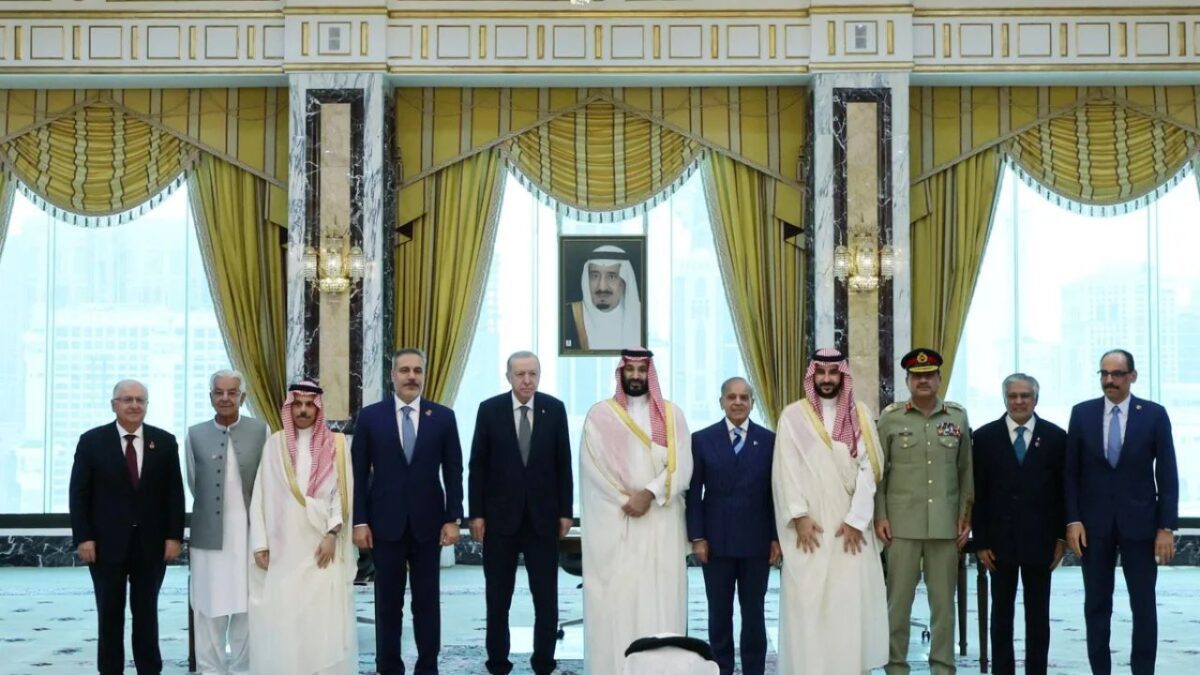
The Mecca Joint Defence Agreement, signed August 7 by Saudi Arabia, Türkiye and Pakistan, was built to be deliberately vague about its target. All three founders have repeated that the pact names no enemy and stays open to new members. Egypt has been floated as a candidate almost since the ink dried, and Syria’s foreign minister said during an August 20 Islamabad visit that Damascus was weighing whether to join or cooperate with it. Iran’s initial public reaction ranged from cautious welcome to open mockery from hardline clerics.
That range of reactions is exactly why Munir’s visit matters more than the unconfirmed invitation itself. Interior Minister Mohsin Naqvi travelled to Tehran on August 12 specifically to brief President Masoud Pezeshkian on the Mecca agreement’s contents, carrying a message directly from Munir and the prime minister. Pakistan is the only accord founder Iran has kept talking to consistently through a shooting war, a collapsed US negotiation, and a defence pact its own hardliners initially treated as provocation.
The question the accord can’t dodge: Palestine
Here is what most coverage of the Mecca Accord treats as background and what should actually be the center of any expansion scenario: this pact did not emerge in a vacuum. Turkish Foreign Minister Hakan Fidan made little secret of wanting to build a Muslim alliance partly in reaction to what he and others in the region describe as Israel’s war in Gaza, and the founding summit’s choice of Mecca over Riyadh — accompanied by images of the three leaders praying together — was a deliberate signal about the moral register the accord wanted to claim.
That test gets harder, not easier, as membership grows. A wider accord, and especially an Iran-inclusive one, would functionally become the first Muslim-majority security architecture in decades explicitly capable of imposing costs on Israel over Gaza and the West Bank, rather than merely issuing statements about them. Emirati and Israeli intelligence services were reportedly caught off guard by the original pact and remain unsettled by it — the fear in Abu Dhabi and Tel Aviv is not really about Pakistan’s nuclear status, it is about a bloc gaining the collective standing to actually extract a price for continued action in Gaza. If a critical mass of Muslim states sits inside one framework, Israel loses the ability to manage the Palestinian file through bilateral relationships alone, and normalization tracks with any Gulf state still outside the bloc become far harder to sell domestically.
How far does “Muslim-majority” actually stretch?
There is a version of this scenario more dramatic than Iran alone, and it’s worth naming precisely because it’s the one most casual commentary reaches for without examining it: not just Iran, but a genuine majority of the Muslim world — Indonesia and Malaysia from Southeast Asia, Azerbaijan and the Central Asian states, Nigeria and Algeria and Morocco from Africa, most of the Gulf beyond Saudi Arabia — folding into one framework. That version isn’t a defense pact anymore. It’s the Organisation of Islamic Cooperation with an actual enforcement mechanism, something the OIC has talked about and never built in nearly six decades of existence.
The scale would be real. It would mean a bloc spanning the world’s largest Muslim population (Indonesia), two of its most capable defense industries (Türkiye and, at a smaller scale, Indonesia), its only nuclear-armed Muslim state (Pakistan), and control over energy chokepoints from the Strait of Hormuz to the Bab-el-Mandeb to the Strait of Malacca simultaneously. No single existing alliance, including NATO, controls that combination of population, energy transit, and geographic spread.
But scale is also exactly where this version of the scenario runs into the problem the narrower Iran-only version doesn’t have to face yet: Indonesia and Malaysia’s actual strategic anxieties — the South China Sea, ASEAN centrality, a careful non-alignment between Washington and Beijing — have almost nothing to do with Gulf security or Gaza. Central Asian states balance Chinese and Russian influence daily and have no appetite for a mutual-defense clause that could drag them into a Middle Eastern confrontation. A bloc that stretches from Jakarta to Rabat solves the “size” problem and immediately inherits the same disease that has hollowed out every previous pan-Islamic institution: agreement on identity, and near-total disagreement on what that identity obligates any member to actually do when a crisis hits. The Iran-and-Palestine version of this story is sharper precisely because it stays inside one coherent theatre. The genuinely global version is the more striking headline and the far less likely near-term reality — which is itself worth saying plainly, since the size of the claim shouldn’t be mistaken for the size of the probability.
Where this leaves India: not a bystander, an outlier
India’s public reaction to the original trilateral pact was carefully neutral — “closely following the development.” That posture survives a version of Mecca that stays a narrow Gulf-Pakistan-Türkiye security arrangement. It does not survive a version that expands toward Iran and a meaningful share of the Muslim-majority world and explicitly organizes itself around the Palestinian cause.
Three things converge against India in that scenario. India has spent the past decade building exactly the relationships — deep defense and energy ties with the UAE and Saudi Arabia, a strategic partnership with Israel, a working relationship with the US through the Quad — that an expanded, Palestine-centered Mecca Accord would place under strain simultaneously rather than one at a time. India’s own Kashmir position becomes harder to insulate from criticism inside a forum where a nuclear-armed Pakistan sits as a founding member and moral framing around self-determination and occupation is already the accord’s organizing language for Gaza. And a version of the bloc reaching into Central Asia and Southeast Asia would surround India’s extended neighbourhood on multiple sides at once, not just its western border through Iran.
The realistic outcome isn’t diplomatic isolation in the sense of India losing existing relationships overnight. It is something narrower and more costly: India finding itself the only major regional power with no seat, no channel, and no framework of its own inside the one security architecture that would be setting the terms of Gulf and Palestinian-question diplomacy going forward.
What Monday actually tells us
None of this depends on Monday’s meetings producing a breakthrough. What Munir’s visit will tell us, at minimum, is whether the channel capable of carrying this conversation still holds up under the weight of two agendas at once. The larger claim worth making isn’t that the Mecca Accord is about to rebalance global power. It’s that even its more modest, Iran-and-Palestine-centered version would be the first Gulf security architecture in living memory whose legitimacy doesn’t depend on Washington’s blessing — and that the fully global version, however unlikely in the near term, is close enough to plausible that six major capitals and one increasingly isolated regional power are already recalculating around a door that hasn’t fully opened yet.