
|
Getting your Trinity Audio player ready...
|
There is a silent population inside Kenya’s correctional facilities that rarely enters public debate, penal policy discourse, or the national imagination. They appear in no crime statistics, are absent from sentencing records, and have committed no legal infraction. Yet they wake up behind locked steel doors, live within barbed perimeter walls, and spend their most formative developmental years in state custody.
These are the infants and toddlers—children under the age of four—who reside with their incarcerated mothers under Section 30(4) of the Prisons Act. Historically, their presence has been framed as an administrative concession, a humanitarian allowance, or a compassionate exception to preserve maternal attachment. But examined through the joint prisms of neuroscience and transformative constitutionalism, their situation is neither benign nor humane. It represents an unconstitutional paradox: the de facto penal detention of innocent citizens by association.
Our observations inside Kitui Women’s Prison—undertaken through the Early Play & Healing Initiative of the Early Years Development Centre (EYDC) under the Alpha New Beginnings Foundation—have brought this reality into sharp focus. Combining the perspectives of early childhood neuropsychology and constitutional jurisprudence, we have witnessed how babies grow, adapt, and regress within an institutional environment structurally hostile to human flourishing.
We have watched infants learn to crawl on cold, abrasive cement. We have seen toddlers take their first tentative steps along narrow, echoey cell corridors under the armed watch of uniformed correctional officers. We have listened to mothers whisper lullabies through stifled tears, attempting to soothe distressed infants while suffocating under their own unprocessed trauma.
These scenes do not fit within Kenya’s stated narrative of justice, humane rehabilitation, or constitutional protection. They are an indictment of an unthinking penal architecture that demands urgent legal interrogation and systemic repair.
The constitutional paradox: Guarantees on paper, violations in concrete
Kenya’s penal framework operates in open defiance of the 2010 Constitution. Section 30(4) of the Prisons Act—a colonial relic enacted long before modern human rights jurisprudence—permits a child to remain with an incarcerated mother until the age of four. While ostensibly conceived to prevent abrupt separation, the statute is silent on developmental standards, psychosocial care, environmental adequacy, or the child’s autonomous civil liberties.
The supreme law of the republic permits no such legal blind spot. Under Article 2(4) of the Constitution of Kenya 2010, any law, customary practice, or institutional conduct inconsistent with the constitution is void to the extent of the inconsistency.
Article 53 is categorical: Every child has the right to basic nutrition, shelter, and healthcare (Art. 53(1)(c)); Every child has the right to be protected from abuse, neglect, inhuman treatment, and punishment (Art. 53(1)(d)); Every child has the right not to be detained, except as a measure of last resort, and when detained, to be held for the shortest appropriate period of time, separate from adults, and in conditions that take account of their sex and age (Art. 53(1)(f)); A child’s best interests are of paramount importance in every matter concerning the child (Art. 53(2)).
These guarantees are reinforced by Section 8 of the Children Act 2022, which secures every child’s right to a nurturing, safe, and stimulating environment.
Constitutional rights do not terminate at the prison gates. They do not dissolve because a parent has been convicted or remanded. Yet in practice, infants residing in Kenyan prisons are subjected to structural, daily breaches of Article 53. They are detained not as a measure of last resort, but as collateral consequence; they are held in adult penal wards; and they inhabit environments devoid of the sensory and psychosocial resources necessary for early childhood survival.
Subjecting an infant to an ecosystem of containment, sensory deprivation, and institutional stress amounts to cruel, inhuman, and degrading treatment under Article 25(a) and Article 29. The state recognizes these children as rights-bearing citizens in theory, yet reduces them to legal non-entities—appendages to their mothers’ punishment—in execution.
Childhood in confinement: The neuroscience of early harm
The first 1,000 days of life constitute the foundational window of human neurodevelopment. During this period, the brain forms neural connections at an unrepeatable rate of over one million new connections per second. This neural architecture is sculpted directly by sensory variety, emotional security, bilateral movement, and environmental stimulation.
Prisons systematically disrupt every single one of these developmental prerequisites:
Sensory under-stimulation: Prison wards are sterile and visually barren environments dominated by grey masonry, iron bars, and concrete. Infants spend years in confined settings lacking varied colour, diverse tactile textures, natural landscapes, and auditory complexity. In early neuroscience, prolonged under-stimulation weakens synaptic pruning, retards cognitive processing, and substantially delays language acquisition.
Severe motor restriction: Gross motor development requires space to crawl, climb, fall safely, run, and map three-dimensional space. In penal institutions, movement is strictly regimented, spatial boundaries are tight, and outdoor access is contingent on institutional schedules. Infants restricted to damp floors or narrow perimeters suffer delayed motor milestone attainment, compromised vestibular balance, and diminished spatial awareness.
Toxic stress and neural architecture: Prisons are emotionally volatile, high-arousal environments permeated by anxiety, hypervigilance, shame, and despair. Developing infants biologically absorb maternal and ambient distress. Sustained exposure floods the infant brain with elevated cortisol, disrupting the hippocampus and prefrontal cortex. This triggers an enduring state of toxic stress that permanently dysregulates emotional equilibrium and increases lifelong vulnerability to cognitive and psychiatric disorders.
Subjugation to institutional rhythms: A penal facility operates on carceral mechanics: early roll calls, intrusive headcounts, abrupt inspections, and cell lockups. These institutional routines run counter to the biological rhythms of infancy. Feeding is tied to kitchen rosters, sleep is fractured by count schedules and clanging iron doors, and play is subordinated to custody logistics.
The intergenerational trauma ecosystem: The majority of incarcerated women enter prison with complex trauma histories rooted in poverty, domestic battery, structural exclusion, or sexual violence. Inside correctional facilities, this distress compounds without meaningful therapeutic intervention. Maternal trauma directly undermines the sensitive, reciprocal “serve-and-return” interactions vital for healthy attachment. In a penal setting, trauma ceases to be an isolated psychological event; it functions as the child’s continuous developmental climate.
The fragility of outsourced rights
For decades, the state has addressed early childhood care in correctional settings by abdicating its statutory obligations to non-governmental organizations, philanthropic donors, and faith-based charities.
While civil society interventions—including the work at Kitui Women’s Prison—provide crucial, life-saving respites, relying on charity to safeguard fundamental constitutional rights creates a precarious system:
Securitization over welfare: Clinical tools, therapeutic toys, play mats, and learning supplies must undergo tedious security screenings, where items are frequently delayed, impounded, or rejected by guards unfamiliar with paediatric care.
Contingent access: Early childhood development (ECD) interventions remain at the mercy of shift changes, institutional lockouts, prison security alerts, and administrative whim.
Ephemeral donor cycles: Philanthropic funding shifts unpredictably. A donor-funded playroom or nutritional supplement programme can collapse overnight when a grant expires, plunging children back into structural deprivation.
Institutional absolution: By allowing civil society to plug these gaping systemic deficits, the state avoids budgeting for, staffing, or structurally rethinking early childhood rights within the justice sector.
Philanthropy cannot serve as a substitute for constitutional compliance. Entitling an infant to an uncompromised developmental foundation cannot hinge on the goodwill of an NGO or the benevolence of a prison warden; it is an affirmative duty incumbent upon the Republic.
Clinical and legal witness
The constitutional and neurological arguments become impossible to ignore when observed directly within the cells.
We have held infants who reached eighteen months of age without ever touching grass, seeing an animal, or exploring an open green field. We have watched toddlers freeze in defensive terror at the mere metallic rattle of keys turning in heavy security locks. We have sat with mothers weeping in quiet despair because they could not secure a clean blanket, a soft toy, or a dark, quiet space to calm a feverish child.
We have watched correctional officers—untrained in infant safeguarding—wrestle with the irreconcilable tension of balancing custodial security with the vulnerable presence of babies. Most critically, we have witnessed young children learn to utter their first words in an environment where the dominant linguistic framework consists of commands, surveillance, compliance, and reprimand.
These are not peripheral administrative difficulties; they are acute developmental traumas. They force the Kenyan legal system to confront a basic moral question: What constitutional justification allows an innocent child to serve a prison sentence?
A constitutional and jurisprudential roadmap
Addressing this systemic failure requires confronting an underlying contradiction: Reforming prison nurseries without altering sentencing policies simply normalizes the unconstitutional incarceration of infants.
If detaining a child is permitted only as a strict measure of last resort under Article 53(1)(f), then incarcerating a mother of a dependent infant or toddler without exhausting non-custodial options directly violates the child’s constitutional rights. Kenya requires a cohesive, tiered roadmap spanning penal policy and institutional reform.
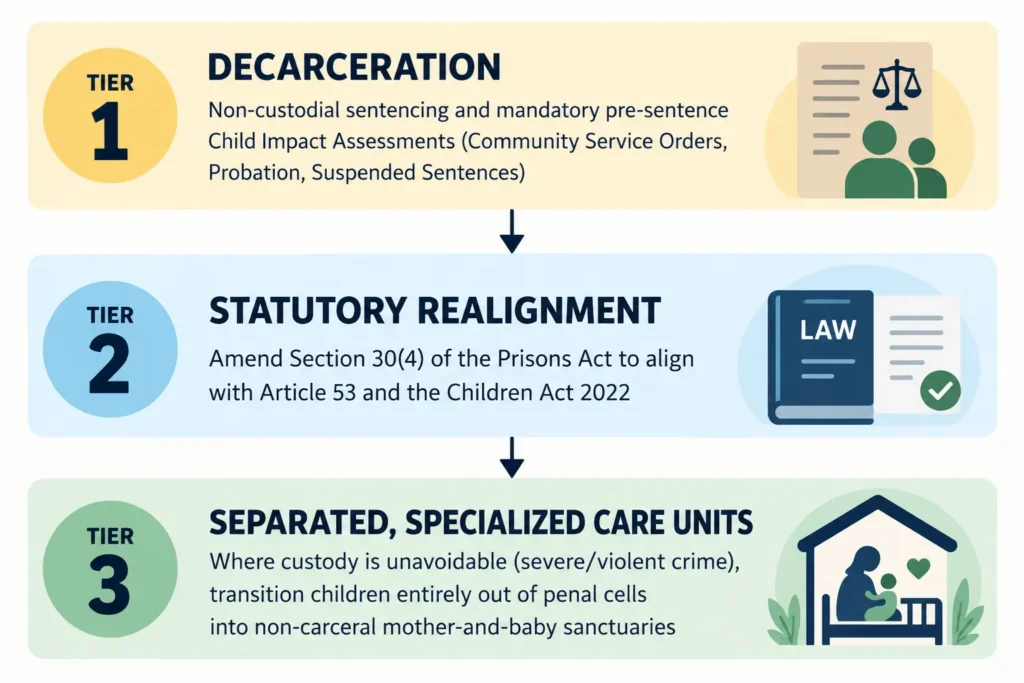
Decarceration as the primary constitutional remedy
The default sentencing policy for primary caregivers of infants and young children must be non-custodial. Custodial sentences for mothers of children under age four must be restricted to extraordinary cases involving serious, violent offences where public safety leaves no alternative.
Courts must institutionalize mandatory Child Impact Assessments prior to sentencing any primary caregiver, explicitly weighing the child’s Article 53 protections against punitive retributive aims.
The judiciary should make extensive use of the Community Service Orders Act, probation regimes, suspended sentences, and restorative justice pathways.
Incarcerating an infant by association simply to punish a nonviolent maternal misdemeanour is a disproportionate violation of the child’s right to liberty and dignity.
Statutory realignment of the Prisons Act
Parliament must urgently amend Section 30(4) of the Prisons Act. The law should eliminate the notion that children are mere custodial dependents accommodated at institutional discretion. It must codify specific developmental entitlements, paediatric medical baselines, and legal representation requirements for any accompanying minor.
State-funded, non-carceral mother-and-baby sanctuaries
In the rare instances where custodial remand or imprisonment of a nursing mother is demonstrably unavoidable, the child must not be housed inside standard adult cells. Correctional facilities must construct entirely separated, non-carceral mother-and-baby units outside the central security gates. These sanctuaries must be managed as dedicated child development environments staffed by certified Early Childhood Development (ECD) professionals, nurses, and paediatric specialists, not armed correctional guards.
Environments must be neuro-inclusive, equipped with play-based therapeutic resources, stimulating colours, green playfields, and dynamic layouts to support neurodivergent children (including those with Autism Spectrum conditions and ADHD).
Mandatory inter-ministerial governance
Responsibility for children in prison cannot remain an internal operational affair of the State Department for Correctional Services. A joint oversight framework between the Ministry of Interior, the Ministry of Health, and the Ministry of Education must manage these units.
The Health Ministry must oversee early infant screening, developmental tracking, and nutritional regimens, while the Education Ministry must integrate early learning and structured stimulation into official institutional budgets rather than relying on private charity.
Systemic trauma-informed and safeguarding training
Correctional staff assigned to female facilities must complete mandatory, continuous instruction in paediatric safeguarding, attachment dynamics, neurodevelopmental milestones, and trauma-informed responses. Officers must be equipped to support maternal stabilization rather than relying exclusively on custodial control.
Comprehensive maternal mental healthcare
Maternal mental health directly shapes child neurological development. Clinical psychology services, psychiatric care, peer-support models, and trauma healing programmes must be established as non-negotiable state provisions across all women’s facilities. Stabilizing the mother is the primary safeguard for the infant.
A call to the constitutional imagination
The presence of infants inside Kenya’s prison walls exposes the distance between our constitutional ideals and our institutional realities. It challenges our understanding of punishment, exposes the limits of retributive justice, and demands a fundamental reckoning with our duty to the young.
These children have broken no law. They belong to no charge sheet. They are not anomalies to be swept into the corners of damp cells, nor are they collateral damage to be forgotten while their mothers serve out penal sentences.
They are rights-bearing citizens of the Republic. Every day an infant spends behind bars without stimulation, security, or developmental support is an active constitutional violation that fractures human potential. It is time for Kenya to close this gap – by reforming custodial sentencing, holding the state accountable to its foundational charter, and ending incarceration by association once and for all.