|
Getting your Trinity Audio player ready...
|
“Geography is the mother of history.” Ali A. Mazrui
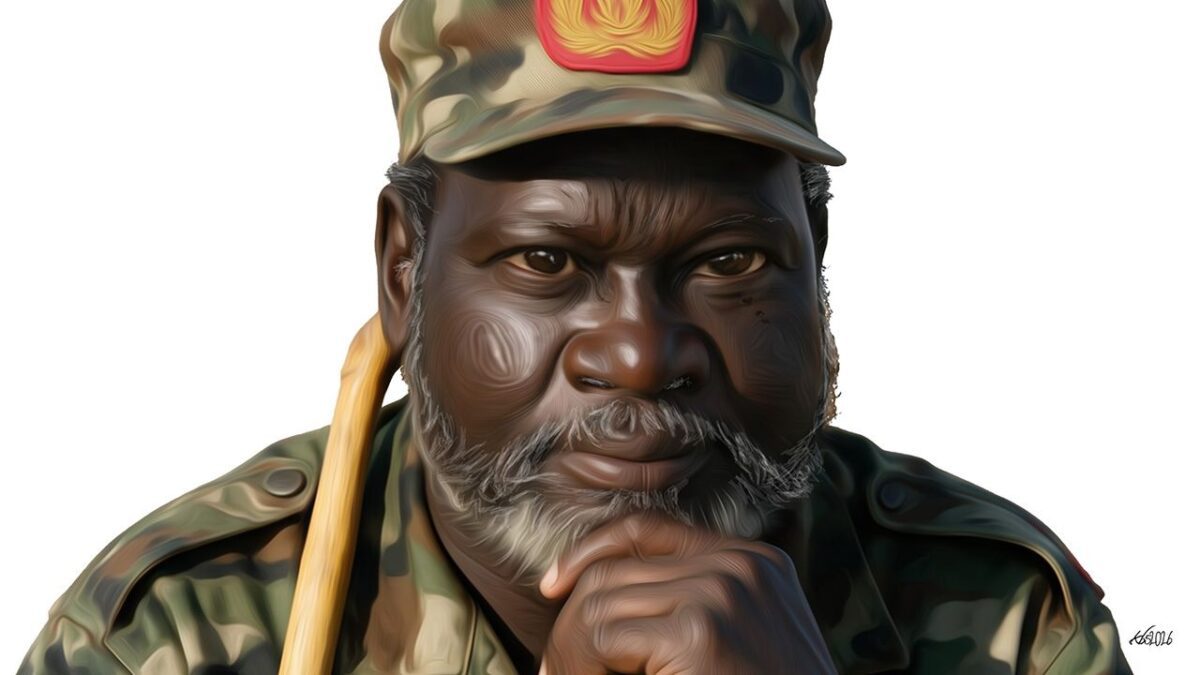
Twenty years ago today, John Garang de Mabior boarded a helicopter in western Uganda and never arrived at his destination.
Garang had spent the day at Rwakitura; not in Kampala, not in a ministry, but at a private cattle ranch in the hills of Kiruhura District, the personal property of Yoweri Kaguta Museveni.
Three weeks earlier, Garang had signed the Comprehensive Peace Agreement in Nairobi, ending Africa’s longest civil war. The liberation of South Sudan was complete.
What remained was the harder project: building a state that was not merely Southern Sudanese but genuinely New Sudanese, secular, multiethnic, democratic, a country in which the citizen-subject divide that had structured Sudanese life since Khartoum’s Arab supremacist compact would finally be dissolved. That project died in the Imatong Mountains, before the helicopter reached Juba.
We have spent twenty years mourning Garang the man. We have not adequately mourned what he carried. The New Sudan was the most ambitious political idea produced by postcolonial Africa’s liberation generation, more architecturally serious because it did not begin from state power and extrapolate outward. It began from the bush, from a guerrilla army fighting a war it had no guarantee of winning, and it theorized a state worth fighting for before that state existed. Garang did not want Southern secession. He wanted the entire country transformed. The South was his floor, not his ceiling. That idea required a geography to survive in. It found one in Uganda.
This is why Rwakitura is not a backdrop but an argument. Museveni does not conduct state business solely from State House. He conducts it from the location of a man who has never fully distinguished between the state he governs and the patrimony network he manages. His constant refrain was, “I fought in the bush for this”. Liberation to him was personal; he’s like a hunter, and the hunt is his. The state was just a tool for the realization of a personal project.
The Sudanese People’s Liberation Army’s strategic headquarters for two decades was not in Sudan; it was in Kampala. Its supply lines ran through Ugandan traders. Its officer class spent the liberation years not building institutions in the south but negotiating access in northern Uganda. When Garang boarded that helicopter, he was leaving the country that had made his liberation possible and whose interests his liberation had simultaneously served. He was, in a precise sense, Uganda’s most consequential creation.
Uganda occupies a structural role in the Great Lakes; It is not a regional power in the conventional sense; it lacks South Africa’s GDP or Nigeria’s demographic weight. It is not a proxy state, a term implying passive instrumentality. It is a sub-imperial pivot state: a mid-sized, strategically positioned country that projects power beyond its borders through military transmission, political incubation, and commercial penetration, operating beneath the threshold of formal empire while exercising power no empire would disown. It has done so across six decades and two radically different leaders. The geography that mothered Garang’s liberation became the geography that buried its idea.
The original transaction
The story begins not with Museveni but with a Congolese scandal. In 1965, Colonel Idi Amin, serving under Prime Minister Milton Obote, was implicated in the Gold Scandal, in which gold, ivory, and cash from the Congo were funnelled through Ugandan military channels in exchange for arms supplied to Congolese rebel leaders. Obote suspended the constitution, arrested five ministers, and promoted Amin to army commander.
When Amin overthrew Obote in 1971, and his Western sponsors refused to sell him guns, he turned to Tripoli, and a structured regional transaction followed. Egypt and Libya needed the Anyanya, the residual fighters of Sudan’s first civil war; Sudan needed a stable, Arab-aligned Uganda on its western border. Amin needed arms and Obote’s neutralization. The terms of the deal: absorb the Anyanya into Uganda’s military, receive arms and cover, and remove Obote.
Museveni would never countenance the comparison. What he perfected, Amin began, was the Congo extraction logic, the regional transaction for domestic political gain, and the deployment of Ugandan military capacity as a commodity in the political marketplace. The unbroken line runs from Amin smuggling Congolese gold as a colonel in 1965 to the Uganda Peoples’ Defence Forces’ (UPDF) documented extraction in Ituri, confirmed by the International Court of Justice in 2005. The difference is not invention but method. What Amin ran as improvised theft, Museveni modernized, scaled, and professionalized. One of Museveni’s remarkable abilities is his knack for learning, even from people he does not like, like Amin, and those he likes, like Mwalimu Nyerere.
Geography is the mother of history
Mazrui meant this precisely, not poetically. The landscape does not provide a neutral stage on which human events are enacted. It generates the conditions that make certain histories possible and forecloses others before they begin. The trade routes of the Great Lakes connected kingdoms for centuries and then, when the colonial cartographer drew his lines, became the smuggling corridors of the postcolonial military economy.
John Garang was born in Twic, Upper Nile, in 1945, into a geography that had been producing insurgents for a century, Nilotic communities whose relationship to Khartoum’s Arab project was one of structured exclusion and permanent negotiation over the terms of their own subordination. The geography mothered the grievance. The grievance required a theory. Garang provided one that no one born in that landscape had provided before: not separation from the north, but its transformation. Not a smaller Sudan for the south, but a larger idea of Sudan for everyone. His one Sudan Speech encapsulates his vision. At a time when even what is left of Sudan is slowly fracturing, Garang would have been needed now more than ever.
Garang read Fanon in the bush because Fanon had theorized exactly this move, the colonized not fleeing the colonial structure but seizing and remaking it from within. The New Sudan was committed to civic belonging. But it required a geography to survive in while the claiming was prepared, and southern Sudan, landlocked and without the infrastructure of a state, could not provide it. Uganda could. The liberation gestated in Kampala, in the hills of Kiruhura, in the logistics networks of Ugandan traders, in the training grounds of the UPDF. Garang understood the dependency. He accepted it because the alternative was extinction. What he did not live to discover was the interest rate.
A man who theorizes the state before he inhabits it knows what the state is for. Garang knew. He carried it onto the helicopter at Rwakitura on the 13th of July 2005, and the New Sudan went down with him in the Imatong Mountains. Not because the mountains were hostile. Because the geography that had mothered the liberation had also set its limits, and those limits did not include a Garang who survived long enough to convert patronage into independence.
The inheritance
Salva Kiir Mayardit is a man of the same geography and none of its theory. Kiir is a military commander of documented courage, a survivor of a liberation war that consumed most of the men who began it, a politician who has navigated the lethal factionalism of South Sudanese elite politics for two decades without being destroyed by it. These are not negligible achievements. But courage is not theory. Survival is not vision. What Kiir inherited when he formally took office on 11 August 2005, was the shell of an argument without its animating intelligence: a military organization that knew how to fight but had never been asked to think about what the fighting was for, a patron relationship with Uganda whose terms Garang had accepted as temporary and which Kiir accepted as permanent, a sovereignty that existed on paper in Juba while its supply chains ran through Kampala and its security architecture depended on the UPDF.
Mazrui understood that Africa’s tragedies are never merely political. They are civilizational moments when history, having laboured to produce something of genuine grandeur, hands it to someone whose formation the same geography produced but whose capacity it did not guarantee. The region produces Garang and, in turn, creates the conditions that make Kiir his only possible successor. Geography is not cruel. It mothers what the historical moment requires and does not audit the inheritance.
Kiir inherited the project’s flag without its theory. When South Sudan’s civil war erupted in December 2013, Kiir against Machar, Dinka against Nuer, with a ferocity Garang had predicted in his doctoral thesis and spent his life trying to prevent, what arrived at Juba airport was not a theory of the state. It was the UPDF. The AU Commission of Inquiry on South Sudan and subsequent UN Panel reports document the arc: a patron that birthed a state, maintained it on military life support, and extracted commercial advantage from the dependency at every stage.
Uganda saved the state it had created. It charged accordingly: the supply-chain monopoly on Juba’s shelves, the commercial penetration of South Sudan’s import economy, the military presence that converted sovereign territory into a dependency dressed in the language of partnership. The history, left without its architect, returned to the geography that produced it, smaller, more dependent, more extractable than Garang had ever intended it to be. History does not repeat. But geography keeps mothering, and when the children of a particular landscape lose the theory that was supposed to carry them beyond its limits, they return to those limits and call the return stability. Twenty years on, the helicopter has not stopped falling.
The invisible economy
This commercial penetration provides the structural foundation for Uganda’s military and political projections; the Congolese arc remains uninterrupted. What Amin managed as an improvised smuggling racket in 1965, the UPDF under Museveni has professionalized into a sophisticated military-commercial complex. The UN Panel of Experts identified a dual objective: the public provision of security masking the private practice of extraction. This was subsequently codified by the International Court of Justice in its 2005 judgment, a finding echoed by Uganda’s own Porter Commission. Even today, as ISS Africa notes, Kampala functions as the essential transit hub for the region’s mineral wealth. The geographic corridors and the commodities they carry are familiar; what has evolved is the scale of the enterprise. Amin’s improvisation became Museveni’s system.
South Sudan’s import economy runs almost entirely through Uganda. Food, fuel, construction materials, consumer goods: Kampala’s wholesalers supply Juba, and Ugandan trucking companies control the main corridors. When South Sudan’s civil war drove over a million people into northern Uganda, Bidi Bidi, Adjumani, Rhino Camp, Uganda’s humanitarian hosting was simultaneously genuine refugee protection and the economic absorption of a displaced labour force that Ugandan agriculture now structurally depends on. The extraction economy does not impose itself on an unwilling regional geography. It reactivates the interlacustrine trade system that connected these kingdoms for centuries before Belgian Congo or British Uganda existed.
The mechanism that connects all of this to the international system is subcontracting: large powers need regional security outcomes but will not pay the full political cost, so they outsource to sub-regional states with military capacity and political willingness, who collect payment in aid, diplomatic protection, institutional legitimacy, and insulation from human rights scrutiny. Museveni had watched Amin’s catastrophic miscalculation, the rupture with Western patrons, and drawn the correct lesson: Uganda’s geographic position was a permanent asset whose value was contingent on the service it provided. Amin withdrew the service and lost everything. Museveni provided it comprehensively and charged accordingly. And the DRC is where the architecture becomes visible because it becomes uncontrollable: Uganda and Rwanda both subcontracted Great Lakes security while running extraction in eastern Congo, producing the 1999 to 2000 Kisangani battles, in which their armies fought each other on Congolese soil over Congolese resources, while nominally partners in the same framework. Extractive states do not stop extracting when they cross a border. They extract harder because accountability mechanisms are entirely absent in foreign territory.
Twenty years after the helicopter went down in the Imatong Mountains, the idea that died with Garang has found its most honest memorial not in Juba’s parliament but in a settlement in south-western Uganda, where the people his liberation was meant to serve are managing, with whatever remains, the distance between what was promised and what arrived.