|
Getting your Trinity Audio player ready...
|
Prologue
The Kenyan politician is to be venerated at all costs, in all situations. When you meet him, have no nerves, be his political pawn. Kiss his red-bottomed Christian Louboutin shoes if you can. Isn’t he fourth after the Holy Trinity? Smile. Nod in approval at all he says. Don’t worry about the exhaustion of your cheeks; he is going to compensate you enough. At functions, he will arrive late, disrupt the programme, but still be applauded. You, with the microphone, will have to stop as he is welcomed with thunderous cheers. The ululations are a condition; he has to be exalted. Otherwise, he won’t release the mobilization fee. Your tributes, speeches, and eulogies are of no substance to him. If you don’t know yet, then know it today. He loathes the quotidian life you lead. For him, a funeral is a stage for his theatrics. He walks with his supporting cast of goons, and they have the right to cause chaos without consequence.
The Kenyan politician’s heart is understanding. So much so that when the state kills your child or husband or wife or parent, causing a public uproar, his team comes looking for you to condole with you. Be sure that his team will transport you to his office. They will offer you a token, an amount of cash that you have probably never held in your hands. While at his office or place of abode, he will insist that you take a photo with him. He will stand to your right, his sharp suit contrasting with the unpressed, hand-me-down Sunday best you are wearing. This photo will be posted on his socials with a hearty caption:
“I have been looking for….
Today I held a meeting with….
We have come to an agreement…”
Or such similar statements. A performance of solidarity with you.
On the road, he – the politician – has his own set of traffic rules. He drives on the wrong side, exceeds speed limits, knocks down a child, but keeps going. He is an imperium, and you better know that an imperium waits for no Wanjiku. If you dare block him, brace yourself for insults. His proxies will put you in your place. “Takataka…” You will be reminded of the indigent position meant for you in this country.
Have you listened to his speeches after you have elected him? Most of the time, he speaks at you. Your thoughts count not. He knows more about governance and policies and the constitution and so his voice has to always be condescending.
To him, you become, “Wewe kijana, mama, mzee..” “Wacha tukupange…” He is brusque.
What changes him? How come he is humble, wooing, courting when asking for votes, and brash after he gets them? There must be an art to this. He knows how to employ the figurative use-and-dump ploy. Only that your dumping is for a period. Five years later, he will look for you, endear you. His refurbished lies will seduce you back to him. Are you willing to accept that he doesn’t like you? If he did, we wouldn’t be here talking about his politics of contempt. Maybe his affluence is a charm that traps. Could it be that you also wish for his designer clothes, his ultra-luxury wristwatches? What hold does he have over you that you keep electing him? Is it his omnivorous intelligence? If only he was as knowledgeable as he presents himself to be, then he would know that raising taxes and hiking prices hurts you. You are his puppet. Just don’t demand for better living standards. To him, any voice of dissent is an enemy of development. Do you need reminding of how ruthless this Kenyan politician is to his enemies? If you haven’t experienced that side of him, better not slight him. If you do, often, your story will end in abduction. You will be disappeared. Or worse, be found lifeless. He is above the law. Being arrested, going to court, respecting court orders depends on his leniency. These procedures are perfunctory tasks he only follows when there is a public outcry against a crime he has committed.
I pause the satire. It is a tactic that won’t be effective. The Kenyan politician has no shame, and as Nigerian writer Elnathan John puts it, “The effectiveness of satire is directly proportional to the ability of [the Kenyan politician] to feel shame.” I’d rather tell the story of my be(com)ing a new native.
***
Much of life is forgotten, says American writer Ian McEwan. I have lost many memories in my years of living. But not the memory of when I first heard the word “radicalization”. I distinctly recall the passionate but tentative tone in which Mr O said this word. He used it in my first literature class in Form One. Mr O, whose compact and plain, high-waisted trousers distinguished him from the other teachers, walks into my class, carrying no book but a packet of dustless chalk in his right hand, his left in his pocket. His face is warm, radiating with brilliance. Instead of introducing us to literature, he talks about his high school days. The jutting of his jaws punctuates his narration. I listen as he tells how his lot demonstrated after a teacher punched one of them in the eye. “We knew not to offer grace to any injustice. We were a radicalized lot.” I mouth this new word. It tastes steady and unbreakable. Then I look it up in my Oxford dictionary.
Radicalization: the action or process of making someone become more extreme or radical in their political, social, or religious beliefs.
Before he leaves, Mr O leads us in a song that I know from my primary school days. The cantor and chorus arrangement make us sound like pupils in lower primary school.
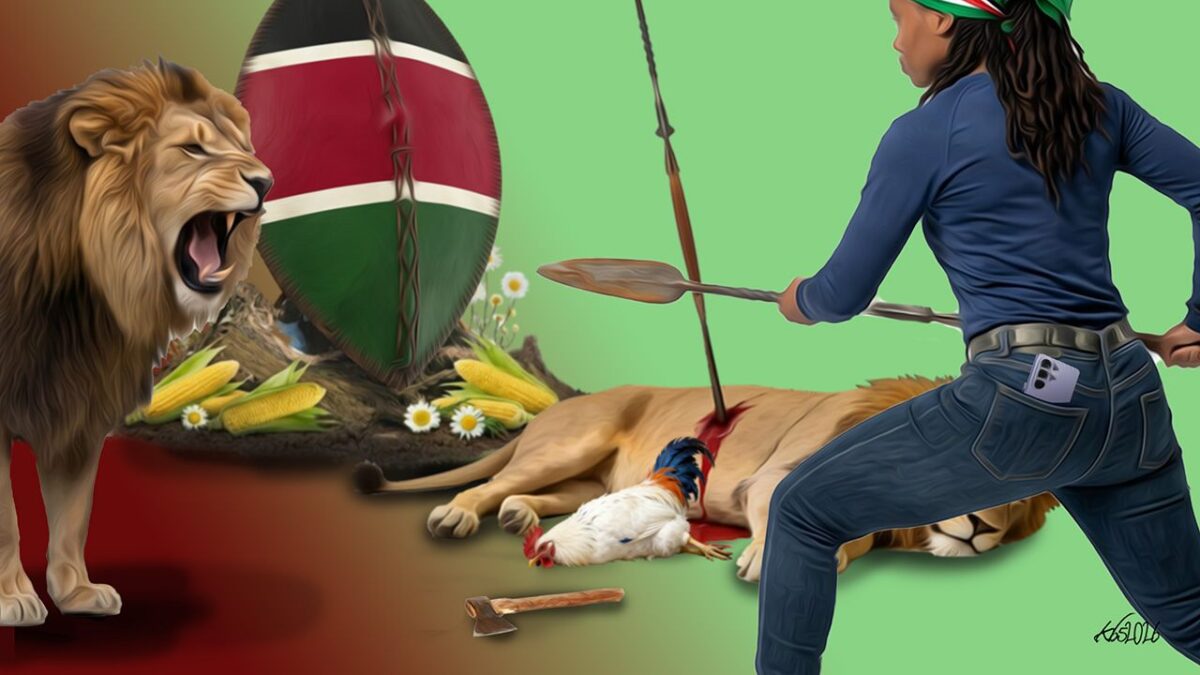
“Watoto wangu wee,”
“Wee”
“Mimi mama yenyu”
“Wee”
“Simba ni mkali”
“Wee”
“Aliua mama, akaua baba, sasa torokeni”
Mr O leads us in this more to radicalize than to play. I realise this because of what he says right at the end of the lesson. “Think of yourselves as the children, Kenya as your mother. Who is the Lion? Who?” He leaves the question as a riddle that he never returns to. Never, in the four years of high school.
“You will love my literature classes.”
***
The question of the “new Kenyan native” has been floating in my mind for a while. My fixation with it is because I am born into the generation that mostly comprises the new Kenyan native. I share in the fatigue, the broken hopes, the forsaken dreams of the Gen Z. This question of the new Kenyan native concerns my place in this place; this country, Kenya, that others think of as an idea that is either unfinished or failed. If one generation fought for independence, another persevered through the Moi-era, returned multipartyism, voted Moi out, and gave us a new constitution, then what is my generation here for? This is the big question for us.
I am writing this a few days to June 25th. It is night, silent, and the solemnity of a sleeping world is creeping up on me. On my desk is a printed excerpt from The True Story of David Munyakei by Billy Kahora and a chapbook by Oyamo Richard titled The Kenyan Gen-Z Protest Lexicon. One is the story of an ordinary man who blew the whistle on one of the greatest corruption scandals in Kenya, the Goldenberg Scandal. How miserable his life becomes thereafter is disheartening. Munyakei’s story is a classic example of how standing up for this nation often leads to being punished rather than rewarded. “This country has started to consume itself like the Chinese serpent is depicted of eating its own tail,” Kahora quotes Kenyan-based American writer Paul Goldsmith when talking about the Goldenberg saga. Oyamo’s chapbook is simply an archive. It stores the language that was used during the protests in 2024. “This chapbook is more than just a compilation of words and phrases with their meanings. It is a preservation of history. It is an alarm to wake you if you ever slumber in the quest for better governance. It is a celebration of the gains and lessons learned. It is a celebration of lost lives,” the blurb reads.
“Will I ever get to celebrate the innocent lives taken by this rogue state?” I write as an opening paragraph to an earlier draft of this piece.
Truth is, there are days and nights when this country scares me. A lot of days, actually. It is for such times that I am inventing new ways of being numb to Kenya’s travails. I am inventing these ways to perhaps find reprieve in the quest for a better country. Fighting for a better Kenya has remained a fatal affair. It is a trepidation that is in many ways shared with my peers. I talk to them. Our conversations have migrated from just wanting to be into stories of liberation. Revolution has become a watchword to us. The grammar of our living has changed. Coercively, we have been altered by the events which keep happening. The high levies and taxes. The Ebola centres. The shooting of peaceful protestors.
In our conversations, one of us will say that they share a birthdate with Rex Masai, and the pain of Rex being shot at will break out in my eyes. One will say that they went to the same university as Denzel Omondi, and the heaviness of recalling his lifeless body floating in a dam will cause my heart to race. Another will say that a missing family relation has never been found, and I will clench my fist in anger.
We can’t wait for the “Ruto must go” dream to be realized.
For now, our education is consequently nurturing us into critical thinkers. The critical thinking means that we have sensibilities that we are persistently advocating for. Our advocacy is predicated on the rule of law and respect for human rights. We are reading the writings of revolutionaries, seeing how states and people can move forward. We are quoting Frantz Fanon – “On the other hand, a regime which is completely oriented towards the people as a whole and based on the principle that man is the most precious of all possessions, will allow us to go forward more quickly and more harmoniously.” – as we examine whether the Kenyan political elite have ever viewed our lives as precious. What they think of us is apparent in how they treat us. To them, we are disposable bodies. If they did find us to be precious, would they have allowed the use of live bullets during our peaceful protests?
“Where is the reckoning?” we are asking.
Isn’t a reckoning needed before we go around talking about moving on?
How can it be that there are still delays in the prosecution of extrajudicial murderers?
Whether we know it or not, we are subscribing to Chinua Achebe’s view that “Patriotism is an emotion of love directed by a critical intelligence,” as he writes in his book The Trouble With Nigeria. We love this country. So much so that our consciousness continues to rise every day, even if shaped by rage. Our rage stems from the government’s impunity. Police brutality. Corruption. And state violence.
Our collective faith rests in the words of our national anthem: “Justice be our shield and defender.”
***
Asked how he would define the identity of Kenya as a nation today, Ngugi wa Thiong’o replies, “The Kenyan identity is a work in progress. We struggle to be the best that Kenya can be. For this, we continue to struggle to secure our economic, political, and cultural base. We have to continue to struggle against the gross social and income inequalities within our own country.” We, the new natives, are asking for this. The torrid debates we are having all cycle back to the need for us to secure our economic, political, and cultural base. Is this hue and cry so outlandish that they have to answer us with violence?
As we undertake this struggle, our constant negotiation is how we can consolidate beyond the limited, used-to-be political order of clans, tribes, denominations. This is possible; we know for we rehearsed it during the 2024 protests in which young people in 44 out of the 47 counties took to the streets to reject the oppressive Finance Bill. The unified manner in which we spoke with each other crossed the delta of meaningless rhetoric peddled by our leaders. We embodied camaraderie. We applied toothpaste around the eyes of strangers to counter the effects of teargas. We covered bodies that had been shot at with our national flag without first inquiring to which community they belonged. Someone I had never met before gave me a ride home after one of the protests. Bottles of water, food, bandanas, flags, printed t-shirts were randomly shared.
Umoja ni nguvu, we manifested.
This is the spirit of the new Kenyan native.
Woe unto the Kenyan politician who keeps dismissing this new lot as digital wankers. If he is the proverbial simba whom my teacher sang about all those years ago, then we, the new natives, are a swarm of ants that are going to cover his body, bite him all over until he falls. Our relentless pressure will have to be heard.