|
Getting your Trinity Audio player ready...
|
My concerns with international flights are usually mundane things like making sure my Swiss Army knife is not in my carry-on luggage. Do I have anything in my pocket that I might have to part with at security? My passport is not in my suitcase, right? Will my MasterCard work? Do I have my documents and answers ready for Immigration? Where the hell is my charger, and do I have enough of my own cigarettes for the stay? Ordinary people stuff. When I was leaving for Kenya in July of 2025, I had new concerns: my father, gravely unwell at the time- how was he faring? And, of course, how would I make sure they didn’t find 28 grams of dagga in my luggage?
The problem starts in 2010. While catching up on Zimbabwean news from the computer lab at the University of the Witwatersrand, I came across a story that gilds the aphorism “truth is stranger than fiction” and learnt the name Owen Maseko.
Perhaps the story doesn’t even start in 2010; it could begin in the early 1980s. While the world looked at Zimbabwe, newly minted from the scrap metal of Rhodesia to join the ranks of liberated countries, her government, led by then Prime Minister Robert Mugabe, was casually killing people like Owen Maseko and me – people of Ndebele descent.
The official term of the operation was Gukurahundi: a Shona word for the first rains that wash away the chaff. Mugabe would later call it “a moment of madness” while the Catholic Commission called it a genocide. The current president of Zimbabwe, Emmerson Mnangagwa, has recently suggested commissions of enquiry be established to look into the events that lasted about five years, between 1982 and 1897. Meanwhile, enquiring minds would like to know how he feels about his frontline role in the “madness” – seeing as he was the State Security Minister at the time – as well as the modalities of how the blade commands the wound to heal.
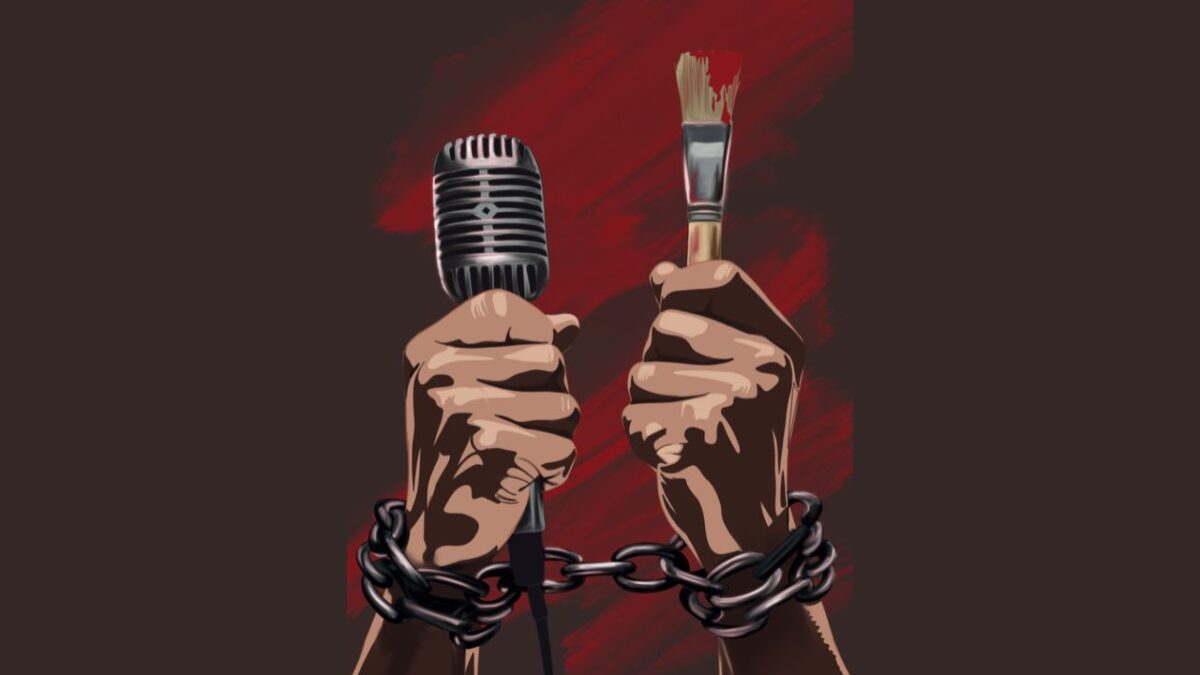
Noviolet Bulawayo would use this gruesome time as the backbone of her second novel, Glory, as I did with my last publication, The Testament of Black Jesus. Before all that, in 2010, with nowhere to turn for answers, and inspired by an entire ethnic group still reeling, Owen did the unimaginable: he coaxed, out of his art hand, an exhibition of paintings, installations, and murals interrogating the Great Taboo. He named it Sibathontisele, which translates to “Let’s drip on them” from the Ndebele. As Owen pointed out in I Am Patience, our 2022 pocumentary (a documentary narrated in poetry; totally, totally normal), the dripping of hot plastic onto human flesh was a common method of torture used by the Fifth Brigade. He was also dripping creativity onto Them; writing back to the empire: canvass for mangled bodies, red paint the lore of gore.
Now, between you and me, genocidal maniacs don’t like being called out for their shit. So they shut him down before the day was done. Owen was thrown into jail, alongside Vote Thebe, who was then the director of the National Art Gallery in Bulawayo. The theatre was absurd; the scriptwriting itself, even his custodians, failed to comprehend: “We arrested you for… drawings?” Yes, they had; officially charged him with “undermining the authority of the president”.
Voti made it out sooner, but Owen’s ordeal had only just begun… since he had been caught, eh… red-handed. To continue with our garish puns, the trial transcript is pure courtroom drama; for example, when the arresting officer is asked how the artworks undermine the president’s authority, he says that the artist should not have depicted the dear president… like… that. And then the defence lawyer asks: Who told you that is the president? After a drawn-out process (the bad puns are not stopping anytime soon), the result is a win for the artist, and a legal precedent nobody wishes to ever invoke, because who wants to go to jail for art? Speaking for writers, we all want to be Ngũgĩ, but nobody wants to be Ngũgĩ.
Owen’s hard-fought battle changed his life entirely. For starters, his circle of friends became tighter. Trusting people became harder. Also, when you have the stink of the law about you, nobody wants to stick around and become guilty by association, so even the work stopped coming in – never mind that his case had to go all the way to the Supreme Court – and phrases like “freedom of expression and conscience as guaranteed by the Constitution” were thrown about. He also lost his family through divorce.
If it’s any consolation, Owen was the runner-up for the 2010 Freedom to Create Prize. Some have suggested he would have placed first had Cont Mhlanga, a Zimbabwean writer, film and theatre-maker, not received it two years prior; nonetheless, placing second from a pool of 1700 artists from 127 countries puts some perspective on the dampness of the entire affair and the time. It’s a fascinating story right out of the oppression Bible if such a thing ever existed: throw a guy into jail for depicting things that actually happened.
As for the exhibition itself? The entire space and its walls, red with paint like massacre, remained cordoned off through half a decade. It was a fiery legend that we could only glimpse from the pavements of Leopold Takawira Avenue, or the upper level of the gallery that opened down into the forbidden space. Eventually, the windows were taped up with newspapers, then sealed off with black-tinted film. Ironically, the week before writing this, someone in the Zimbabwean government had decided that no vehicle should have blacked-out windows unless it’s government or security. Why? I’m glad you asked: “Because tinted windows conceal criminal activities”. I finally experienced the work in 2015 when Owen was allowed to take it down. One would have hoped that that would close the circle of absurdity: an exhibition that occupied a space for five years was only seen twice.
During that Kenyan trip whose logistics were giving me new kinds of heartburn, I was to meet up with Karolina Jeppson to do some research on Ngũgĩ wa Thiong’o, courtesy of the Swedish Authors’ Foundation. Last year when I was in Sweden, I came across a reproduction of one of the paintings from Owen’s exhibition in Jeppson’s kitchen; unmistakable in its bold and brilliant red and blacks and, of course, the artist’s signature.
“Interesting artwork,” I said.
“Oh, I bought it in Kenya, during the exhibition at the Goethe Institute.”
I may have gushed some version of his story: the genocide, the exhibition, the arrest, and most importantly that he was my friend with whom I had created trophies for the Regional Centre for Corporate Social Responsibility when I still worked there in 2013, published books with him when I wrote Mars His Sword, and a whole lot of other projects that saw us not sleeping for days on end, chasing impossible deadlines when printing machines, cameras or kilns would not be rushed. I had my cigarettes to keep me awake; he had his tea. Maybe I just smiled and pondered how small the world is, and asked to take a selfie to show Owen how far his work and its spirit had gone.
I think I was also sad that this inspirational and phenomenal work that rewrote the country’s legal apparatus was a pariah in its home, and became, like Coriolanus, a hero banished. What a thankless, lonely road we travel. Maybe it’s not about the thanks, but about what must be done; art, first of all, is cathartic. There was something healing in seeing that piece of canvas in that Scandinavian kitchen; even while we are being silenced, our story matters.
Owen’s exhibition has travelled to places like Norway, Kenya, Egypt, London, South Africa, and has allowed him to speak on panels about art, expression and oppression in many other spaces. Unfortunately, he could not travel with it to Ireland earlier this year.
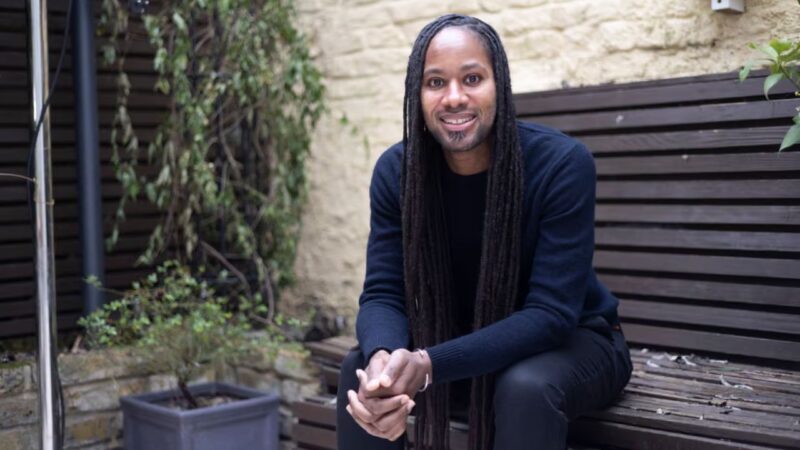
You see, Owen Maseko has locs. Locs are the mark of Rastafarians. Rastafarians (are presumed to) smoke weed. It’s all logical; back when I wore my hair long, I became accustomed to being accosted for ganja by the cops. Sometimes I would let them search me, and call them names while they were at it. Once, they even asked for the password to my phone because if they couldn’t find drugs on me, they’d find pornography in my phone. Sometimes I would tell them I’d already smoked it. In the November of 2018, walking past the High Court towards the Harare Gardens for the official opening of the Harare International Literature Festival, I was instructed to produce a spliff by some chaps from the Presidential Guard.
“Well, gentlemen, I don’t carry when I’m at work.” It was easier than saying I don’t partake. I was summoned to a small circle, where, upon arrival, my lit cigarette was confiscated, and a joint thrust upon me. Of course I smoked it; though four months into sobriety, for I am not in the business of arguing with men with guns, particularly while they are doing drugs… at the High Court.
My dreadlocks weren’t that impressive, but Owen on the other hand, has a Bob Marley mane. So, when he was caught with 28 grams of cannabis on the 13th of June 2025 at the Joshua Mqabuko Nkomo International Airport while attempting to travel to Ireland with his incendiary exhibition, it was understandable, right? Right? Except I had never seen him with as much as rolling paper. So, I wondered, when did Owen start doing drugs? I’m sure fifteen years ago was a better time to pick up a habit.
Maybe I was asking the wrong questions. You see, once upon a time, Xitha Magetha, a South African poet and friend, came through the same airport and was interrogated on the purpose of his visit, then made to sign a document that explicitly said he would not do anything associated with his work while on a tourist visa. And so, during his stay, I was scared shitless we would all be hauled off to jail each time I saw him hold a pen. So what should I have been asking myself? What was the right question? Here’s one: What did the musician Vusa Mkhaya mean – right after they “caught” Owen with drugs – when he said travelling via the Bulawayo airport is now scary for artists? If anything like that happened to me, it would kill my father.
At least I would be flying from Harare. That must be safer, right? And fly safe I did; no incidents at the security checkpoints, smooth sailing (yes, sailing, if it has port and starboard lights, it’s a ship). I was hoping to see some people in Nairobi, including Zenzo Nyathi, a good friend, veteran stage and television actor. Unfortunately, he was in Mombasa when I arrived, attending some conference or other on Theatre Policy Advocacy. I did not get to see him before he flew back to Zimbabwe a week later.
Zenzo’s arrival was not without incident. Despite travelling light, with no checked-in luggage, and one of the first to clear entry formalities, he was the last to leave. He tells of a gentleman accompanied by a lady asking for his passport, then interrogating him on the purpose of his visit to Kenya, demanding documents – invitations, source of funding, and so forth – to corroborate his story; that he was merely attending workshops and not performing, as if what he performs in a different time zone should be any of their morbid concern. The scariest part? These civilian-dressed inquisitors did not identify themselves but made it clear that they knew a lot about Zenzo and his career. We are watching.
It’s the stuff of legend and nightmares, how telling stories becomes a crime. And yes, the irony is that the story ends up writing itself, for we are not conjurors. To fight us is to fight the mirror. We are only servants of the fastest thing in the universe: light, much faster than bullets.
When I came back home, it was without an airport incident. Before that week was done, we carried my father to the hospital where I was born. Not another word did he utter again.