|
Getting your Trinity Audio player ready...
|
In Uganda, censorship is a reality, and in fact, a governance necessity. Once those governing us came to the realization that they cannot give the population what it needs, either because they don’t want to, or because they are not able, then they have got to try to stop the conversation about governing. Why permit or encourage talk about something you know is not going to change? Why raise hope?
That becomes step one, the usual result of which is to then see the discourse migrate to creative spaces, where it operates in a much more multi-layered and subliminal way. This requires a different kind of management of that arts scene, as step two.
With political censorship, matters have been very clear for some time now. Vocal activists who say things that those in power find offensive now have a standard playbook against them. They get barred from as many media outlets as they can. In extreme cases, landlords can be persuaded to evict them from their homes and business premises. Media houses themselves can be banned, or their troublesome journalists harassed or dismissed. There have been reports of even the tax authorities being sent after the records of businesses owned by such critics. Social media influencers are brought on board to cast the predictable aspersions.
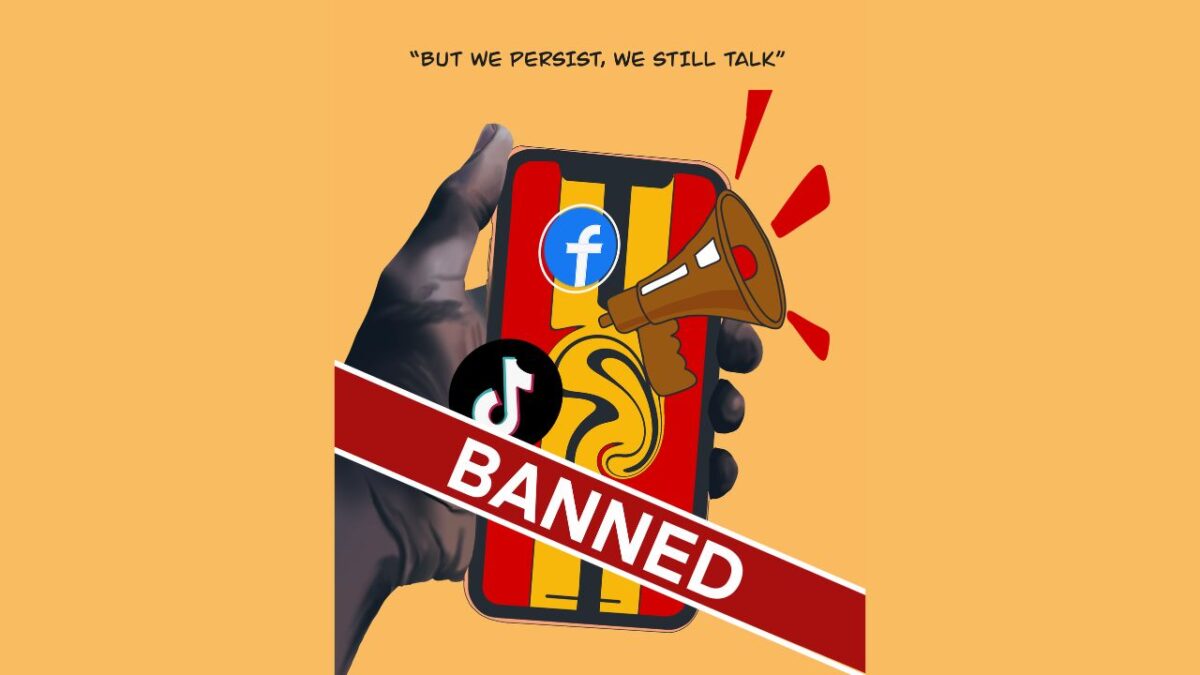
Social media platforms themselves can be shut down as a whole. During the contentious 2021 general election, there was a shutdown across the board. Up to today, Facebook remains banned. Then there are the abductions.
This is not to say it comes easy. The human is designed to see, reflect and speak. So political censorship has it challenges. Recently, some laws seeking to make digital democracy more punishable were thwarted. But in the end, it gets done. Of late, there has been a steady stream of convictions of simple users of X (formerly Twitter) for making posts critical of important government figures. The longest sentence has been six years for the offence of insulting the president via TikTok.
The arts are a different kind of problem, requiring a different set of tools. Art is nebulous. It defies time and form. The key thing to understand is that there is a difference between freedom of speech, and freedom of expression. The Uganda arts sector has suffered over a two decades of deliberate sabotage in my view, and this is why I argue that arts censorship has thus been historically approached in a structural way.
In terms of practical implementation of immediate measures, the lines between politics, art, media and morality are very blurred. Many personalities wear more than one hat, with prominent journalists also being politicians, musicians being opinion leaders, and politicians becoming entertainers.
So the goal has been to create an entirely plastic and artificial practice of noisy, energetic, colourful, but ultimately very hollow forms of “African” expression.
This is actually the best form of arts censorship; creative voices must be monitored, and then led astray.
The transformation of the singer Bobi Wine into the major opposition politician known as Robert Kyagulanyi was not the origin of this process, but became the occasion for its intensification.
There had been other political musicians, like Ronald Mayinja whose themes had become a source of quiet nervousness among the authorities. Various theories exist as to how he vanished from prominence, amid a flurry of mixed messaging.
The closest analogy I can think of is the analyses I have seen by and about certain pioneers of old-school Hip Hop in the United States, such as Wise Intelligent, KRS-One, Chuck D and others, who say that the art form was hijacked.
Citing examples from original rap groups such as Roc Nation, they argue that the wider American power structure and society became worried about the political impact of rap music due to its articulation of Black political concerns about racism, imperialism, and poverty.
They say that the strategic response to this was to encourage the emergence of a new kind of Hip Hop practice, which was mainstreamed and made the dominant and more accessible kind. This was done through the manipulation and encouragement of entertainers more concerned with hedonistic themes in the way those in charge of the major recording companies signed up, curated, distributed and marketed them. The result is largely what became known as “Gangsta Rap”.
They argue that this process was aimed at depoliticizing, or corrupting a valid art form with the purpose of derailing the radicalizing effect it was having on a new generation of, especially, Black American youth.
My title phrase, “As long as you don’t say nothing, you can say anything at all,” is an American expression (possibly from the singer Bob Dylan) to reflect this.
Apart from the usual lack of funding and deliberate appointment of unskilled people to manage the lead state institutions, censorship has also been done through the building of ignorance and falsehoods into our cultural discourse and historical memory. Because in the end, the absolutely certain way to ensure that people do not talk about the things that matter is to not let them know of the existence of those things to begin with. Or, failing that, not know about their significance in the wider scheme of things. Ignorance is a pre-emption. Co-option is a method.
Freedom of artistic expression in Uganda therefore depends on who the particular artist is, and what they are expressing. Some are extremely free; others are silenced.
My last personal experience of censorship was when I was asked to direct the one-man play For My Negativity, written and performed by Kgayi Ngobi, during the 2022 edition of the Kampala International Theatre Festival. Ngobi is a well-known performance poet with a number of works that excoriate the way we live now and the role of the government in creating it. I, for my part, just seem stuck with a name that appears on many an official blacklist going all the way back to 2009. Various stratagems were brought into effect to discourage either the venue, or the festival owners, or the festival sponsors from staging the play. In the end, and with not a little irony, it was the decision of the ambassador of one of the European Union countries that was among the event sponsors to be physically present at the performance that seemed to have kept at bay the scores of not very well-disguised undercover intelligence cops mobilized to the venue.
The emergence of Bobi Wine into political visibility led the regime and its associates to seek to build a counter-industry to match his youth appeal. For a while, this literally created a busy marketplace among the creatives in which singers, in the main, chose which side they would sing for, or switch to. Concerts and counter-concerts, songs and counter-songs, and imagery and counter-imagery became the order of the day.
New bodies were hurriedly set up to “represent” these wiser artists, and at least one was granted office space at the National Cultural Centre. Some singers were even officially appointed “Presidential Advisors”.
So the real censorship has been strategic and structural. This is actually very wise. Because a “fire-fighting” approach is much costlier, destabilizing, and does not cover as many targets.
It has also been long-standing. Uganda, a country of fifty million people, has one public-owned art gallery and one public-owned theatre, both of which are based in the capital, with no real upcountry sites. This builds exclusion and discourages innovation. Arts programmes are essentially driven by some schools, or by embassies and their cultural institutes.
Whatever other facilities do exist are essentially private enterprises set up by heroic and dedicated individuals. Access and exposure require money. The various national awards that were given out for the arts basically no longer exist. The only exception is a “national” film award, which is owned and managed by the Uganda Communications Commission. And that was largely to do to the film sector what the other initiatives have done to the music sector, at least.
But we persist. We will still talk.