|
Getting your Trinity Audio player ready...
|
Praia, Santiago Island — Jan 1, 2025
[08:32 a.m]
The beach of São Francisco was half-empty when we arrived. The morning light had a metallic edge, slicing through the mist that hung low over the Atlantic. The beach smelled faintly of salt, diesel, and prayer. A speaker played a gospel hymn in Creole, punctuated by waves hitting the rocks.
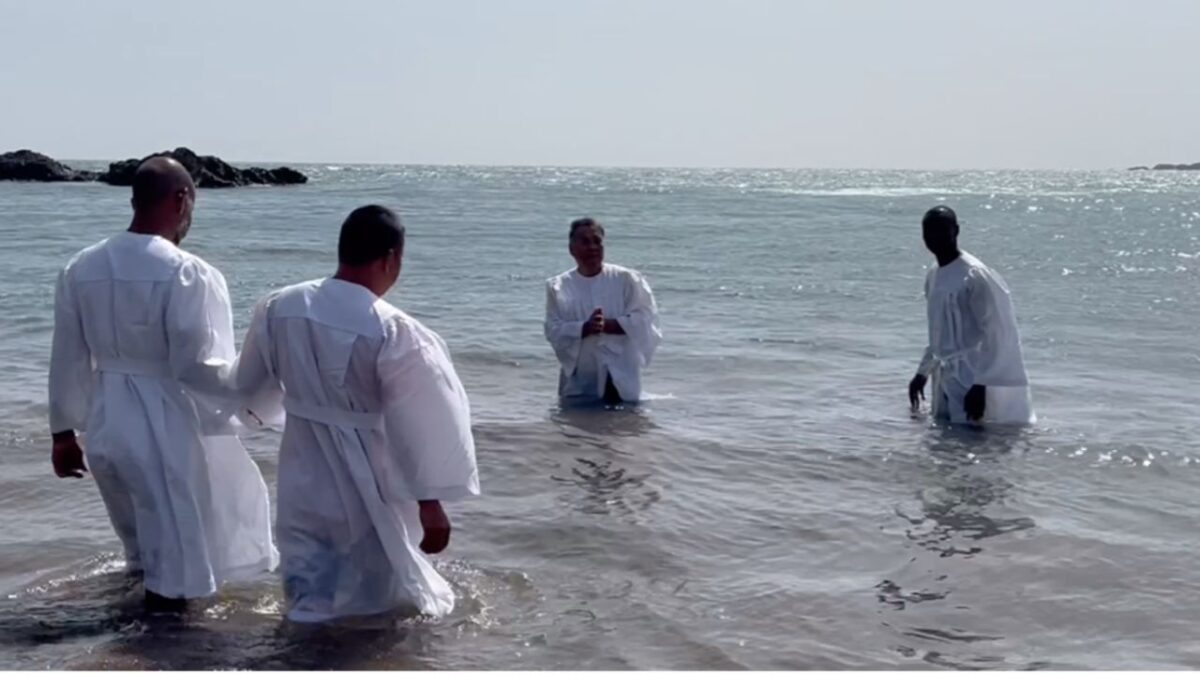
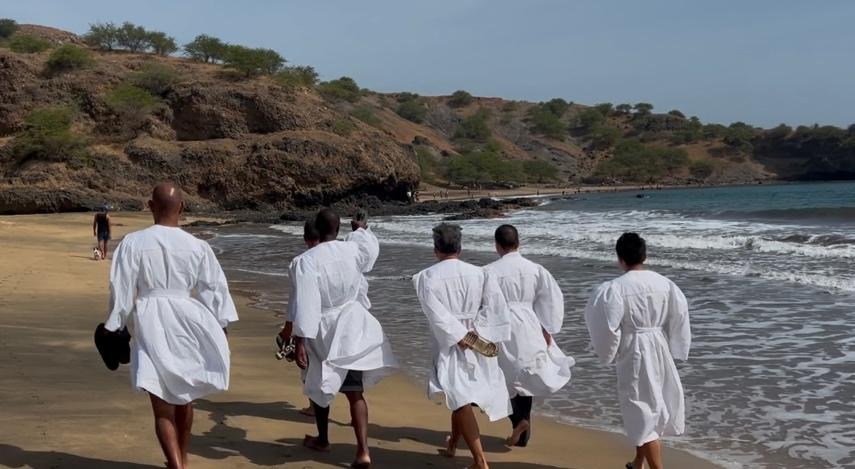
A small crowd gathered near the shore. Three Chinese men stood apart from the rest, each holding a towel while wearing the pure white cloak. The pastors, two tall Cape Verdean men named João and Manuel, and an invited pastor from South Korea, smiled as they shook their hands.
[08:50 a.m]
João lifted his Bible, the pages swollen with moisture. “Água é vida,” he said. Water is life. Then he continued, “And life is not divided by language.” That line stayed with me. Around us, Portuguese, Língua Kabuverdianu, Korean, and Mandarin drifted like separate waves, sometimes colliding, sometimes harmonizing.
The three Chinese men listened attentively. The man, Lin Yi, wore a long white cloak that fluttered in the wind. He had come from Wenzhou six months earlier to sell Chinese fried noodles and chicken in Praia’s market. “I didn’t come for baptism,” he told me quietly, “but maybe it came for me.”
[09:10 a.m]
The ceremony began. The pastors waded into the sea, robes soaking, voice steady. “God’s ocean belongs to all,” One of them said. “Today, we return what we are made of.” His voice trembled slightly. The Mandarin phrasing turned the metaphor inward, which is more existential than religious.
[09:20 a.m]
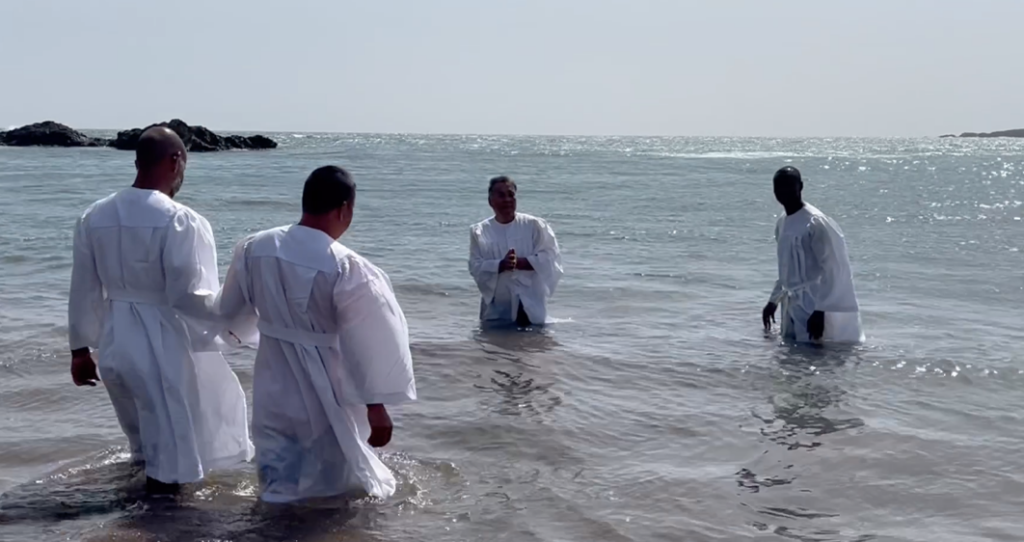
Lin Yi stepped forward. Waves broke around his knees. The water was not that cold, his breath visible. He glanced back once at the shore, not for reassurance, but perhaps to confirm he was really doing this. João raised his hand: “Do you accept the path of faith?” Celina translated, but Lin Yi answered in Creole: “Sim.”
The sea surged, and João forcefully lowered him into the water. For a fleeting moment, the world seemed swallowed by the ocean’s roar. Lin Yi felt the cold seawater instantly envelop him, and in that instant, a fleeting image of the sea back home in Wenzhou, its wind carrying salt and longing, flashed through his mind. When he emerged from the water, the congregation’s song erupted like a tidal wave in his ears, Mandarin hymns intertwining with improvised Creole harmonies, echoing through the sky and sea. There was no expected ecstasy or fear on his face, only a profound calm, a subtle, ineffable smile playing on his lips. It was as if the Atlantic’s depths had washed away all his past, returning a new soul, imbued with the taste of sea salt, completing a silent transformation, a complete farewell to his old self.
[09:40 a.m]
Two Chinese men followed: one from Hebei, one from Wenzhou. Both owned small hardware stores downtown. They laughed nervously as they waded in. Their friends filmed the moment on phones, careful not to drop them in the surf. When it was over, one said in Mandarin, “太咸了。” (“Too salty.”) The congregation applauds. Zhang, one of their friends, films it all on his phone. “Send it home,” he says. “Let them see Africa isn’t just lions. It has blessings too, and these blessings are from the Atlantic.”
[12:00 p.m]
Afterward, we gathered by the beachside for lunch.
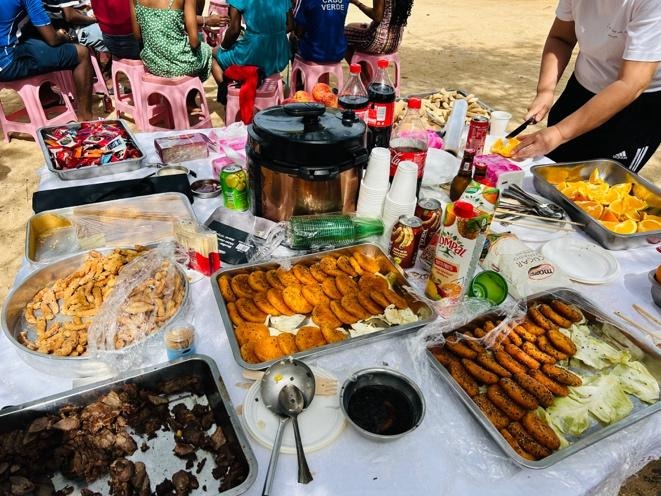
After lunch, the sun had already bathed the beach, and the air was filled with the fragrant char of grilled fish and the salty dampness of the sea breeze, like a silent symphony of flavors. They carefully opened plastic bags, revealing warm pumpkin cakes and soy sauce braised beef, tastes of home. The church members offered golden crispy grilled fish with charred skin, the fresh sweetness of the fish and the tangy zest of lemon wafting forth. Chopsticks and forks gently clinked on plates as people of different skin tones sat in a circle, setting aside words, sharing this simple yet abundant lunch amidst the rhythmic lapping of waves, feeling the primal comfort brought by food, like boats floating on the sea’s surface, each carrying its own stories, but sharing tranquility in the same waters.
João tried to use chopsticks, failed, and laughed until his Bible slipped from his lap. “Faith,” he said, “is learning how to hold new things.” Lin Yi smiled. “Sometimes it’s also about letting go.”
[12:30 p.m]
I asked Lin Yi why he joined the church. He said, “In China, I was too busy to slow down. Here, belief fills the silence.” He paused. “In business, I sell what people need. But here, I receive what I didn’t know I needed.” His words, simple yet layered, echoed one of anthropology’s paradoxes: that movement, migration, displacement, sometimes reveals what home cannot.
Behind him, children played at the water’s edge. One boy asked a Chinese man for his phone to take a photo. The man handed it to him without hesitation. Later, I saw them reviewing the images together, laughing — two strangers finding themselves reflected on the same small screen.
[12:25 p.m]
The tide was high now. The pastor called everyone for a closing prayer. “May misunderstanding become another form of understanding,” he said. “May the sea teach us how to listen.” Then he added a sentence of his own: “The sea never asks who you are.” João turned toward him, surprised, then nodded. “That,” he said, “is the gospel.” I wrote it down.
[01:40 p.m]
The group dispersed. I stayed to record notes. The ocean kept folding itself onto the shore, erasing footprints. Watching that rhythm, I thought of renjianshi — “the human world.” In Zhuangzi’s writing, the term refers to living amid others which is neither retreating from power nor being swallowed by it. Here, on this Atlantic shore, renjianshi was no longer merely the philosophical depth of Zhuangzi’s ‘living in the world yet detached from it.’ It materialized into that fragile yet resilient coexistence between languages, religions, and cultures. It was evident in João’s clumsy but joyful attempt with chopsticks, in Lin Yi’s epiphany, ‘Sometimes it’s also about letting go,’ and even more so in the moments when children freely shared phones, finding their reflections on the same small screen. This was a renjianshi that transcended grand narratives, a true picture woven from daily frictions and warmth. And these, precisely, were the profound meanings of ‘being in the world’ that Lin Yi had never truly experienced in his busy life in Wenzhou.
[03:10 p.m]
In the afternoon, I walked with João to his church. He told me he never expected Chinese believers. “At first,” he said, “I thought they only wanted to make money. But then I saw how they pray, like, very quiet, almost like negotiation.”
He smiled. ‘Maybe that’s what prayer really is: a negotiation with the invisible.’ His words resonated with something tender — belief as dialogue, not doctrine. Of course, on this land, beyond the hymns echoing in the church, there were also the whispers of African beliefs, and the silent prayers of Chinese migrants in a foreign land to their ancestral deities. Together, they wove the diverse spiritual tapestry of Cape Verde. Whether facing a cross or a red paper charm with ‘平安’ (peace), that quest for the unknown and for hope seemed to share a common underlying essence.
[04:45 p.m]
Later, I visited Zhang’s Baihuo Shop in Plateau. The air smelled of plastic and rain. Mannequins wore sequined dresses from Yiwu; a radio played Kriolu pop. A small wooden cross hung beside a red paper charm that read “平安”.A Cape Verdean customer entered. “Olá,” he greeted. Lin Yi responded, “Oi”. Behind the counter, a kettle whistled. Lin Yi poured tea, offered me a cup. “The water here is different,” he said. “It boils slower, but it tastes deeper.” I thought of the baptismal water, how it, too, boiled beneath the sun, held salt and silt and time.
[06:20 p.m]
At sunset, João stopped by his shop. They spoke about tomorrow’s sermon. He wanted to talk about forgiveness; he suggested patience. When he left, Lin Yi turned to me. “Sometimes I think he prays too loudly,” he said, smiling. “Maybe God prefers whispers.” Cape Verde, I realized, was a place where faiths did not compete — they coexisted like tides crossing paths.
[08:10 p.m]
I returned to my apartment overlooking the harbor. The cargo ships were now dark silhouettes against the orange sky. The same ships that carried Chinese goods across oceans now seemed to carry invisible stories of labor, of longing, of shared salt.
The sea actually does not separate Africa and China. It only delays their conversation. I reread my notes, underlining João’s words: “Water washes what the world cannot.” In the age of the Anthropocene, where even the ocean bears human fingerprints, that sentence gained a painful clarity. If water remembers everything- our plastics, our bodies, our prayers- then baptism becomes not cleansing but acknowledgment. To enter the water is to admit our shared contamination, our collective belonging. This could be renjianshi: not transcendence, but immersion.
[Final reflection]
In the sweeping global narratives, the story of Africa-China relations often gets distilled into a ledger of deals, debts, and grand infrastructure projects. Yet, the true pulse of this intricate connection beats in the small, unremarked moments,the daily exchanges that rarely grace the headlines. It might be the quiet understanding in a smile exchanged across a shop counter, the unexpected harmony of a shared hymn sung in different tongues, or the profound comfort of tea after the bracing taste of baptismal salt water. Here, the relationship between Africa and China reveals itself not as a vector of expansion, but as a process of translation- language, faith, of the very essence of humanity.
As I walk back along the shore, the ocean’s rhythmic breath seems to whisper of equality, not as a lofty political slogan, but as a tangible, physical truth. In its boundless embrace, all bodies, regardless of origin, float or sink with the same elemental grace. The insistent salt asks no questions of passports or nationality; the impartial sun casts its golden light, undiscriminating between skin tones. This, I realize, is the profound message of the baptism: a sacred rehearsal of another kind of world. A world where belonging is not rigidly measured by the lines on a map, but by the shared rhythm of breath, the collective pulse of life carried on the same wind. It is in these moments of immersion in the vastness of the Atlantic, in the shared humanity across cultural divides—that the true spirit of renjianshi emerges: it is not an escape from the world, but a deeply felt, often challenging, but ultimately enriching engagement with its beautiful, complex tapestry. It is a testament to the resilient human spirit, ever seeking connection and understanding amidst the ebb and flow of difference.
–
*This piece has been awarded Honourable Mention in the category of non-fiction in the Second Global China-Africa Writing Competition (2026) held by CASIN (China-Africa Shanghai International Network). The competition is managed by Dr. Flair Donglai Shi (Shanghai Jiao Tong University), under the directorship of Dr. Jodie Yuzhou Sun (Fudan University). The judging panel of 2026 consisted of Dr. Lifang Zhang (Tsinghua University), Dr. Kaiyang Xu (China Foreign Affairs University), and Mr. Eric Mupona (Zhejiang University). The piece was originally written in English. The Elephant has permission from both CASIN and the author to publish it first. For more details about the competition and CASIN, contact us at casinwriting@gmail.com.