|
Getting your Trinity Audio player ready...
|
Patrick “Panye” Mukabi, painter, tutor, imaginer, always stood tall, ready to lend a hand, an eye, a piece of advice, a gentle nudge, always in the service of others. He, with his patient, unassuming demeanour, taught those who came after him to look closer, not just at the canvas, but at the space between the canvas and the wall – the world the painting carried with it. So, as he bows out, maybe he will be remembered for (besides his legendary paintings on the Java house walls) being the voice that helped many young artists paint their imagination onto the canvas.
In his heyday, when you first walked into his Dust Depo at the Railway Museum, the air always smelt of turpentine, charcoal dust, and something rarer: possibility. Mukabi often stood barefoot, moving between easels like a man tending to seedlings, pausing to tilt his head at a student’s work, offering a quiet word, then moving on. He never shouted. He never performed authority. He simply was there, and that was enough to make his mentees believe, perhaps for the first time, that they belonged.
That was the Panye everyone knew. That was the Panye the world lost on the 23rd of March, 2026, when diabetes – a quiet, brutal thief – finally closed the curtains on one of the most prolific visual artists Kenya has ever produced.
But to speak only of Panye’s passing is to miss the point entirely. In his absence, we gathered beneath the shadow of loss alone. We gathered to witness that the shadow, cast by a gentle giant, had become the canopy under which an entire generation of Kenyan artists has learned to stand.
The boy from Kariokor
To understand the mentor, we must first find the boy. And the story of the boy begins in 1969, in Nairobi, the fourth of seven children born to a Kenya Railways employee. Mukabi’s earliest images arrived not from art school but from the stained-glass gaze of Catholic iconography at Loreto Convent Mombasa – with its saints and sorrows, its halos and humility. I’m prone to wonder what a chat between Panye and celebrated Catholic art historian Camille Paglia would have been like, but oh, well, we’ll just never know.
While other children chased footballs along the alleys of the numerous Jogoo Road housing complexes, young Patrick spent hours staring at other people’s illustrations, absorbing the grammar of line and shadow before anyone taught him the vocabulary.
He would do the sensible thing first. He pursued graphic design at the then Kenya Polytechnic (now Technical University of Kenya), learning the trade of precision and reproduction. But the sensible thing starved something essential. Eventually, he returned to his first love – the fine arts – stepping away from a secure government job reprinting logos, to chase a life that offered none of the guarantees and all of the grace.
In 1994, at the age of 25, Mukabi found his way to the Museum Art Studio at the Nairobi National Museum – a cramped, hole-in-the-wall artistic enclave that would become the cradle of his movement. He shared it with three other budding artists: Michael Soi, Peterson Kamwathi, and Simon Muriithi. Soi remembers the older Mukabi, already selling work, buying paintings from the younger artists and leaving them in the studio – not as acquisitions, but as silent tuition.
“Since he was older than us and made money before us, he would buy paintings and leave them in the studio for us to use,” Soi recalled. There was no lecture. No grand announcement. Just presence, and paint, and the quiet insistence that the young ones deserved to work… and learn.
That is how Panye taught. Not with syllabus, but with space and approval.
The mwalimu who gave his studio away
Mukabi’s career unfurled across the major arteries of Nairobi’s contemporary art landscape. He was there at the GoDown Arts Centre when it opened in 2003, a resident artist practically from the day the doors swung open. He worked at Kuona Artists’ Collective, at the Museum Art Studio, and finally at the Dust Depo Artist Studio at the Railway Museum – a space that bore the poetic irony of his family history. His father had been a senior Kenya Railways executive; his grandfather had slept in the back of East African Railways trains as they shuttled from the Coast to Kampala. Mukabi spent much of his happy childhood traveling on trains across Kenya with his father.
“I feel as if, in a way, I have come home,” Mukabi once said of the Dust Depo.
And then, just as his father and grandfather had carried people across the continent, he carried young artists across their own creative frontiers. The Dust Depo was never really his studio. It was a thoroughfare, a bazaar, a sanctuary. He opened the doors to anyone who showed up with a hunger stronger than their fear. Nadia Wamunyu, who first walked in at seventeen, described it as the place where her entire life recalibrated. “His studio became my sanctuary,” she said. “He saw my potential before I fully understood it myself”. Mukabi helped her through school, through her own journeys, through the long, disorienting apprenticeship of becoming an artist. He never turned anyone away, regardless of background or formal training. And he never made you feel like a charity case. He made you feel like a colleague-in-waiting.
The roster of artists who passed through his orbit reads like a directory of Kenya’s contemporary art renaissance: Peter Elungat, Florence Wangui, Dickens Otieno, Mike Kyalo, Alex Mbevi, Nadia Wamunyu, Levens Lenyerere, Eric Mureithi, Bebeto Ochieng, Jimmy Kitheka. And behind each name, a story of a young artist who had nowhere else to go – until Panye moved over and made room.
“He single-handedly produced a new generation of artists,” Michael Soi told mourners at the Nairobi National Museum. “Only Kuona Artists’ Collective has done that, but Mukabi did it in his own way, individually. It is no small feat.”
The generous giant who couldn’t say no
But generosity, when it runs too deep, becomes its own kind of wound. Njeri Tani, who acted as Mukabi’s unofficial agent, often puzzled at his inability to value and trade his own labour. “Panye isn’t money-minded,” she said. “He would often give away his paintings at very low prices to people who appreciated them.” He didn’t see art as a transaction. He saw it as a handshake, a conversation, an invitation to the feast. He sold the digital video camera and computer gifted during a residency in Birmingham to buy canvases and paints for the Nairobi studio – converting technology back into tradition, currency back into creation.
There is an expression in Swahili for such a man. Mtu wa roho safi. A person of a generous spirit. But spirit, unguarded, leaves one exposed. And Panye was exposed. The diabetes crept in slowly, then sudden. By the time the art community rallied, the mountain was steep. In April 2026, 47 artists donated 50 works to a medical fund benefit exhibition at the Trademark Hotel – a desperate, beautiful gesture from the very people he had once bought paintings for. The Banana Hill Art Gallery ran a solo exhibition titled Mali Safi – Goods Are Clean – borrowing works from collectors to fill the walls because Mukabi was already too ill to produce new ones. The titles mocked the urgency beneath them.
As he lay in Kenyatta National Hospital in those final months, the “Gentle Giant” had been reduced, hollowed. He spoke slowly, but his eyes still beamed with that old cataloguing rhythm – assessing the light, the shadows, the posture of visitors. He was still painting, even when he couldn’t hold a brush. He was still teaching, even when his voice was barely a whisper. The soul was in art, and the art would not release him.
The body on the canvas
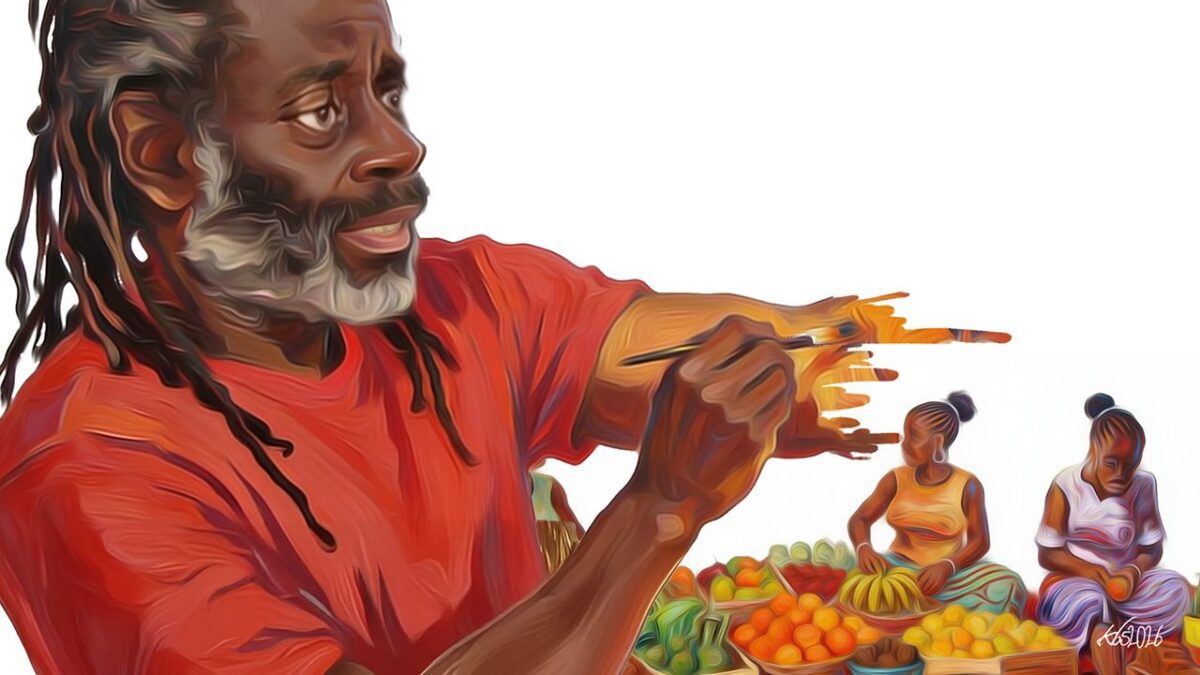
And what art it was. Mukabi’s signature – those full-figured women in marketplaces, their wide hips swaying beneath the weight of pineapples and maize, their heads wrapped in kitenge, their faces lifted toward an unseen sun. He called his later series Cover Girls – ordinary women, women who were unlikely to appear on a magazine cover, women whose bodies bore the honest topography of childbirth and labour and survival. He painted them with reverence, with an almost religious attention to curve and shadow and the way sunlight falls across brown skin.
“We are saddened by the passing of Patrick Mukabi,” Java House said in a statement.
And indeed, his murals on their walls – those market mamas, those children with cornrowed hair – had become as familiar to Nairobi’s middle class as the cappuccino foam. But to reduce him to commercial decoration is to misunderstand the politics of his brush. He painted Black women the way Black women deserved to be painted: not as objects of a colonial gaze, not as ethnographic specimens, but as sovereigns of the everyday. His potraiture of nudes, once banned from the National Museum for being “too controversial”, were less provocation and more of an affirmation. This body, this brown body, this fat body, this scarred body – it is worthy of portraiture. It is worthy of permanence.
In 2007, Mukabi created life-size human figures cut from tin sheets. They were scorched during the post-election violence that tore through the country, their silhouettes burned into the city’s memory as surely as the flames themselves. Mukabi never made a spectacle of his anger. He simply put bodies on the canvas – bodies that could not be ignored, bodies that demanded you see them on their own terms.
The puzzle we could not solve
Perhaps the most haunting testimony came from his own family. At the memorial at Nairobi National Museum, his brother-in-law, Isaac Kamuta stood before the gathering and confessed a profound uncertainty. “Hearing about him is like a puzzle being filled that we didn’t know as a family,” he said. “His soul was in art. He kept it personal and did not want us to find out what he was doing. It was difficult to penetrate that wall for 26 years.”
Here was a man who opened his studio to any stranger who walked in, yet kept his artistic life locked away from the people who loved him most. His family knew the public paintings – the murals at JKIA, the Java House walls, the occasional CNN feature. But the man behind the brush? He was a visitor from another country, fluent in a language they could only admire from a distance. He never missed a family meeting in their ancestral home in Luanda, Vihiga County. He brought laughter, sat among them, then returned to his art without explanation.
This is the paradox of Panye: a man of radical openness and profound privacy. A man who gave his studio away but kept his heart behind a door he never fully opened. Perhaps the two impulses were the same. Perhaps the studio was the heart. And perhaps, in the end, the only way he knew how to love was to make space – space for young artists, space for imperfect bodies, space for the messy, unfinished, beautiful business of becoming.
Raising the movement
At the memorial, artists gathered for a mural painting session. Yegonizer, who had met Mukabi at the GoDown in 2010, spoke of the revolution he ignited. “He revolutionized the art scene through his masterful creations and his selfless commitment to guiding others,” Yegonizer said. Then he added something sharper, something that cut through the grief. Mukabi, he said, leaves the art community with a profound challenge – to continue his mission of inspiring and mentoring young talent.
That is the work that remains. That is the debt we carry forward. The “Yegonizer” has a tribute painting, a medium acrylic on canvas, a memorial portrait created to honour the legendary Panye.
There are no more “Panye stories” to be made – those entry points where a young artist walks into a studio and finds a mentor waiting. The studio at Dust Depo has gone quiet. The barefoot man no longer moves between easels. The charcoal dust settles where no hand stirs it.
But if you look closely enough at the hundreds of paintings created by Kenyan artists working today, you can still see his hand. In the way they model the human figure. In the way they refuse to look away from ordinary life. In the way they keep their studios open, just a crack, for the next hungry kid who shows up with nothing but a sketchbook and a resolve.
Patrick Mukabi – Panye, Papa Supaa, the Gentle Giant – has taken his final bow. But a movement does not need its founder to keep breathing. It only needs the people he raised to remember that they were raised for something.
So as his mentees head back to the studios, his voice still implores to keep painting, keep teaching, and keep the door open. That was the only instruction he ever gave. And now, it is the only eulogy he would probably accept.