|
Getting your Trinity Audio player ready...
|
On the morning of 21 October 1956, Dedan Kimathi was walking near a trench on the edge of the Nyandarua Forest in Nyeri, exhausted and alone, when a Home Guard named Ndirangu Mau shot him in the leg. Kimathi raised his hands and identified himself. He was captured, tried before an all-African jury on a charge of illegal possession of a firearm, and hanged at Kamiti Prison on 18 February 1957. The British colonial government printed over 100,000 leaflets in Gĩkũyũ announcing his capture. Ndirangu received a share of the bounty on Kimathi’s head and used part of it to buy a bus.
Nobody ever rode that bus. His children were bullied in school. His neighbours made sure his family understood, at every national holiday, exactly what he had done. He died in 1986, having spent the last thirty years of his life telling anyone who would listen that he regretted it. The community did not organize a campaign against him. They simply remembered, and they acted on what they remembered. The bus sat and rotted.
I have been thinking about Ndirangu’s bus over the last few days.
Emmanuel Macron arrived in Nairobi on Sunday for the Africa Forward Summit, a gathering France billed as a new chapter in its relationship with the continent. He and President Ruto signed eleven agreements covering nuclear energy, transport and agriculture. Macron announced €23 billion in investment and told the assembled audience that the France-Africa relationship was now “entirely free of hang-ups”. At a university event, he interrupted a presentation to scold a noisy audience, telling attendees to leave if they wanted to keep chatting. He danced to Hakuna Matata at his welcome ceremony.
Dennis Ombachi made a cooking video with him.
Ombachi is genuinely beloved. He is a former Kenya Sevens rugby player, an Olympian, one of the best athletes this country has ever produced, a man who carried the flag with distinction and then built a second career as a content creator on the strength of his warmth and his food. He has millions of followers and, until this week, a reputation so clean it was almost unusual for someone that famous. The cooking video was easy and charming, exactly the kind of content he makes well.
The optics were bad, and Kenyans said so. What followed is worth careful examination.
A section of the internet rose to Ombachi’s defence by calling his critics performative pan-Africanists, online warriors with no real politics, practitioners of cancel culture imported from American Twitter. The people raising their concern were framed as the problem. Their concern was framed as hysteria dressed up as ideology. The word “cancel” was deployed, and the conversation collapsed into a familiar shape.
Let’s begin with Ombachi, because he deserves more than being reduced to a mere symbol in someone else’s argument.
He made a call that many people, including me, think was bad optics. That criticism is fair, and it should be said plainly. But the critics who treated this as betrayal rather than misstep were asking Ombachi to have instincts that our entire education system was designed to prevent him from developing. There is no union in the Kenyan creator economy asking hard questions before a contract is signed. There is no established conversation in that community about what it means to lend your face and your warmth to a foreign leader’s image rehabilitation tour. Ombachi walked into something that required a political and historical lens, and that lens was never part of his formation, or of most of ours.
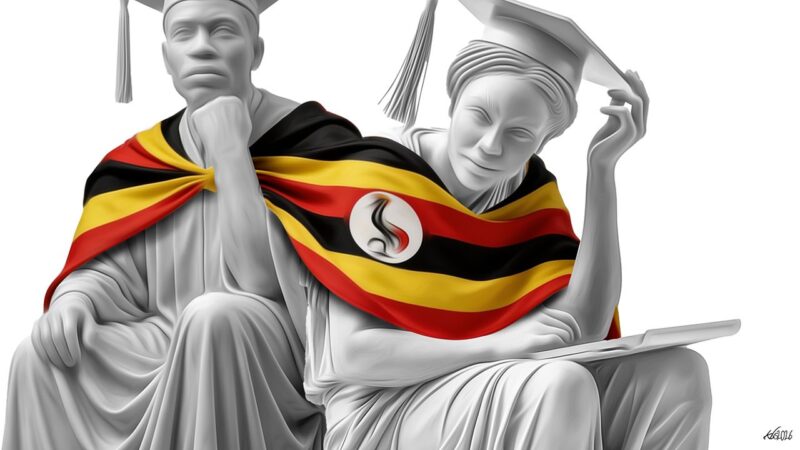
The British did not only take land. They took control of the curriculum. Colonial schools were built with a specific purpose: to produce Africans who would be useful to the Empire and grateful for the opportunity. The most educated among us were educated away from ourselves, taught that Europe was the origin of civilization and that Africa was a place awaiting improvement. The framing was not neutral. It was policy, and it ran for generations. Kenya gained independence in 1963, and the schools remained. The textbooks changed slowly, partially, incompletely. The result is that most Kenyans moving through the world today, including the most accomplished ones, were never given the tools to look at a French president arriving with billions in investment and ask the basic question: What does he want, who actually benefits, and what does my presence in this image cost?
That question was not in the syllabus. Ombachi not asking it is not evidence of a character flaw. It is evidence that the system worked exactly as it was designed to.
Macron’s visit carries its own weight, entirely separate from the debate about creators.
France never really left Africa after independence. For decades after African countries raised their flags, France maintained a quiet grip: keeping troops on the ground, backing governments that protected French business interests regardless of how those governments treated their own people, and running a currency arrangement that meant fourteen African countries could not fully control their own money because the final decisions were made in Paris. This was acknowledged policy, so entrenched it had a name: La Françafrique. France was driven out of Mali, Burkina Faso, and Niger in recent years, not through negotiation but because ordinary people in those countries had finally had enough, and their fury was loud enough that even installed governments could not ignore it.
Now Macron comes to Nairobi to announce that all of that is behind us and the relationship is “entirely free of hang-ups”. He told a magazine ahead of the summit that Africa cannot keep blaming colonialism for its problems, that leaders need to look at the seventy years since independence and take responsibility for what went wrong. This from the leader of a country that, when Haiti became the first Black republic in the world by defeating French colonial rule in 1804, forced Haiti to spend the next century paying France reparations for the financial losses slave owners suffered when they lost their slaves. Haiti was still making those payments in 1947. The resulting debt shaped the poverty that country carries to this day. The hang-ups Macron dismisses are not paranoia. They are a paper trail.
Like every Kenyan president before him, Ruto rolled out the red carpet. This is not a criticism unique to Ruto. Kenyan governments have consistently chosen access to Western money and goodwill over the harder conversation about what that access actually costs. The eleven agreements signed this week may carry real benefit for Kenya. They may also carry the conditions that have historically come attached to these partnerships: the requirements about who gets the contracts, the debt arrangements that keep the borrower returning to the same lender, the fine print that makes the relationship look like partnership while functioning like dependency. The history of such agreements on this continent means asking those questions is the minimum reasonable response.
Now, let’s turn to the politics of language.
The people defending Ombachi under the banner of “cancel culture” and “woke” deserve their own scrutiny, because their argument is not actually about Ombachi.
A genuine defender of Ombachi would acknowledge that the optics were poor, extend him grace given everything described above, and ask for a more measured response from his critics. What his loudest defenders actually did was use him as a vehicle to discredit Pan-African critique wholesale. Whether Ombachi recovers from a bad week was never really their concern. He was a convenient shield for a different argument entirely.
The charge that online criticism is not real politics is particularly cynical when Ombachi built his entire career online, this conversation is happening online, and the people making the charge are also making it online. Dismissing the internet as not the real world is not a serious argument in 2026. It is a way of disqualifying a conversation you would prefer not to have.
Then there is the language itself, and this is worth sitting with. “Woke” is a Black American vernacular term. It came from African American communities, and it described exactly what pan-Africanists are being accused of: being alert to the ways that racial and colonial power operates against you. Staying woke meant not being naive about the systems designed to work against people who look like you. The American right spent years deliberately hollowing the word out, repeating it with enough mockery and contempt that it became a slur, a way of making political awareness sound like a mental illness. They did this because the original meaning threatened them. A population that is alert to how power works is harder to manage than one that is not.
“Cancel culture” was built by the same political movement, for the same purpose: to protect powerful people from consequence by reframing accountability as persecution, to make the person being held responsible look like the real victim. Together, the two terms form a complete toolkit: “Woke” to discredit the consciousness, “Cancel culture” to discredit the response.
The people who built that toolkit would not like the Pan-Africanists. They would not like their Kenyan defenders either, for that matter. They would find all of them tiresome for the same reasons. There is a particular irony, then, in watching Africans deploy that vocabulary against other Africans for raising African concerns about a European leader’s visit to their own continent. It is a borrowed weapon, and it is pointed in exactly the wrong direction.
Shunning is not new. Communities have always had a reckoning for collaboration with power, and they have exercised it without needing a name for it or a framework borrowed from American cable news. Ndirangu’s bus sat empty because people knew what he had done and decided accordingly. That understanding did not require a campaign. The instinct those critics are trying to pathologize is older than any of us, and it is thoroughly Kenyan.
The most useful thing that could come from this week is not a final verdict on Ombachi. He will be fine. He is talented, and people love him, and this will pass, as these moments do.
The more important conversation is the one the creator economy in Kenya has not yet had: what does it mean to lend your platform to a state visit? What questions should a creator, or their team, be asking before they say yes to an opportunity like this? How do we build, collectively, the political literacy to evaluate what our images mean and whom they serve? These are not abstract questions. They are professional ones, and the industry needs infrastructure to address them seriously.
The colonizer did not leave. He arrives now with investment summits and bilateral agreements and cooking videos, and he needs warm, credible, beloved local faces to make the message land. That is not Ombachi’s fault. It is the machinery operating as it always has. What we owe our history is the capacity to see the machinery clearly enough to make informed choices about when and how we engage with it. That education was taken from us long before we were born, and the work of taking it back is generational. This week was one small, uncomfortable, necessary part of that work.