|
Getting your Trinity Audio player ready...
|
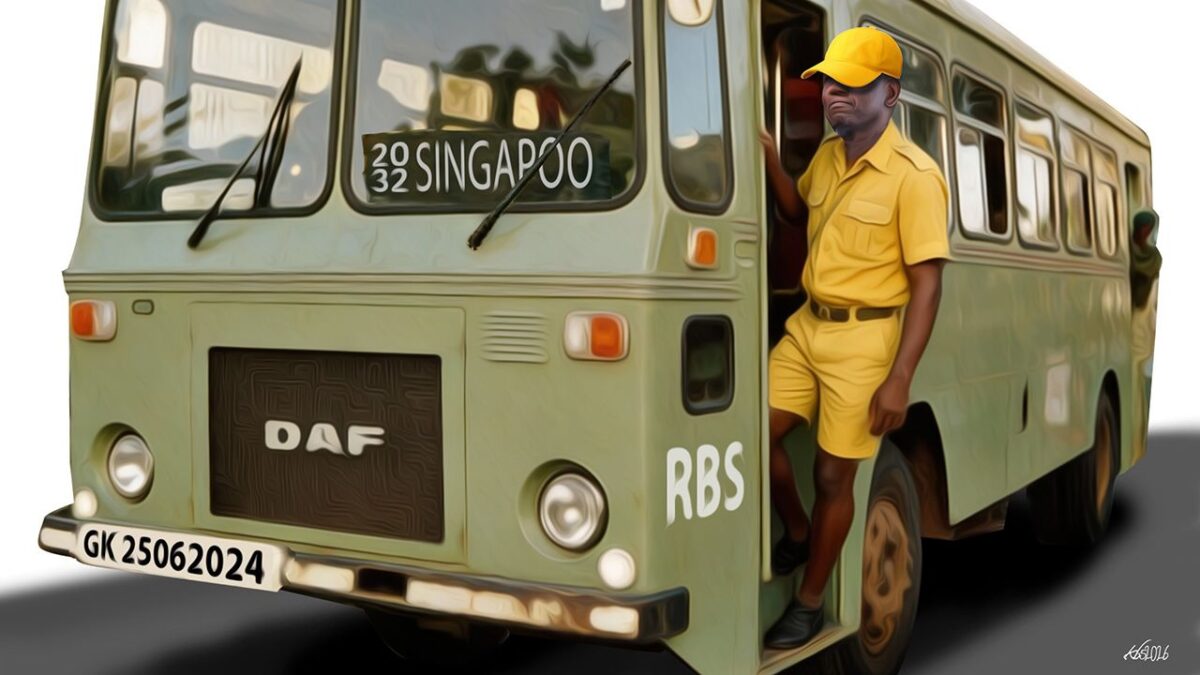
Six years after COVID-19, the world is facing another pandemic. It is a little-known disease but very destructive: rhetorical exoticism – mentioning the woes or wonders of some remote place to make a political statement to one’s countrymates. Since late 2025, Kenya’s executive seems to have become afflicted with the condition. Suddenly, an insular city-state 7,500 kilometres away has become the horizon for President William Ruto, who has promised to send his country on “a journey to Singapore”. The distant state’s road to becoming an ultramodern country has become an ill-defined blueprint for Nairobi.
Ironically, there is no public record of Ruto having made a trip to that place to which he wants to take his country.
Yet, while Ruto initially also mentioned South Korea, Japan, and Malaysia to the Kenyan head of state, the Southeast Asian country has become synonymous with the “First World” into which he wants to bring Kenya in just a few years. Some, like Murang’a governor Irungu Kang’ata, are pointing at the stretch between the country’s US$2,200 per capita of nominal GDP and Singapore’s US$90,000. Critiques have mocked the president’s vision; the “Singapoor” pun can be found in various posts online decrying Kenya’s persistent challenges.
As foreign policy analyst Mwangi Maina has remarked, the Singapore “obsession” is nothing new in the political landscape. Former Kenyan presidents Daniel arap Moi and Uhuru Kenyatta also voiced their admiration for the Asian nation’s trajectory, whose GDP was at the same level with that of Kenya when British colonial rule ended in both countries in 1963.
The comparison should, however, stop here: While the economic performance of the two former British colonies shared similarities in the 1960s, the two countries followed very different paths in the following six decades. Thus, Singapore does not automatically provide a roadmap for Kenya.
Why is the Kenyan president focusing so much on this island city-state that is almost the same size as Nairobi and whose population is nearly ten times smaller than Kenya’s?
The two countries possess structural differences that make any sustained economic comparison irrelevant. To date, Kenya’s economy is mostly reliant on its agricultural sector, which weighs between a quarter and 30 per cent of the country’s GDP. Agriculture represents only 0.03 per cent of Singapore’s GDP. Nearly 40 per cent of Kenya’s workforce is employed in agriculture – something Ruto, who was elected on the promise of improving farmers’ outputs and revenues, has no intention of changing. The share of the manufacturing sector in Kenya’s GDP has declined steadily despite repeated promises by every administration to revamp it, dropping from 13 per cent in 2007 to 7 per cent in 2024; in a lengthy exposé online, Kenyan YouTuber Lynn Ngugi highlights the stalling of most industrial and processing zones across the country. Singapore’s manufacturing sector experienced the most significant growth periods in the 1980s and 1990s, and while it has been in decline since the mid-2000s, it stood at 16 per cent in 2024.
These differences can in large part be explained by Singapore’s unique geographical position. As the country became fully independent in 1965 after two years under Malaysia’s rule, its strategic location at the entrance (and exit) to the Strait of Malacca made it the second-largest port in the world, with the increased maritime traffic driven by growth in the neighbouring countries benefitting the city-state. Singapore would not have experienced the growth it has, had the rest of East and South-East Asia not been successful. Also, thanks to its strategic location, the direct influx of raw materials also helped its industrialisation and, later, the development of high technologies.
This makes any comparison with Kenya difficult. While Mombasa is East Africa’s main port and experiences a strong growth (+8 per cent in the first half of 2025), the goods reaching the country’s second-largest city are sent to – or coming from – the hinterland via logistical corridors that are not yet fully operational, as crucial infrastructural works are yet to commence. As a result, Mombasa expects to handle around 45 million tonnes of freight this year, a far cry from Singapore’s 622 million in 2024.
Moreover, to strengthen its position as a regional commercial hub, Kenya must count on its neighbours’ stability and strong economic growth. But given the current fragile political and economic situation prevailing in most East African countries, it is unlikely that Ruto can realise his ambitions to elevate Kenya to Singaporean heights within the time scale of his mandate – and assuming he obtains a second term in 2027.
Singapore’s success is also often explained by the density and performance of its financial sector, and the adoption of liberal economic policies that facilitate the registration and activity of businesses in a city-state that is sometimes referred to as a tax haven. At first sight, Kenya could be in a similar position: Nairobi is East Africa’s financial hub and its leading banks are represented in most of the neighbouring countries. The Kenyan financial sector is, however, crippled by a lack of oversight that placed the country on the Grey listing of the Financial Action Task Force in 2024, a list on which Singapore has never appeared. This opacity makes it complicated to gauge any concrete and beneficial reinvestment of foreign capital concentrated in Kenyan banks.
And here is one of the most repeated points concerning Kenya’s Singaporean dream: institutions matter, transparency matters. Singapore managed to build strong institutions as the basis of its economic development, practically erasing the corruption that is today hampering Kenya’s economy.
But strangely, in his Singaporean “project”, Ruto mostly emphasized a KSh 5 trillion investment plan focusing on energy, education, infrastructure, and irrigation, four sectors in which Singapore is not particularly singular; every high-income country in the world has actually been investing – and generally performing highly – in these sectors.
So why the obsession with Singapore? It turns out that Ruto – and every proponent of the Singapore blueprint – particularly favours one aspect of the city-state’s institution-building history: Singapore’s illiberal, or authoritarian, rule that has prevailed under Lee Kuan Yew (1959–1990) and his successors. The words “discipline” and “effort” appear in every recent Kenyan allusion to Singapore’s development model of “enlightened despotism” as virtues to be adopted. It is also worth noting that Ruto and his allies started mentioning Singapore often in the second half of 2025, at the same time as they were alluding to the possible extension of the president’s term of office to 20 years instead of the 10-year term limit foreseen by the constitution. The president did later clarify that his 20-year vision did not necessarily involve his being at the helm. However, some of his supporters, like businessman Narendra Raval, support the idea of an extended stay in power so that he may achieve his vision the way Lee did for Singapore.
The centrality of Lee Kuan Yew in the Singapore example is particularly useful for whoever claims to follow his path. For most of his followers, the economic and social success under his rule validate the Great Man Theory and tends to legitimize the concentration of power around a unique individual and their first circle. It is for the same reasons that Rwanda, where Paul Kagame has been in power since 2000, has often been labelled as the Singapore or Switzerland of Africa – a constant Western obsession that involves the finding of either of these two countries in every continent, although we are yet to hear about Europe’s Costa Rica or Asia’s Botswana. While the success generally attributed to Kagame and Lee is not the object of this article, one should nevertheless be cautious about tying the success of a country to only one person. Notwithstanding the role played by the leaders in their countries’ economic prosperity, we should also remember that other Asian countries – South Korea, Malaysia, Japan – experienced high and sustained growth throughout the 20th century without this being attributed to any one particular leader.
Even the authoritarianism needs to be specified: besides the general repression of the public, Singapore also created an independent body in charge of investigating corruption that did not spare members of the ruling party. This is not happening in Kenya, and Ruto does not seem to be taking that route for now. Kenya’s closest equivalent is the Ethics and Anti-Corruption Commission (EACC), which has strong investigative powers and frequently probes figures from both sides of the political divide. But it does not possess any prosecutorial authority and must rely on the Directorate of Public Prosecutions – whose head is named by the president – for any case to proceed to court. In practice, no sitting senior member of the current administration has been convicted by the judiciary, and corruption allegations have instead been handled by political figures, such as when former Deputy President Rigathi Gachagua was impeached – but not convicted – in 2024 on grounds of corruption.
This does not mean that scandals have not been revealed: the former Cabinet Secretary for Agriculture, Mithika Linturi, was accused of importing substandard fertilizer. He has, however, not faced any trial but was merely removed from his position in a cabinet reshuffle. Kenyan officials never officially linked his dismissal to the scandal, nor did they express any position on the latter. Despite backsliding in the latest democracy index, Kenya’s growing authoritarian trend has not improved the fight against corruption. Ruto was even named the second “person of the year” in 2024 by the Organized Crime and Corruption Reporting Project (OCCRP), behind Syria’s Bashar al-Assad.
Many countries have managed to eradicate or significantly reduce corruption at all levels by implementing non-authoritarian policies whose impacts can, however, take longer to materialise. The creation of independent investigative bodies whose autonomy is enshrined in official texts depends on the political goodwill of a country’s ruling class. Some countries, like Uruguay, have combined this with the creation of a strong bureaucratic body that does not change with every electoral season, thereby limiting the politicians’ ability to bend the state machinery in their favour. Finally, in the fight against corruption, some democracies – one could mention Namibia and Botswana here – have conceded even greater freedoms, in particular press freedoms to protect the media in their investigations, complicating de facto any potential corruption scheme. But highlighting these examples could also be another case of rhetoric exoticism: Kenya can chart its own path, with policies that are adapted to the country’s own peculiarities.
In a nutshell, this story does not claim to invalidate Singapore’s trajectory, nor the efficiency of the country’s policies to rapidly grow economically. But in the wake of a global wave of authoritarianism, Kenya’s democracy, which is entrenched in a particularly progressive yet only partially enforced constitution, must not be sacrificed under the pretence of seeking to attain the achievements of a remote city-state. Kenya’s relatively open democratic system is one of the country’s biggest comparative advantages, which has helped create the basis for functioning institutions and checks and balances.
There is no reason for pessimism, however. Despite having to absorb massive global shocks like the COVID-19 pandemic and Russia’s invasion of Ukraine, Kenya’s economy has grown steadily over the last few years, registering rates of between 4 and 5 per cent. The relative stability of its currency and its more attractive business climate compared to its neighbours makes Kenya the country of choice for growth and investment. Strong pockets of independence within the judiciary and the media contribute to making Kenya a privileged place in which to invest and do business compared to its neighbours.
There is no need to look as far as Singapore to find homegrown solutions. Some successful policies in one country can, of course, be replicated and successfully implemented in another country, if well adapted. But importing policies from another continent needs adaptation to local dynamics: the failure of the IMF-led, uniform, structural adjustment programmes in African countries since the 1980s is a clear example of this.
If we examine some of the policies adopted by Singapore – and by many other countries – that could be implemented in Kenya, we see that the main proponents of the Singaporean model are doing the reverse. Ruto, for example, is promoting what his administration calls “labour exports” – sending young workers for jobs abroad with the sole objective of increasing remittances. While Singapore did support (including financially) the sending of its most brilliant students to the world’s top universities, it also designed incentives for them to return home after their studies. Singapore also tried to attract highly qualified foreign workers to complement local talent as part of its economic development. The current Kenyan administration, on the other hand, has increased the cost and raised the administrative barriers for foreign investors seeking to send personnel into the country.
Apart from geographical considerations, one could also mention the significant differences between the population structures of the two countries. In this article, we have not addressed significant cultural peculiarities such as the fact that almost the entire population of Kenya is either Christian or Muslim, while more than half of Singaporeans are either Buddhists or without any religion. Some research exists on the role of religiosity in Singapore’s economic growth, which should invite any analyst to look at more than one factor when it comes to explaining a country’s trajectory. As Kaltum Guyo recently pointed out in a column in the Nation, Nairobi could call upon its own many strengths to build its own future.