Connect with us

Politics

ANGOLA: Oil, Diamonds & One Family’s Phenomenal Greed

Published

on

Angola drain
Download PDFPrint Article

Luanda, Angola – Recently, I was flagged down by a traffic policeman seeking a ride back to the station after finishing his shift in one of Luanda’s main thoroughfares.Candidly, he explained his predicament: The pick-up vehicle had broken down.

Angolans being more used to seeing traffic cops stopping cars to check papers or negotiate a petty bribe, I expressed my surprise. The officer then explained why corruption is endemic. He said official salaries are so low that regular police officers cannot afford even the basics of life.His income is only the equivalent of $120 per month, even taking the informal exchange rate as a guide.

The officer’s admission came days after a media circus organised by the Commander-General of the National Police, Chief Commissar Ambrósio de Lemos. Without due process, the chief presided over a ceremony to expel two traffic police officers suspected of having taken a petty 1,500 Kwanza ($3) bribe. This public humiliation was intended to convey the message that the police are fighting corruption in their ranks. But it was evident that only the small fry are targeted.

What about the big fish, such as Chief Commissar Ambrósio de Lemos himself? Ironically the chief is embroiled in an ongoing criminal investigation in Spain that has already seen nine people thrown into jail. He himself is suspected of taking millions of dollars in kickbacks in a corrupt scheme whereby the Angolan National Police paid $169 million to import equipment from Spain that was valued at just $50 million. But in Angola,the commander remains firm in his position.

ABOVE THE LAW

Another example that demonstrates how the police commitment to fighting corruption in Angola is a joke: In 2013, I revealed that Chief Commissar Ambrósio de Lemos was profiting on several counts from a conflict of interest. He was acting as the representative of the Brazilian weapons manufacturer Taurus in Southern Africa while purchasing weapons from them, via a private company that he owned, for the National Police. Our exposé provided evidence of his self-serving dealings: Taurus equipment for the Angolan National Police was supplied by his company R& AB. At the same time, his company and Taurus had the nerve to apply for tens of millions of dollars from the Brazilian government’s credit line to Angola, to finance that sale of equipment, including 95,000 guns of various types. Did this spark an internal investigation? Was the Chief Commissar publicly humiliated and sacked? Of course not.

The Chief of Police has been a loyal servant of the regime who has done all he can to ensure opposition and protest are repressed. He has presided over a force that regularly deploys hundreds of police officers to beat up, torture and arrest a handful of young activists who persist in their attempts to protest publicly against the corrupt rule of President José Eduardo dos Santos. This is why the commander enjoys a licence to engage in corrupt schemes as he sees fit, with impunity

The four hallmarks of power in Angola are: Corruption (nepotism included); impunity; propaganda; and repression. The Chief of Police has been a loyal servant of the regime who has done all he can to ensure opposition and protest are repressed. He has presided over a force that regularly deploys hundreds of police officers to beat up, torture and arrest a handful of young activists who persist in their attempts to protest publicly against the corrupt rule of President José Eduardo dos Santos. This is why the commander enjoys a licence to engage in corrupt schemes as he sees fit, with impunity.

In 1996 a High Authority Against Corruption was created. Twenty years later no one has been nominated to serve on it!

WHAT OF LAW ENFORCEMENT?

Angola has a number of laws against corruption on the statute books. In 1996, the National Assembly passed a law (3/96) to create the High Authority Against Corruption, but in the intervening 20 years it has yet to nominate any members to serve on the High Authority, a delay typical of anti-corruption efforts in Angola, which exist in theory but are never put into practice.

Before parliament can nominate members to serve on the High Authority Against Corruption, the law requires the president to formally establish the institution. President dos Santos, who has been in power for 37 years, has never deigned to do so.

Although the High Authority has yet to come into existence, the law exists. And it specifies the procedures required of public servants to maintain a distinction between public and private affairs. It requires public office holders to publish their assets and income. It makes abuse of public office illegal, such as any act by government officials, members of the Angolan Armed Forces (FAA), the National Police, high-ranking civil servants or managers of public companies that would undermine the public interest or “the morality of administration.”[1]

The president’s act of omission in failing to create this body as required by the law passed by parliament, is unconstitutional and illegal. It reflects the lack of respect for the rule of law in the country. During its 40 years in power, the ruling MPLA party has shown an obsession with enacting laws. The aim is to assuage public opinion and maintain a veneer of legitimacy.

Seven years ago, in 2009, the president declared a ‘zero tolerance policy against corruption.’ One year later, Parliament enacted another anti-corruption law, the Law on Public Probity. Ironically, the word corruption appears nowhere in the text.

Seven years ago, in 2009, the president declared a ‘zero tolerance policy against corruption.’ One year later, Parliament enacted another anti-corruption law, the Law on Public Probity.Ironically, the word corruption appears nowhere in the text. This law also requires public office holders to submit a yearly declaration of assets and income – but only to the Office of the Attorney General, with the information not being for public disclosure. The evidence suggests this provision is neither enforced nor taken seriously.

See also: Angola’s Killing Fields: A report on extrajudicial executions in Luanda 2016-2017

The Attorney General, whose job it is to enforce this, does the opposite. That same year, 2009, the office of the Attorney General, Army General João Maria de Sousa, issued a statement confirming that he is the co-owner of Imexco, a private company that acted as a supplier both to his own public office and other government institutions.

The Attorney General, along with the President of the Military Supreme Court, General António Neto, while holding public office, were simultaneously managing partners of the same company. His office justified this clear conflict of interest as a “legal entitlement” the Attorney General enjoys in his capacity of “private citizen,” in blatant defiance of the law.

BUYING GOVERNMENT LAND FOR PEANUTS IN ANGOLA

More recently, I exposed another conflict of interest involving the Attorney General, this time in the role of areal estate entrepreneur who bought rural land from the government for peanuts, in order to build a seaside housing condominium. From the top down, Angola’s lawmakers and judges are as deeply involved in corruption as the lowliest police officer.

WHOM TO TURN TO?

The international scramble for Angola’s oil (along with the revenues therefrom) provided the Angolan president the leverage to gain all the international support he needed to quell internal dissent and to rule unchallenged. In a bold move, he enforced a requirement that any significant foreign investor in the country had to have a national partner. Invariably, this ‘national partner’ involved members of his own family, senior public officials and their families. As a result, foreign companies who have invested in Angola became part and parcel of the corruption schemes.

OPERATION CAR WASH – THE BRAZILIAN CONNECTION

The same can be said of a number of governments. A case in point is the biggest corruption scandal in Brazilian history, “Operation Car Wash” (in Portuguese: Operação Lava Jato), which revealed Angola’s involvement in money laundering schemes designed to funnel millions of dollars into the electoral campaigns of Lula da Silva’s Workers’ Party – apparently to influence Brazilian investment in Angola (both are Lusophone, or Portuguese-speaking countries).

It is in this context that the Angolan parliament is set to pass, in coming days, the 2017 State Budget, which is a work of fiction that also serves to mask institutional corruption. For instance,the Ministry of Finance claims that it will collect three times more tax revenues from beer consumption (165 million Euros) than from diamond extraction and sales (49.2 million Euros). Angola is the fifth largest diamond producer in the world, and beer is one of the cheapest products consumed in the country. How is that possible? Binge drinking? No, the simple answer lies in the private control of the diamond extractive industry by the presidential family and powerful generals for their own enrichment.

The international scramble for Angola’s oil provided the Angolan president the leverage to gain all the international support he needed to quell internal dissent. In a bold move, he enforced a requirement that any significant foreign investor in the country had to have a national partner. Invariably, this ‘national partner’ involved members of his own family, senior public officials and their families

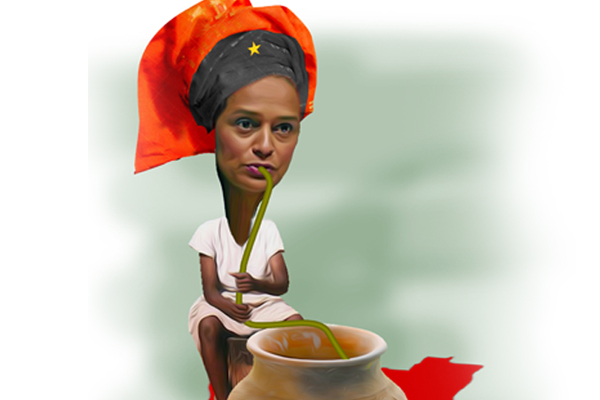
In 2010, President dos Santos’s first-born daughter, Isabel dos Santos, set up a company named Victoria Holdings in Malta. She incorporated it as a joint venture between herself and the Angolan state-owned diamond company Sodiam. The latter is the clearing-house that has the exclusive foreign sales rights on all Angolan diamonds. By 2012, this joint venture was doing so well it bought 75%of the stock of the Swiss jeweller De Grisogno for $100 million. There has been no public disclosure of how much of that was paid by the Angolan state. But experts believe De Grisogono has been a conduit to funnel diamonds out of Angola to fund Isabel dos Santos’s ventures. Announcement of this merger in the world of entertainment and business news was a coup aimed at seducing Hollywood, and serving to glamorise Angolan involvement while masking its corruption.

This year, De Grisogno made international headlines for buying the biggest diamond ever found in Angola, for more than $16 million, as well as the most expensive diamond in the world for $63 million. In a nutshell, Sodiam sold the Angolan diamond to its own venture with Isabel dos Santos. Was this a real sale? Does Sodiam accrue any benefit from such transactions? Although all state-owned companies are obliged to publicly disclose their annual reports, Sodiam and its parent company Endiama, which has the exclusive rights for licensing diamond concessions, have never done so.

In 2010, President dos Santos’s first-born daughter, Isabel dos Santos, set up a company named Victoria Holdings in Malta. She incorporated it as a joint venture between herself and the Angolan state-owned diamond company Sodiam. The latter is the clearing-house that has the exclusive foreign sales rights on all Angolan diamonds. By 2012, this joint venture was doing so well it bought 75% of the stock of the Swiss jeweller De Grisogno for $100 million. Experts believe De Grisogono has been a conduit to funnel diamonds out of Angola to fund Isabel dos Santos’s ventures

Further adding insult to injury, in June, the president appointed his daughter Isabel head of the Angolan oil company Sonangol, giving her full control of a business that accounts for 95% of Angola’s exports.

Other family members also have their snouts in the trough. Three years ago, President Dos Santos appointed his son Filomeno José dos Santos head of Angola’s Sovereign Wealth Fund, which was kick-started with a $5 billion purse and an endowment of 100,000 barrels a day.

WHEN A FAMILY HAS A COUNTRY

As demonstrated by the examples above, within the Angolan regime the corrupt have their grip on everything, including law enforcement,so few can successfully stand up to them. Opposition parties are dependent on government subsidies for their survival. The international community colludes, or turns a blind eye.

Inspired by the 2011 Arab Spring, hundreds of youth have been harassed, tortured and jailed for protesting against corrupt rule. Their drive has become instrumental in challenging the status quo and building a ‘revolutionary’ mindset against a regime that came into power and has clung on to it while trumpeting its own ‘revolutionary’ credentials

It is therefore commendable that a handful of journalists, against all odds, have continued to find creative ways to expose the corruption at the heart of an authoritarian regime. Inspired by the 2011 Arab Spring, hundreds of youth have been harassed, tortured and jailed for protesting against corrupt rule. Their drive has become instrumental in challenging the status quo and building a ‘revolutionary’ mindset against a regime that came into power and has clung on to it while trumpeting its own‘revolutionary’ credentials. These new ‘revolutionaries’ opposed to the old-guard ‘revolutionaries’ have made it an article of faith that President dos Santos must be forced to step down before the bonds of corruption that have kept the country hostage can be broken.

In the past few years, Angolans have taken to social media to vent their discontent against the scourge of corruption. The chorus of voices opposed to the excesses of the regime is growing and they demand accountability.

https://www.dmcc.ae/content-page?404-Carat-Rough-Diamond-Acquired&articleid=a055F00000p7U4qQAE

http://www.forbes.com/sites/robertanaas/2016/09/12/de-grisogono-brings-63-million-813-carat-rough-diamond-to-biennale-des-antiquaires/#7d9f098e8a25

http://www.arabianbusiness.com/one-of-world-s-largest-diamonds-now-in-dubai-631369.html

http://www.forbes.com/sites/trevornace/2016/02/17/largest-diamond-found-angola-flawless-404-carats/#e1879d4681de

http://www.nemesisinternational.com/single-post/2016/08/23/Angola%E2%80%99s-SODIAM-Diamond-Firm-Second-Largest-Exporter

[1] Assembleia Nacional (1996).

Avatar
By

Marques de Morais, Angola’s leading anti-corruption advocate, is winner of the Allard Law School 2015 Prize for International Integrity and the Transparency International Integrity Prize.

Politics

The Sinicization of Christianity: How China Is Responding to Religious Threats

11 min read. China is fending off the influence of religion, particularly Christianity, by “rewriting” the Bible, and adapting it to the goals of the ruling Communist Party – which include becoming the world’s most influential superpower.

Published

on

The Sinicization of Christianity: How China Is Responding to Religious Threats
Download PDFPrint Article

It is around 4.00 pm on an easy, quiet Sunday. At the Kingdom Hall in the upscale suburb of Kilimani, off Elgeyo Marakwet Road, a church service begins with a song. Kingdom Hall is where the Christian denomination of the Jehovah Witness (JW) meets to praise and worship God. In fact, unlike many other Christian denominations, they call their church service a Christian meeting.

After the song, the congregants will pray and then follow the prayer with a 30-minute Bible lecture. The lecture could be on any of the ethical and moral scriptural teachings, as captured in one of the more famous JW’s teaching tracts, Watch Tower. The other is Awake magazine. While, Watch Tower deals with biblical teaching, Awake tends to concentrate on contemporary issues. These two pocket-size, simple and well-written, and available in many of the world’s languages, including African languages, have been the selling point of JW’s proselytising mission wherever they are stationed.

The Bible lecture is followed by a one-hour discussion on the selected theme of the late afternoon. The discursive session closes with a song and then a prayer, just like it had begun. Unlike many of JW’s meeting across the country, this is a special meeting: the Bible, the prayers, songs, the Awake and Watch Tower tracts are all in Mandarin. And that’s because the worshippers are Chinese expatriates and migrants living in Nairobi.

“The Jehovah Witness believe in spreading the gospel of Jesus Christ to all people, in their languages and without discrimination,” says one of the Chinese converts, who didn’t want to be named. Even though they are thousands of kilometres away from mainland China, the Chinese, wherever they are, are wary of the Communist Party of China (CPC)’s surveillance on Chinese citizens abroad. “Especially when they are engaging in activities considered anathema to CPC’s national interests – like participating in religious activities.”

This particular meeting comprises Chinese entrepreneurs and high society Chinese men and women living in Nairobi. The congregation number between 50 and 60 worshippers. They are joined by a smattering of Kenyan JWs who speak and understand Mandarin. “In its mission to spread its creed to all the peoples of this world, Jehovah Witness in Kenya grabbed the chance to evangelise to the discerning Chinese foreigners in the country,” said a Kenyan JW adherent, who speaks fluent Mandarin and attends the church meeting.

The Kenyan, who also sought anonymity, told me that the Jehovah Witness has one of the most robust websites of any religious organisations in the world. “We have Bible teachings, general information, messages and notices, practically in all the major languages of the world.”

The Jehovah Witness is a good place to commune and worship because it offers a convivial experience of oneness, there’s spirit of brotherhood and there isn’t any racial discrimination,” said one of the Chinese Jehovah Witness.

Ge Yuchen, in his article, “Chinese Migrants in Kenya: Why Do They Seek Religion?quotes a Chinese dentist who says, “Jehovah Witness is not only a church that forsakes all kinds of racial prejudices, but also an ideal place for interacting with the local people. It is an excellent place for social communication.”

Yet,it has not always been easy for the Jehovah Witness to reach out to some of these Chinese expatriates. “The Chinese living in Kenya are segmented: there are those that come through government agencies such as the China Global Television Network (CGTN), a public broadcasting station that used to be China Central Television (CCTV), Xinhua, the Chinese news agency, road construction workers, and those who migrant on their own in search of freedom (subjective as it may sound) and business opportunities,” said the Kenyan JW, who speaks Mandarin and lived in China in the early years of this century.

“Chinese working for the government cannot be seen in or go anywhere near a church sanctuary or a religious gathering – Big Brother CPC is ever alert to Chinese flouting its rules and the punishment can be dire once you’re recalled or when back for home holidays,” said the Kenyan.

He said he learned this when visiting a Chinese friend who works for a huge construction firm and who he got interested in an Awake magazine. “We Jehovah Witnesses are called to spread the ‘good news’ to all the people, wherever we meet them, more so, to people who may have not heard about Jesus Christ. That’s why we carry these tracts wherever we go.” But as soon as he was done seeing his friend, the supervisor approached and told him never to discuss religious matters with any of the Chinese workers.

“Chinese working for the government cannot be seen in or go anywhere near a church sanctuary or a religious gathering – Big Brother CPC is ever alert to Chinese flouting its rules and the punishment can be dire once you’re recalled or when back for home holidays”

The Chinese migrants in Kenya not only attend the JW meetings, they also attend other churches, mostly evangelical/Pentecostal churches, while a few are to be found in the mainstream churches such as the Catholic and Protestant churches. However, no Chinese person living in Kenya wants to discuss his or her religious beliefs, especially to a non-Chinese stranger. So, although Wang Wei (not his real name) has lived in Kenya since the turn of the century, and converted to Catholicism, and is today a parish member of a well-known Catholic parish, he pleaded that I should not expose him.

“For some of the tens of thousands of Chinese businessmen and entrepreneurs who are working in Kenya, following religious creeds helps to establish good codes of conduct in their business operations. Those who convert to Christianity are often able to receive positive recognition from the public. The way that they look at their situation and surroundings is also often altered for the better.

“By deliberately guiding us the exploration of life pursuit, the Bible is just like a beacon which gives us light and illuminates the dark roads forward,’ said Mr. F, a middle-aged merchant who trades in shoes in coastal Mombasa,” writes Yuchen. He continues:

“Perhaps most significantly, believing in a religion seems to allow foreign residents in Kenya to integrate into the local community more easily. In particular, believing in Christianity helps Chinese residents understand the local culture and lifestyle. In contrast, according to Mr. D., as a result of a reluctance of learning and understanding the local people’s lifestyles, many Chinese residents have failed to assimilate into the local social environment of Kenya. When I spoke with a few Chinese employees at a company on Nairobi’s Mombasa Road, they described how they seldom have any opportunities to interact with locals.”

Conversion as a means of assimilation

In his article “How Africa is Converting China”, Christopher Rhodes, a Boston University don who has been studying Chinese migrants in Eastern Africa and their affinity to Christianity, observes, “Many Chinese who have gone abroad, especially Africa, have met alien cultures and traditions – leaving them feeling alone and foreign.”

For many of the hundreds of thousands of Chinese who live and work in Africa, life is often not easy. Low pay, long hours and extended assignments in unfamiliar cultures often lead to feelings of isolation and disillusionment, says journalist Eric Olander. “Connections with friends and family back home, largely using WeChat, are often difficult to maintain over extended periods of time, which prompts some to look for comfort closer to home. And in places like East Africa, some of these disaffected workers are finding their way into the evangelical Christian community that is so pervasive in that part of the continent. Seeing the opportunity to grow their parishes, church leaders are readily embracing this new population with services in Mandarin and other Chinese dialects.”

But after they return to China, notes Olander, they become a potential problem for the Chinese Communist Party, which imposes strict regulations on religion and bans any unapproved religious activity.

Therefore, in an interesting twist of fate, these Chinese have found religious solace in the evangelical Christianity of the Pentecostal persuasion that has been spreading so fast in sub-Saharan Africa, like the devastating bush fires wreaking havoc in New South Wales, Australia. Spurred on by an expansionist ambition and appetite to attract new converts to swell their numbers, these churches have stumbled upon a ready fishing ground of a people in search of fellowship and meaning.

For many of the hundreds of thousands of Chinese who live and work in Africa, life is often not easy. Low pay, long hours and extended assignments in unfamiliar cultures often lead to feelings of isolation and disillusionment, says journalist Eric Olander.

For these churches, winning the souls of the Chinese is a big project, especially seen in the wider context of the fact that many of the evangelical churches in Kenya and Africa are proxies of mother churches in the US. Hence, bankrolled by those organisations to carry their global agenda, part of which is to spread the American version of Christianity through evangelical Christianity. Similarly, for the migrant Chinese, attending a church service freely and openly, unhinged and uninhibited, is a liberating experience of religious expression and belief in a supra-natural deity other than the CPC. In mainland China, this is practically impossible.

Christianity in China

“Religious freedom in China has really reached to the worst level that has not been seen since the beginning of the Cultural Revolution by Chairman Mao (Zedong) in the 1960s,” writes Samuel Smith, a journalist with the Christian Post. He points out that the Chinese government is supervising a five-year plan to make Christianity more compatible with socialism. There will be a “rewrite” of the Bible. According to a prominent religious freedom activist, the Rev. Bob Fu, the revision of religious regulations will actively guide religion to “adapt to socialist society.”

Religious control in China today is even more severe than it was even just a few years ago, observes Rhodes. “The CPC has always been anti-religion, but after (Premier) Xi Jinping assumed Party control in 2012, China enacted a level of religious persecution not seen since Mao attempted to eliminate religion and other sources of dissent during the bloody Cultural Revolution.”

The plan proposes “cultivating and implementing the socialist core values.” One way in which they plan to “Sinicize” Christianity, Fu is quoted saying, is by “re-translating” the Old Testament and providing new commentary to the New Testament to make socialist ideals and Chinese culture seem more divine. Fu said that in order to comply with the new religious regulations, the Three Self-Patriotic Movement and the Chinese Christian Council (China’s state-sanctioned Protestant bodies), have developed a five-year plan on “promoting the Sinicization of Christianity.”

“Religious freedom in China has really reached to the worst level that has not been seen since the beginning of the Cultural Revolution by Chairman Mao (Zedong) in the 1960s,” writes Samuel Smith, a journalist with the Christian Post. He points out that the Chinese government is supervising a five-year plan to make Christianity more compatible with socialism.

Thence, posits Rhodes, Catholics in mainland China can legally practise their faith only through the Chinese Catholic Patriotic Association, a government body that regulates them into a tightly managed and Communist-friendly version of Catholicism. “Under President Xi, Chinese officials have literally exploded churches, arrested entire Christian congregations, forcibly removed images of the Dalai Lama from Tibetan Buddhists’ homes, and detained up to one million Muslims from the minority Uighur ethnic group in ‘re-education’ camps.”

This notwithstanding, it has not stopped Msgr Agostino Cui Taim 69, the “controversial” Catholic bishop of Xuanhua, of being seen as a threat and treated as a rebel by CPC. Sanctioned by the Vatican, he is derided by CPC and viewed as an enemy of the state. Since 2007, he has been constantly harassed and placed under surveillance by the CPC. He was recently released temporarily to spend some time with his ageing sister on the eve of China’s Lunar New Year celebrations, which began on January 24. The celebrations were supposed to end on January 30, but they have been extended for another three days because of the sudden explosion of the coronavirus disease, which has hit the populous Wuhan province.

“In a more disturbing move, last year, the Vatican and the CCP concluded years of negotiations with a deal to merge the government-controlled Catholic organization and the underground Catholic Church in China, while allowing Beijing to maintain a substantial role in approving the appointment of new bishops. Many have viewed this deal as a win for the Chinese government, extending its oversight over all Catholics in the country,” wrote Rhodes.

He adds: “From the days of Confucius until now, Chinese governments have been consistently focused on social order, and the Chinese Communist Party is downright obsessed with maintaining stability. Between a quarter and half of the Chinese population now believes in one religious tradition or another, and the CPC fears any large group of organized and ideologically motivated citizens could challenge the Party.”

“Religion is seen as a weakening influence and an existential threat to the very existence of a new emerging Chinese order that is bent on ruling the world in the coming years,” said a Chinese national living Kenya. “China is in constant fight and struggle with the West, which it believes wants to undermine its stranglehold on world power through the influence of Christianity. On this one, China cannot and will not relent.”

He alluded to the six-month Hong Kong city demonstrations by the unrelenting Hong Kongians and the CPC’s backlash. CPC views these demonstrations, not as a demand for more democratic freedom and space, but as one of the West’s strategies of sneaking in religion into Chinese culture, hence weakening its power. Because of the Hong Kong riots, CPC has tightened its already strict controls for Chinese Christians going to Hong Kong for retreats and seminars.

Although it clear the churches are not in control and are not the originators of the unending strikes, CPC believes the churches have surreptitiously been lending support to the strikers. “From criticizing the Chinese Communist Party and supporting underground churches both before and after the handover, to calling upon the population to defy repressive Chinese-proposed laws in the early years of the ‘one country, two systems’ era, the churches of Hong Kong have actively mobilised opposition to Beijing and created an atmosphere of defiance against the CPC,” said Rhodes. “And so, the current round of protests in Hong Kong reflect the larger ongoing battle between the CPC and the church. So far, the protesters have stuck to singing the eponymous chorus of ‘Sing Hallelujah to the Lord.’”

Currently celebrating their Lunar New Year, whose celebrations commenced last weekend (many of the road construction workers in Kenya are back in China for the fete), CPC is also luxuriating in the fact that it is living in the “New Era”, an epoch of the emergence of Chinese global power. In this New Era, China is definitely reclaiming its past glory and influence from centuries of exploitation and humiliation from the West and is viewing religious infiltration as a real threat. The one area CPC will not compromise on is religion. From 1839 to 1949, China faced a “century of humiliation,” an epoch that China does not like remembering and has vowed is a thing of the past, never to recur again.

The world’s new superpower

Before Lee Kuna Yew, the indomitable Singaporean Prime Minister, died in 2015, he noted that “China under Xi Jinping is driven by an indomitable determination to reclaim past glory. The size of China’s displacement of the world balance is such that the world must find a new balance. It’s not possible to pretend that this is just another big player. This is the biggest player in the history of the world.”

Today CPC believes that America is no longer a power to be frightened of; it may have a slight edge in military might for now, but CPC forecasts that by 2049, it will bridge the gap and then accelerate with speed to further widen that gap. It is also aware that it has to deal with the “little problem” of 300 million Chinese people living in poverty. Once it has sorted out those two issues, China will be ready to conquer the world. From then on, China will take its place of pride in global power play by cementing its overall dominance – economically and politically.

This year, China is supposed to achieve an urbanisation level of 60 per cent, and to become an Internet power and a moderately well-off-society. This means that its per capita income will have doubled from the 2010 figures. It also hopes it will have established its global image and refashioned its soft power. Next year, China also hopes to showcase its accomplishments at the 100th anniversary celebrations of the founding of the CPC. CPC views these goals as the “Chinese Dream” or the “great rejuvenation of the Chinese nation”.

Before Lee Kuna Yew, the indomitable Singaporean Prime Minister, died in 2015, he noted that “China under Xi Jinping is driven by an indomitable determination to reclaim past glory…It’s not possible to pretend that this is just another big player. This is the biggest player in the history of the world.”

Two important milestone years – 2021 and 2049 – mark China’s hegemonic project. 2021 marks the first of China’s “two centenary goals” that are pegged to the 100th anniversaries of CPC and the People’s Republic of China. At the centre of these patriotic goals is a civilizational creed that sees China as the centre of the universe. In the Chinese language, the word for China, zhong guo, means “middle kingdom.” In the lead-up to the centennial celebrations of 2049, CPC has the ambition of galvanising the great China as one unstoppable hegemonic behemoth, devoid of any external influences (read the West) and especially religion. CPC sees religion as a Trojan horse that can never be let into the kingdom.

According to Xinhua, China’s major news agency, by 2049, the centenary year of the People’s Republic of China, the ultimate goal is to build a modern democratic, socialist country that is prosperous, strong, culturally advanced and harmonious. The Chinese powers that be are nostalgic about a world where China was the dominant power and where other states looked upon it in supplication as a superior power. These states came to Beijing as vassals bearing tribute, said Lee Kuan Yew.

As CPC fends off the powerful influence of religion, particularly Christianity from the West, Xi Jinping has promised to make China great again. How? By returning China to the predominance it once enjoyed in Asia before the West interfered, and commanding the respect of other great powers in the council of the world.

Continue Reading

Politics

Another Country: The Cultural and Religious Struggle between Northern and Southern Kenya

10 min read. Mutual deep-seated xenophobic sentiments define the relationship between Northern pastoralists and Southern agriculturalists. In this final part of a three-part series, Dalle Abraham argues that it will take more than religious tolerance and developmental interventions to bridge the vast spiritual and psychological schism between North and South.

Published

on

Another Country: The Cultural and Religious Struggle between Northern and Southern Kenya
Download PDFPrint Article

Late in 2018, Ben Kitili, a popular TV news anchor, wed Amina Mude at a private event. The two had a three-year-old daughter. Ben had proposed to Amina in 2015. This wedding ran into some controversy. It was described by local bloggers as “a cross-cultural and cross-religious” event; TV anchor Ben Kitili is Christian and from the Kamba tribe and his wife Amina Mude is a Muslim and belongs to a Somali clan from Wajir.

Kitili and Mude were derided for their decision to marry. A section of the Somali community couched its biased sentiments in pseudo-Somali “purity” and “morality” language; others quoted Surah Al Baqarah and Al Mumtahanah and concluded that the marriage was religiously invalid. Words like kafir, murtad, sharmuuto, malaya, un-Islamic, slave, and ugly were used to describe how Amina had broken with tradition to marry a “kufr” and an “adome”. A kafir and a slave.

Some said that economics was at play and that Amina had married Kitili for money. For a majority of the social media fanatics, the bigger shame was that Amina had lowered herself to such depths. Warnings were issued to other girls that what Amina had done was unforgivable.

I wasn’t surprised. This was congruent with the sort of stereotypes that fit the Kenyan national social ethos. I had seen this play out before in real life and in fictional worlds.

My friend Abdul captures this complex dichotomy in his short story “The Somalification of James Karangi“. In this story, James Karangi, a Kikuyu, wants to marry Ayaan, Khalid’s cousin, but in order to do this he must first become a Somali. We watch his futile attempts through his “Somalification” process.

When we first meet Khalid, Karangi and Ayaan are in a restaurant in downtown Mombasa. Khalid says:

“I told you from the beginning…there’s little hope along the line of religion. You could be the Imam and lead all of the late-night prayers in the month of Ramadan, but the Somali guy who steals shoes from the mosque would still stand a higher chance of taking her hand.”

Karangi protests, saying that those were tribal and un-Islamic sentiments, to which Khalid responds:

“…..But you better understand that what we are dealing with here is way beyond tribalism. They are talking of differences in appearance, hair-types and such nonsense.”

Ben Kitili and Amina Mude’s wedding offered an opportunity for a candid conversation, but the viral nature of the matter eclipsed any constructive discussion. The small windows opening up were shutting down just as quickly.

Why is there such bile when in Marsabit and Moyale Borana, Somali, and Gabra girls marry Bantu men? Yet this had been going on for a long time; I have cousins who are half Kikuyu, half Kamba, half Luo etc.

But it should be remembered that the further one moves from the cities, the harder the lines become; that in the popular pastoral mindset, such marriages are almost revolutionary. When such marriages happen, people make references to nose size, skin colour and hair coarseness as things that show differences between all the long-established binaries: Christians and Muslims; farmers and pastoralists; North and South; superior and inferior. People wonder, “Was she blind to have followed such a man?”

In the cities, liberalism triumphed over cultural stereotypes. But Kitili and Amina came to represent something more – mutual feelings of superiority.

Ben Kitili and Amina Mude’s wedding offered an opportunity for a candid conversation, but the viral nature of the matter eclipsed any constructive discussion. The small windows opening up were shutting down just as quickly.

It’s precisely this sentiment that Nasra, a Kenyan Somali comedian, shared on the Churchill Show – how a “Kenyan” man who happens to date a Somali lady flaunts this as an achievement. “Bro mimi nimekula hata bui bui” was met with thunderous laughter. Similarly. Joseph Kamaru, in his song Gathoni, describes a tall slender girl with the hair of a Borana, an object of some kind of sexual fetish.

Away from the fictional world of Ayaan and Karangi, or the reality of Kitili and Mude, we have seen these confrontations playing out before in many everyday scenes. They are captured in xenophobic names like “Gurale” (Blacks) used by Borana speakers when referring to what they call “Bantus”. Other words used are “Gererr” (coarse hair) and “Adome” (slaves). These are words used by Somalis in everyday lingo to refer to the rest of the Kenyan non-nomadic and non-Islamic ethnicities (collectively referred to as Bantu).

Xenophobia

Beyond meta narratives of negations, the canonical biases, the media frames created by the Kenyan media and newly minted utopian narrative of development and of opportunity that sought to supplant half a century of negative state policies and unequal economics through LAPSSET lies something more: an uneasy and intractable cultural division between the North and the South of the country, which is often unexplored and taken for granted.

Opening up the “closed” Northern Kenya cannot suture the badly grafted relationship between the North and the South, between Cushites and Bantus. While the xenophobic relationship between Northern Kenya and Southern Kenya has been noted at different times, its true form has not been fingered properly.

The new development and policy changes on Northern Kenya will have little relevance if they ignore the cultural question, which is premised on mutual suspicion. If Somalis have their stereotypes, so do the Bantus.

In his essay “The Rise of Somali Capital”, Parselelo Kantai, writing in the Chimurenga Chronicle 0f 2013, says:

“Anti-Somali xenophobia has a long tradition in Kenya. The image of the Waria – derogatory slang for Somali – was permanently captured in the 1970s and 1980s in Vioja Mahakamani, Kenya’s longest-running TV court-room comedy…In Vioja, the image of the Somali is represented by Chief Superintendent Wariahe, a tall, light-skinned policeman whose rectitude is only betrayed by his appalling Kiswahili, the source of enduring mirth.

Outside the Wariahe’s clean-cut image, lies another stereotype: that of the Somali as a dirty, khat-chewing Muslim pastoralist more and more at home in the wastelands of Northern Kenya than in the city. In this particular construction, the Somali in the city is a stranger, an invader.”

We meet a version of this Wariah in Binyavanga Wainaina’s memoir, One Day I Will Write about This Place. This Waria is selling items on Kenyatta Avenue:

“…with strange scripts in Arabic, or wrong bottles in the wrong box, or a slightly off-kilter brand name. Porchi. Poisone. Sold by thin thin men from Somalia. Dominos of nations tumble around Kenya – and Somali men walk about, overstimulated, and thrust their faces into yours, dribbling chewed khat, eyes bleary, jacket open and say … Kssss, Kssss, ….Rolexxx….Xss…xxxsss…..SeyKo.”

On the cultural and artistic front, the image of a Northerner has remained the same: infantile, culturally misplaced. Cartoons in the papers depict this one-dimensional character. The image of Wariah, the phlegm spitting, ill-placed nomad, has since the 1970s gone mainstream, jumping off screen, in newspaper clichés, making cameo appearances in Kenyan novels. The ill-fitting pastoralist arrives in agricultural Kenya through these frames. Any Cushite is “Wariah”. (Wariah literally means “hey you!” in Somali, but in Kenya it has become a derogative term used by non-Somalis to refer to Somalis.)

There is another Wariah tag variant that has captured the social dislocation of the pastoralist in the city – “Maasai”. Maasai has become an urban metaphor for clumsiness; to be referred to as “Maasai” is to be made an invalid. “Wacha Umaasai” translates as “Stop your stupidity”.

The function of this division

Our primary school syllabus says that there are three categories of people in Kenya: Bantus, Nilotes and Cushites. But in our minds, there are only two groups: farmers and herders. One sedentary, the other mobile. One Christian, the other Muslim. Both impatient with each other.

Events of these kind speak of a certain Kenyan way of being. Parsalelo argues:

You also understood that this was a crude form of southern Kenya public therapy. For a people for whom ‘negative ethnicity’, the newspaper euphemism for the prevailing ethnic rancour that had shredded the nation into a farcical edifice of a thousand cuts, ‘othering’ the Somalis restored a sense of collective indignation. Hate and rancour were the only things holding us together.”

In order to understand what this cultural divide has done, we have to look at the past closely. The negative political attitude forged by the Kenyan state against pastoralism found some of its reasons as an offshoot of this cultural division, which is also a function of ecology, geography, religion and lifestyle. The Kenyan state is also modeled on the Westphalia Christian structure. In Kenya, cultural distances between the North and South are found in different structures. The cultural distance is like Sahelian acoustics meeting the rhumba revolution of the sub-Saharan soundscape.

How did this cultural and political orientation confront each other?

What form, if any, did the cultural/political rivalry take?

Has the zenith of this collision been reached?

Is there fear, loathing and intolerance in its construct? Yes. Even an impatience.

Proximity to power and access to resources exacerbates biases. For certain ethnic groups, feelings of nativity and indigeneity take on the form of ethnic entitlement. For others, the Kenya state has its owners. 

Our primary school syllabus says that there are three categories of people in Kenya: Bantus, Nilotes and Cushites. But in our minds, there are only two groups: farmers and herders. One sedentary, the other mobile. One Christian, the other Muslim. Both impatient with each other.

Kenya must learn to acknowledge and confront these biases and actively seek to demolish the constructs that continues to divide us.

Muslims in a Christian state

Ali Mazrui showed how “people’s ideas about God can condition their ideas about government”. Kenya is a Christian state in official matters, in its iconography and in its official moral language.

When I was applying for a passport, I sat in the corner where Northern Kenya denizens gather. A young Somali man with his young family sat with me and shared his frustrations. He said, “There is nothing for us Muslims in this country, heri tutoke.”

It was precisely this kind of social division that Al Shabaab wants to exploit by targeting non-Muslims. The church bombings, the selective murder of Christians in Mandera, in Garissa University etc.

Opening up the “closed” Northern Kenya cannot suture the badly grafted relationship between the North and the South, between Cushites and Bantus.

The introduction of police officers as sentries in Kenyan churches resulted in the targetting of any Cushitic-looking believer in the church. Many kinds of humiliation were meted upon the Borana and Rendile Christians in Kenyan churches. They were barred from entering churches, and forbidden from partaking in the Eucharist. They were escorted out of the church for looking like Al Shabaab.

In Kenya, even the school curriculum follows state policy; in its design, the Kenyan syllabus curtails and suppresses cultural and religious differences. In many Kenyan schools, Muslim students are forced to study Christian religious education. For many Muslims joining secondary schools, this fact becomes apparent when they receive admission letters. This prejudiced intolerance will follow them into many offices.

In the late 1990s, as the years of Daniel arap Moi’s presidency in Kenya were waning, a charismatic Member of Parliament, who had served as Kenya’s Foreign Affairs Minister and was at the time the deputy KANU chair, was poised to be the presidential running mate of Uhuru Kenyatta, who was then a rookie politician being fronted by Moi. Curiously, a delegation of Mt. Kenya politicians went to Moi to voice their dissatisfaction with the possibility of Bonaya Adi Godana from North Horr being fronted as Uhuru’s presidential running mate. Their reason was quite simple: they said as a Muslim, Bonaya Adi was unfit for that position. Unbeknownst to them, Bonaya Adi was a Christian.

Ecology as the mother of cultures

Spiritualism was necessary for pastoralist communities facing many uncertainties. Ecology has been a key player in what form of spiritualism was forged. Kenya is highly divided between its green highlands and its arid and semi-arid regions. These two environments induce different forms of spiritualism. This then becomes another key arena where the North-South cultural split plays out.

The Libyan writer Ibrahim Al-Koni in an interview (“In the Desert We Visit Death), locates this as an old problem. He says:

“The human community was early on split into two major tribes. They were so completely different, as if they came from two different worlds. This evolved through time and resulted in the nomadic tribe and the settled tribe. The nomadic tribe’s capital was freedom. They had no ties to a certain area. So they turned to contemplation which gives birth to freedom. The settled people’s capital was ownership – and all the disasters that ownership entails.”

Ibrahim Al-Koni goes on to say that the “spirit among settled people is dead”. He cites St. Augustine who “called the nomadic tribe the divine tribe because it was a spiritual tribe”. He says this problem has existed since creation. “All the wars that took place in the ancient times took place because of this split.” And that a bitter feud between the spirit (nomadic people) and body (settled people) has been ongoing.

Thus a long history of intervention in changing nomads has been spearheaded by NGOs and the Kenyan state. It is a system that tries to “rehabilitate” the Northern landscape and livelihoods through irrigation agriculture schemes, resettlement, and restocking.

And because of this, for Northerners, allegiance to Kenya (spiritually) was fraught with ambiguities. And as a result, they developed an indomitable nomadic spirit that no level of political, social and economic oppression can break.

Superiority complexes 

My friend, a Somali lady, who is liberal, foreign-educated, worldly, progressive and very articulate, someone whose accent can easily be described as “bourgie”, feels very strongly about this matter and has voiced her resentment towards what she considers “Bantu self-disrespect”. She had returned to the UK for a Master’s degree and I somehow expected a change in perspective. I ask her whether she still considered the Bantus to harbour the same feelings. I approached the issue tentatively. I asked, “What do you make of the Southern Kenya people …?” She saw through my caution.

“Who? You mean the Gurales?” and then she laughs

“Yes…..and how Gurale, Adome are racist’s sentiments.”

“It’s their fault, they allow it …when I argue with my friends I often get we wacha kunidharua…It’s like they expect it…”

She broadens the perspective further.

“I often go out with Kikuyu or other Bantu men but the kinds of comments their friends give…ohhhh…manze umewahi!! Umeangukia jo! Eh? Umemtoa wapi msomali…and it makes me feel terrible as if my presence with them was an unattainable goal.”

Sasa nani amejidharau hapo?”

“When Somali guys see me with Kikuyu men, they look at me with eyes that say I am bringing myself down low.”

“But madharau iko!” I say

“Yes…but it’s the way they see themselves…not how we treat them.”

Simple perceptions, media-engendered images, and minor incidents speak of these cultural divides and impressions: ideas about racial purity, of a superior religion coalescing around one’s ethnicity have easily been intensified, repurposed and allowed to be toxic. This leads to stereotypes of hungry women who almost died when giving birth, who are frigid even, because they were cut up badly while undergoing FGM.

Alienating development projects

To expect mega-infrastructure to suture this division would be to heap a psychological responsibility on physical projects. Zoe Cormack, in her paper “The Promotion of Pastoralist Heritage and Alternative ‘Visions’ for the Future of Northern Kenya “explores how pastoralist heritage and culture is being revalorized in the context of large infrastructural development plans in Northern Kenya”. She mentions the prevailing and perverse anxiety that characterises local perceptions of the new infrastructure projects where “fears have been raised of coming exploitation and that the north will be culturally and politically assimilated into the privatised, sedentary and neo-liberal model of the central state.”

To expect mega-infrastructure to suture this division would be to heap a psychological responsibility on physical projects.

This privatised, sedentary neo-liberal model is visible in the towns of the North. Policies on conservation, rehabilitation of rangelands, and administrative boundaries have led to decreased mobility, which has impacted the pastoralist lifestyle.

How do we confront this bitter reality?

In Yvonne Adhiambo Owuor’s novel Dust, when Odidi and Ajany join school, they take up hobbies: music for Odidi and painting for Ajany.

“Music and painting bandaged soul-holes.

They forgot teachers who asked ‘ati, from where? Is it on the map?’ Drowned out classmates: ‘You people cook dust to eat.’”

Many students from the North face similar scornful comments that follow them silently throughout their lives.

The capital accumulated by Somalis offered better socio-political and economic mobility and increased prospects of fusion and synthesis.

Parsalelo argues that “that ethnic capital mobilised at both an individual and communal level (the notional claims to ethnic-blindness notwithstanding) is still the most effective route to securing economic and political legitimacy.”

The current media presence of a certain class of Somali journalists from Northern Kenya is encouraging. Political representation is also increasing. Uhuru Kenyatta’s regime has been particularly receptive to and accommodative of Northern Kenya politicians.

However, the participation of a few elites in the ivory towers of Kenya’s uneasy and often unholy construct should not be confused with full integration. Other internal ethnic and cultural politics need to be addressed; once Kenyans learn to place a high value on unity and ethnic diversity, then cross-regional cultural harmony can be forged.

Continue Reading

Politics

Wajinga Nation: The Rising Popularity of Protest Music in Kenya

11 min read. King Kaka’s controversial new song on the state of the Kenyan nation reflects the thoughts of an increasingly disillusioned youthful population that is cynically being manipulated and marginalised by both church and state.

Published

on

Wajinga Nation: The Rising Popularity of Protest Music in Kenya
Download PDFPrint Article

In December 2019, Kennedy Ombima, better known by his stage name King Kaka, released a new song called Wajinga Nyinyi (You Fools) that caused ripples nationwide. This incredibly popular song not only sought to speak truth to power, but also highlighted the state of the nation – how it has been captured by endemic corruption, inept governance and noxious ethnic politics. Wajinga Nyinyi was not only bravely rendered, it trended for days, took the country by storm, and excited a deeply frustrated citizenry.

Since its release, it has spawned similar protest songs, with other artists releasing renditions of the song. Although other artists, such as Eric Wainana of Nchi ya kitu kidogo fame (A country of petty corruption), Charles Njagua aka Jaguar of Kigeugeu (hypocrisy), (the artist is today the Jubilee Party MP for Kamukunji constituency in Nairobi County), Gidi Gidi of the Unbwogable (Unbeatable) beat, among others, released popular “protest” songs a while ago, there was something different about Wajinga Nyinyi that caught the attention of Kenyans, especially the youth.

The song highlighted the Jubilee government’s multiple failures, empty promises and its “mortgaging” the country to China through reckless borrowing. Why did this song cause so much hue and cry, yet King Kaka did not speak about anything that we did not know already? What made this song so attention-grabbing and catchy?

First, the song captured a raft of issues that have sadly become a defining feature of the our politics: theft, tribal politics, incompetent leadership, bad religion, bad church, rogue clergy, indecent public behaviour, lack of role models, lack of integrity, youth unemployment, drug and substance abuse, a compromised and ineffective judiciary, poor treatment of teachers and hospital staff, among other ills.

The song highlighted the Jubilee government’s multiple failures, empty promises and its “mortgaging” the country to China through reckless borrowing.

Secondly, and more importantly, the song did not just rap away these issues, but it sought to directly engage Kenyans by calling them out for their apparent foolishness and squarely putting the blame on them. The song blamed Kenyans for perpetually voting in bad leaders based on tribal bigotry and money.

Third, the song urged Kenyans to elect competent leaders so that they can hold them to account through exercising their power of the ballot.

Fourthly, because the song was delivered in the language of the youth and by appropriating simple but popular narratives, it struck a chord and affected the conscience of Kenyan youth, the most disenfranchised and restless constituency.

“I think the song stirred not just our minds, but also our conscience and made us look really foolish,” said Willis Odhiambo, a Nakuru County youth. “The leaders we elect through the politics of manipulation and ‘mtu wetu’ syndrome (the politics of our man) display a condescending attitude towards us the electorate as soon as they have been sworn in. They will then go on a looting spree so I think the song was a call out to all our elected leaders that it is no longer business as usual.”

Odhiambo also said that the song was a wake-up call to the powers that be that “vitu kwa ground ni different” (on the ground, things are different). “The song is a passionate appeal to my generation to vote properly if we are to effect the desired change we so badly need.”

Another youth, Grace Naliaka, said the song called for a non-violent youth revolution, “one that calls us to take our civic duties, to soul search on our future that has been stolen by the old geezers. This song pierced both our personal and collective conscience and for the first time, I thought very seriously about my civic duties. So for me, the song was about us the youth to see beyond tribe and elect leaders of integrity. We must refuse to whine and rap away our frustrations, but take control of our destiny by changing how we vote and who we vote for.”

Naliaka observed that the independence generation had messed up the future of the millennials. “By belting out the lyrics, King Kaka had read the riot act to the inept corrupt-ridden Jubilee government.”

I think the song was not just about speaking truth to power; it also called for deep introspection. Given that the Kenyan electoral psychology and sociology is a study in ethnic mobilisation, the lyrics pricked Kenyans where it mattered most.

In the book It’s Our Time to Eat by Michela Wrong, Kenyan politics is characterised as the politics of tribe and belly politics through primitive accumulation of wealth, and by the looting of public coffers. As such, during every election cycle, the electorate goes out to elect leaders based on a tribal matrix.

The status of Kenyan youth, like many youth on the African continent, raises huge concerns for those who care about this large and significant constituency that happens to wield tremendous voting power. Africa is a young continent with a teeming youthful – but deeply frustrated and unemployed – population. Nearly 80 per cent of Kenya’s more than 40 million people are under the age of 35. Yet, a significant majority of the youth in Kenya operate in a hostile environment, where the dominant issues they grapple with include, but are not limited to, unemployment, poverty, unequal opportunities (economic and/or otherwise), ethnic bigotry, marginalisation, HIV/AIDS, drugs and substance abuse, mental health issues, crime and violence.

Coupled with the crippling unemployment is the fact that the average young person in Kenya is a victim of a gerontocratic economy and polity, where the tendency by the government is to give most public jobs to retirees and political cronies. King Kaka derides both President Uhuru Kenyatta and Parliament about this apparent gerontocracy when he says “youth ni Moody at 90 and Gikonyo at 80”.

Moody Awori, a veteran politician born in 1927 who served as Kenya’s ninth Vice President from 2003 to 2009, was recently appointed at the age of 91 to serve on the board of the Sports, Arts and Social Development Fund. He and others like Karuthi Gikonyo and many others who are in their sunset years keep being re-appointed to plump public jobs. The appointment of former Othaya MP Mary Wambui, 69, to chair the National Employment Authority, for example, angered many Kenyan youth, even though a court annulled her appointment on the grounds that she was not qualified for the job.

Decisions on pubic matters that affect youth are therefore made by people who are out of touch with the realities of young people in the 21st century. At best, the political elite pay lip service to the youth question, but more often than not, they tend to treat the youth as outsiders in the decision making process, as a group on permanent hold, waiting to be leaders of tomorrow – a tomorrow that has turned out to be a mirage. And if that tomorrow comes, it only does for the old and the frail, and the already very wealthy.

Coupled with the crippling unemployment is the fact that the average young person in Kenya is a victim of a gerontocratic economy and polity, where the tendency by the government is to give most public jobs to retirees and political cronies.

In the political arena, the youth are, at worst, treated as objects to be manipulated and used or, at best, as junior partners. Often, decisions affecting them are made in their absence; their job is only to comply. The youth’s inability to access power at the centre has led to their exclusion and marginalisation. Because of this exclusion, there is a general sense of hopelessness, restlessness and uneasiness, leading to increased vulnerability.

The Jubilee Party government rode to power in 2013 with a promise to create millions of jobs for the youth. Seven years later, the poor youth have realised they have been played, that their role is to be coerced and manipulated by political henchmen.

The youth are not only perceived as malleable and vulnerable to ethnic machinations, but sadly, also to religious manipulation. It is a public secret that some Kenyan youth have been lured to join religion-inspired terror groups such as Al Shabaab. Their recruitment into these terror groups is often the result of unaddressed historical injustices and grievances, as well as the marginalisation of the youth and victimisation by the security agencies. In a situation where the youth feel neglected and unwanted, religious radicalisation becomes the norm and finds its niche among a terrorised lot that has been denied opportunities.

Politicians eating the youth’s future

According to Godwin Murunga, a, Kenyan historian working for CODESRIA in Dakar, Senegal, the framing of the youth as a risky category is “problematic” because there is compelling evidence of the potential of youth to innovate outside of the state. Murunga says that Kenyan youth operate in an environment full of disparities, where progress and regression alternate in unpredictable ways. He says while there are certain segments of Kenyan society that benefit from the limited economic prosperity enjoyed in Kenya and East Africa, especially in the last one or so decades, these benefits are unevenly distributed.

Even as the Kenyan state has excluded the youth from governance and decision-making platforms, the political elites have continued to treat the youth and the general populace with arrogance and disdain. This is not surprising at all, given that the history of Kenya is one of pork-barrel politics, where the youth are suspended in time – they are told that they are the leaders of tomorrow, not of today. Hence money and resources meant for youth is squandered or redirected elsewhere.

These elites thrive on intimidation and threats to scare away anyone pointing a finger at them. The threat by Governor Anne Mumbi Waiguru to sue King Kaka is the latest example. (In his song, King Kaka wondered why Waiguru was still in office, given that she had presided over the loss of millions of shillings meant for the National Youth Service (NYS) when she was the Devolution Cabinet Secretary.

Tracy Namunyak from Kajiado County points out that state officials thrive in discrediting harassing, intimidating, silencing and issuing threats to their critics. Namunyak says Kenyans could be angry with Waiguru because “she ate our future”.

Rogue clerics who steal from the mouths of babes

Not only are youth manipulated by the political class, they are also manipulated by religious leaders. King Kaka criticises the Kenyan church and its clergy who wield tremendous power in this country and who seek to influence not just government policy, but also the citizenry through subtle coercion and threats of fire and brimstone in hell. The clergy, just like the political elite, is deeply condescending towards the Kenyan public and the youth.

Apostle James Maina Ng’ang’a of Neno Evangelism, who is the epitome of a (Pentecostal) cleric gone rogue, is mentioned in Kaka’s lyrics. His arrogance, sense of entitlement, abusive language, and condescending attitude towards women and youth mirror how politicians treat Kenyans. The artist criticises the clergy and its apparent love of money and equates its greed to that of the political class.

Ng’ang’a is brash, rude and reckless. Just like the Kenyan politician, he treats his huge followers with callousness and disdain. Just like the politicians, religious leaders treat Kenyans with madharau (contempt). Ng’anga once asked a church member why she wore cheap sneakers and scolded another for her inability to raise Sh6,000 for her children’s school fees. In one of his latest outbursts, he equated King Kaka to a tout.

A rogue pastor who mirrors Ng’ang’a is Gilbert Deya, who claims to have 36,000 followers in the UK. Deya established the Gilbert Deya Ministries International in 1997. His organisation claims that Deya is able to help infertile, post-menopausal women to conceive through the power of the Holy Spirit and special prayers. These outrageous claims turned out to be a child-trafficking racket.

In 2006, Deya was arrested in Edinburgh, Scotland (where he had moved to in a bid to hide from Interpol) on charges of kidnapping and trafficking of children. He protested his innocence, claiming that the miracles that God performed through him were beyond human understanding and that no man can explain them except God. When he was extradited to Kenya, he was detained for nine months at Kamiti Maximum Prison and then released in May 2018 on a Sh10 million bond.

King Kaka criticises the Kenyan church and its clergy who wield tremendous power in this country and who seek to influence not just government policy, but also the citizenry through subtle coercion and threats of fire and brimstone in hell.

Self-proclaimed Prophet David Edward Owuor, who tells his followers that he is two in one (Elijah and Moses), could rightly be described as Kenya’s spiritual president. Prophet Owuor is a man who loves pomp and power. He is authoritative and has cultivated a personality cult and mystique about him.

More importantly, he is condescending to other Kenyans, be they clergy or otherwise. He is a master of spiritual and emotional manipulation; he often threatens his followers with eternal damnation, death, earthquakes and floods. Prophet Owuor demands absolute adoration from his followers and has created a religious-political personality cult around himself. Any contrary opinion or critic of the mightiest of the mightiest attracts curses, death threats, road accidents and severe illnesses like cancer.

The clergy no longer speaks the language of social justice, of the poor and vulnerable. Religious leaders, just like politicians, treat the youth the same way politicians do. It would seem use-and-dump is their stated policy.

Patriarchy and bedroom politics  

In a conservative country like Kenya, political and religious power is the preserve of men. Threats of violence – political, physical and verbal – are not uncommon in the Kenyan public sphere.

For Ng’ang’a, politics is his bedroom, where he has power over the youth and their mothers. He appropriates the patriarchal language of the Bible, colonialism and toxic masculinity. Women’s bodies are sexualised and sex is used to sanctify men’s control over women’s bodies.

By stating to King Kaka that “your mother is my girlfriend”, Ng’ang’a sees women’s place as not just being in the kitchen, but also in his bedroom. If they are not in the kitchen or in the bedroom, then they are in his church, being exorcised of demons and spirit-husbands, who presumably rape women in Ng’ang’a’s fantasies. Even in the underworld, male demons inhibit women bodies, raping them at will, while Ng’ang’a rapes them of their dignity through his toxic theologies of demonic deliverance.

The female body is a site of abuse where toxic theologies are constructed. Women’s bodies are sites of violence, patriarchal control and surveillance. Women’s body parts have also been used by Kenyan politicians and men to insult and abuse others. Nearly a decade since the promulgation of the new Kenyan constitution of 2010, MPs are yet to pass the two-thirds gender rule.

By stating to King Kaka that “your mother is my girlfriend”, Ng’ang’a sees women’s place as not just being in the kitchen, but also in his bedroom. If they are not in the kitchen or in the bedroom, then they are in his church, being exorcised of demons and spirit-husbands, who presumably rape women in Ng’ang’a’s fantasies.

In today’s Kenya, religion has become indistinguishable from politics. In the last two general elections, we have witnessed tremendous cooption of the Kenyan clergy by the political class. The class fundraises colossal amounts of money for churches to win legitimation and respectability, while compromising the very clergy by stifling their voice.

Deputy President William Ruto, who has variously proclaimed himself to be a born again Christian, has caused quite a stir through his frequent church fund-raising activities, where he has donated humungous amounts of money to different churches. In many such events and during electioneering periods, politicians scramble for prayers and votes, mostly in churches. Images of President Uhuru Kenyatta and his deputy being prayed for and anointed with special oil in churches have become the norm in Kenyan political, religious and social scenes.

The rise of protest music among youth

While the youth are being marginalised in the political arena and in church circles, they have turned to reclaiming the creative and performing arts to protest their exclusion. Through the power of hip-hop lyrics, contemporary songs and poetic music, the youth are seeking not just to contest their marginalisation, but to also challenge, educate, mobilise and organise – to hold the political class and government functionaries, as well as religious leaders, to account through popular entertainment and dramatised narratives.

Protest music has long been recognised as an art form used by the youth to not only fight for their rights and existence, but also to reclaim their voices and to directly appeal to the people’s conscience. Robert Kyalunganyi, aka Bobi Wine, the MP for Kyaddondo East constituency in Kampala, Uganda, has used his talents as a musician to propel himself right into the centre of Ugandan politics. Today, the long-serving President Yoweri Museveni has to contend with Bobi’s soaring popularity in politics and across social circles in Uganda. He has proved to be an irritating itch to Museveni.

While the youth are being marginalised in the political arena and in church circles, they have turned to reclaiming the creative and performing arts to protest their exclusion…and to also challenge, educate, mobilise and organise…

Bobi Wine has done this by giving the youth a practical medium and a new space to express disaffection with the current status quo in Uganda’s political establishment. He offers a critique of power using a language that is accessible, simple and appealing to the youth constituency.

Popular music has the ability to not just prick the powers that be, but also to awaken the consciousness of the citizenry. The youth are carving out spaces for civic engagement outside of the state and church. They have been using social media as spaces for political and social mobilisation.

As the church and government aficionados’ minds remain colonial and static, the youth are moving ahead to recreate and reclaim spaces for themselves. The church, stuck in its colonial framework, is no longer out to save souls and fight for the vulnerable. It doesn’t speak the language of the downtrodden. Today it speaks the language of the oppressor and brutal governments. It is part and parcel of the predatory political class.

Continue Reading

Trending