|
Getting your Trinity Audio player ready...
|
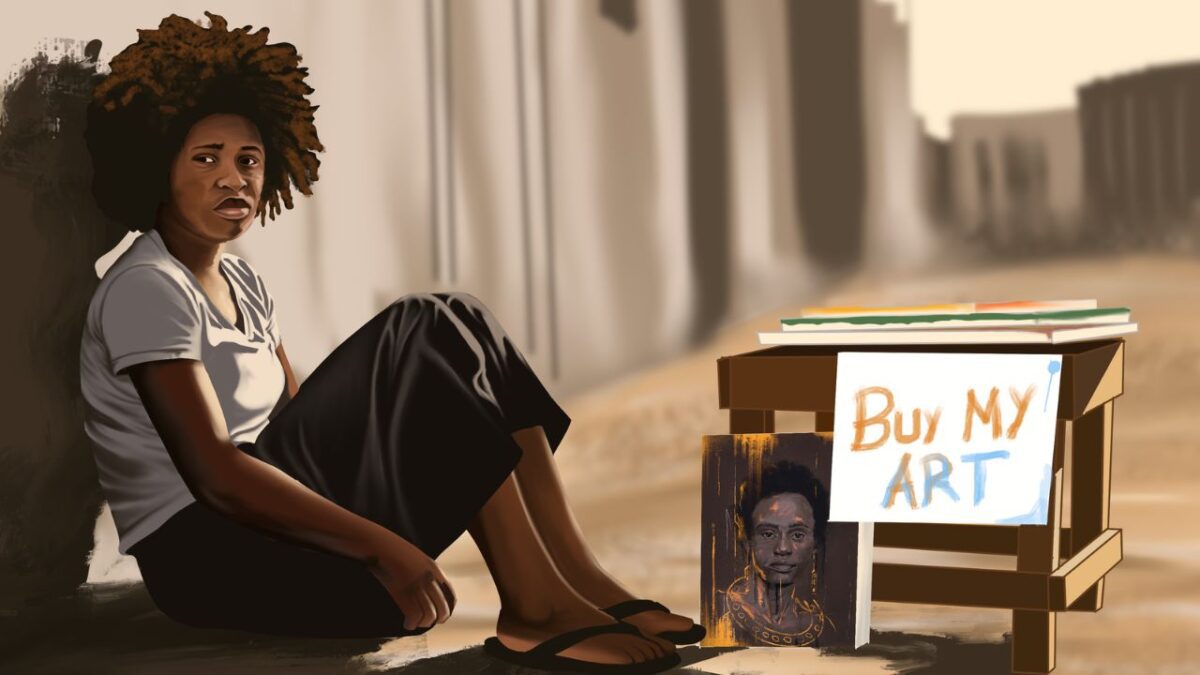
Artistic freedom and expression has long been shaped and constrained by many factors, including power, economic hierarchies, and class. In Africa, the right to create and distribute art without censorship has always been a contested terrain. Artists’ realities in the African region are directly influenced by both their geographical and societal positions; class plays a big role in how the art world runs. What does society consider as art? Who gets to buy, collect, or even witness art? Who has access to exhibition spaces or international residencies? These questions are not abstract; they define the careers of many artists, including my own.
Since 2011, we have seen youth-led movements harness creativity as a tool for political resistance, from the Arab Spring uprisings to #FeesMustFall in South Africa, #EndSARS in Nigeria, and, most recently, Kenya’s Gen Z protests. In Sudan, where I was born and raised, the December Revolution was marked not only by chants in the streets but also by murals, poems, songs, and performances that transformed the cityscape into a living archive of resistance. Yet, even within such moments of collective creativity, class distinctions determined who could participate, whose voices were amplified, and whose remained unheard.
In this article, I reflect on how class shapes artistic and cultural production in Africa: how it has defined access to creativity, how it limits cultural consumption, and what mechanisms – grassroots, digital, and transnational – have begun to narrow these divides. My reflections are grounded in personal experience as an artist and curator working between Khartoum and Cairo, as the founder of The Muse multi-studios and the Sudan Art Archive, and as a participant in regional and international networks of cultural production.
Social hierarchy and access to creativity
In Khartoum, where I first studied architecture before turning to painting and curation, access to art education was already limited to two art schools at the Sudan University for Science and Technology and the newly founded Art programme at the Al-Nileen University. Access to these institutions was competitive, and while not restricted in principle, in practice it was shaped by social status and community expectations. Families in Sudan often encouraged more “practical” fields like engineering, medicine, or architecture – disciplines seen as more secure.
Many young Sudanese who aspired to become artists may have had their educational background shaped by these community views, yet it has not stopped them from pursuing a career in the field upon completing their studies. Those who came from upper-class families had a better chance of accessing educational institutions abroad, while the majority were funnelled into informal workshops or self-taught practices because institutions were either non-existent or insufficiently resourced.
German curator and researcher Larissa-Diana Fuhrmann observes that the development of art education in Sudan has been deeply influenced by colonial legacies. Institutions such as the College of Fine and Applied Arts in Khartoum (originally established under British colonial rule) implemented curricula modelled on Western art academies. These frameworks introduced formalist, Eurocentric paradigms that continue to shape artistic discourse, pedagogy, and aesthetic hierarchies in the postcolonial context.
Access to these institutions, and to international art education more broadly, has historically been mediated by class intersecting with gender and racial categories. During both the late colonial and early post-independence periods, educational and cultural policies enabled a small elite (predominantly from Khartoum’s middle- and upper-class families) to study abroad. Upon their return, these artists occupied influential positions in Sudan’s cultural institutions and helped define national artistic narratives. As Fuhrmann notes, the stratification becomes evident when examining how some of these artists categorize work produced outside formal institutions or urban centres as “folkloric”, thereby reinforcing classed and spatial distinctions in cultural valuation.
This dynamic illustrates the broader relationship between class, cultural capital, and aesthetic authority. Artists with international training and transnational visibility have historically been more likely to receive institutional recognition and access to resources such as galleries, collectors, and critical discourse. By contrast, locally trained artists without such networks often remain marginalized. As Fuhrmann suggests, this pattern is not unique to Sudan but reflects global inequalities in the circulation and validation of artistic production.
The relationship between social class and education is critical here. Education may open doors, but class determines whether those doors can truly be walked through. In Khartoum, access to art schools was less of an issue than what came after: exhibition spaces, residencies, opportunities to travel, and access to international networks. These post-education opportunities were overwhelmingly skewed toward those with means – financial, linguistic, or social. Khartoum’s art scene has been dominated by foreign institutions and their cultural centres, the activities of embassies and supported programmes that have shaped narratives around certain artists and their work. A young artist with fluent English, for instance, could navigate these circles and be able to manage applications for grants or residencies abroad, while others were excluded by language barriers before their talent was even considered.
Class and collecting art
If class determines who creates art, it also shapes who consumes it. In Khartoum, the culture of collecting is limited, and where it exists, it is often restricted to a narrow elite or international buyers; exhibitions are often attended by the same small circle of artists, academics, and diplomats. Public engagement with art was limited, not because of lack of interest but because of structural barriers: galleries were concentrated in certain neighbourhoods, often inaccessible to working-class communities.
In Cairo, a more developed art market exists, but even there, collecting tends to be restricted to a certain kind of social status and even to certain artists in some cases – those already exhibiting internationally, or those whose work aligns with global trends and higher-ranked individuals or institutions. This means that while art education might be accessible, sustaining a career as an artist is still determined by class, by whether one can find patrons, collectors, or institutions willing to invest.
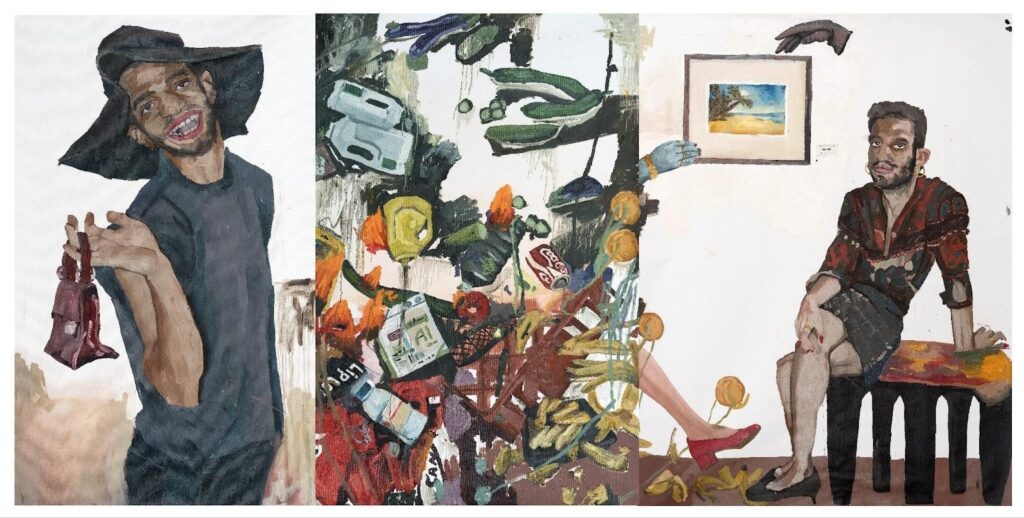
In his work “Funny Effects 1”, young Egyptian artist Omar Gabr addresses this class-controlled environment of art collecting in Cairo. Having entered the art scene at just 19, he uses sarcasm to depict the unease of navigating collectors and audiences from upper-class circles, subtly exposing the divide between young creators and elite consumers.
Despite these elite-driven strictures, informal cultural practices continue to thrive across African cities, offering alternative spaces for creativity that resist class-based gatekeeping. During Sudan’s revolution, walls became canvases, songs were shared freely, and poetry circulated on the streets. These practices challenged the monopoly of elite cultural production, demonstrating how art can thrive in public spaces even without institutional support. Yet they were also vulnerable to erasure: murals were painted over by authorities, performers were harassed, and documentation was often absent. This precarity underscores how fragile artistic freedom remains when it relies solely on informal networks.
Young Kenyan independent curator Thaddeus Wamukoya (Tewa) reflects a shared experience of how status, money, power, and political positions affect the art market. When Tewa is asked why he usually hosts his exhibitions at The Village Market, one of Nairobi’s high-end malls, he says it gives him easier access to potential clients and collectors, adding that, unfortunate as it is, we have to acknowledge that status and class determine how art is circulated. Referrals and word of mouth are also of high value in Kenya’s market: “The culture of having someone refer you can guarantee easy work. People often consume average things – and art – because they saw someone else do it,” says Tewa.
It is important to note that class rarely operates in isolation; it intersects with gender and race in ways that reshape cultural hierarchies. The latter further complicates Kenya’s scene: a market dominated by white gallery owners privileges buyers and tourists, who often access information about artists and their artworks more easily than local Black Kenyans. The “white cube” model is a foreign concept to Africa, introduced by the West and structured to gatekeep, introducing classism to the market, leaving local models of studios, collectives, and initiatives to struggle in a system that does not serve them. Across the continent, similar dynamics play out with local variations.
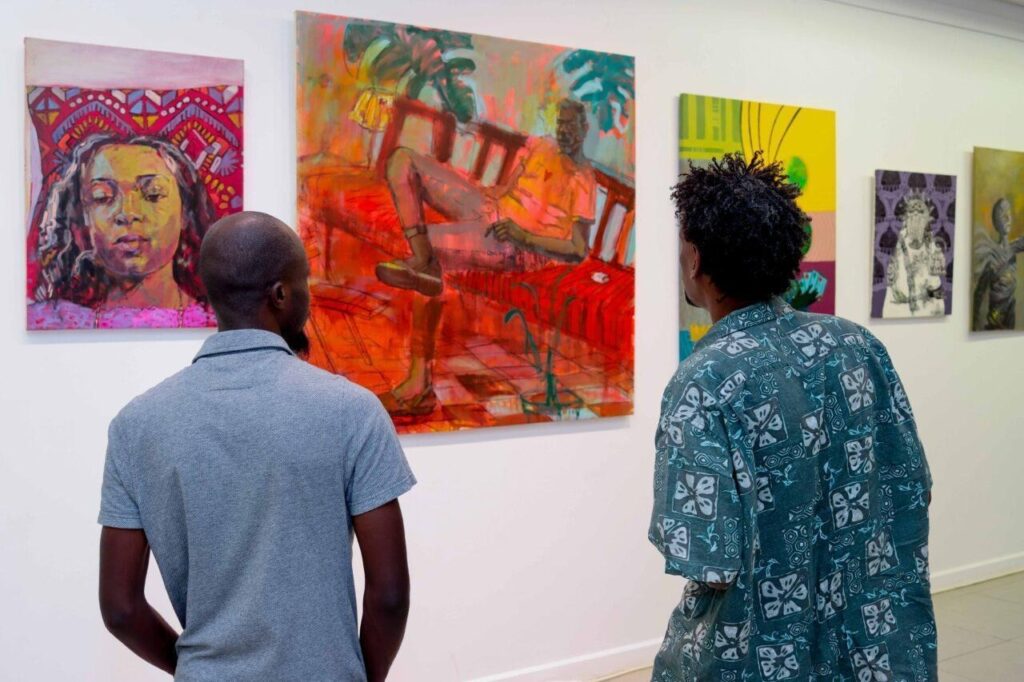
In many African countries, Western women with backgrounds in the aid industry channel their capital into the art market. Their influence extends beyond gallery ownership to social networks, including exclusive networks and events. Here, class and race become the driving forces of access and authority, even in a space where gender, in another context, might have limited such visibility. This stands in contrast with Sudan, where, historically, male artists from Khartoum’s upper and middle classes have held privileged access to recognition and resources, while voices from marginalized regions, such as the Nuba Mountains or Darfur, have been systematically excluded. The picture is therefore uneven: in one context, class intersects with race to privilege white women, while in another, class intersects with gender to privilege men. Both reveal how deeply entrenched systems of power shape who becomes visible in the art world.
New models, new ages
Despite these challenges, mechanisms have emerged to counter the impact of class on cultural production. Tewa’s model of operating has been heavily reliant on the Internet and Instagram as a platform that has been transformative. Social media allows artists to bypass traditional gatekeepers, share work directly with audiences, and build transnational communities. It has enabled artists who lack institutional support or access to collectors to create visibility, mobilize solidarity, and even sell works directly. In contexts where state repression or elite capture of the art market is strong, these digital tools have opened spaces for alternative forms of recognition.
At the same time, the digital sphere reproduces its own hierarchies. Algorithms reward certain aesthetics that align with global trends, while artists without access to high-quality documentation or steady internet remain at a disadvantage. Visibility can be purchased through sponsored posts, and those with greater resources – better studios, professional photography, fluent English captions – still hold an edge. The very same platforms that dismantle some barriers end up constructing new ones.
Alongside social media, we see the rise of collectives, pop-up exhibitions, and community-driven archives that challenge the dominance of the white cube. In Sudan and Egypt, grassroots initiatives have reimagined cultural infrastructure through shared studios, neighbourhood art projects, and self-organized residencies. These models rely on networks of trust and reciprocity rather than on class-based patronage. They also produce new forms of value: visibility in the public space, belonging in community, and solidarity across borders. What these examples suggest is not the disappearance of class, but a reconfiguration of how it operates. Digital and grassroots models do not erase inequality, but they redistribute visibility, shifting the power of who speaks and who is heard. They carve out spaces where young, marginalized, or self-taught artists can assert their presence without waiting for institutional approval.
Class remains one of the most enduring obstacles to artistic freedom in Africa. It shapes who becomes an artist, who sustains a career, and who consumes culture. It also influences whose stories enter the record and whose remain untold. Yet class is not an insurmountable barrier; it is a terrain of struggle, negotiation, and reimagination. The future of creativity in Africa depends on inclusivity, on breaking down class divides to empower diverse voices. When artists from all backgrounds can create, share, and sustain their work – whether through digital platforms, collectives, or reimagined public spaces – cultural production becomes not just an elite pursuit but a collective force for transformation. Only then will artistic freedom truly embody its promise as a cornerstone of democracy and human rights.