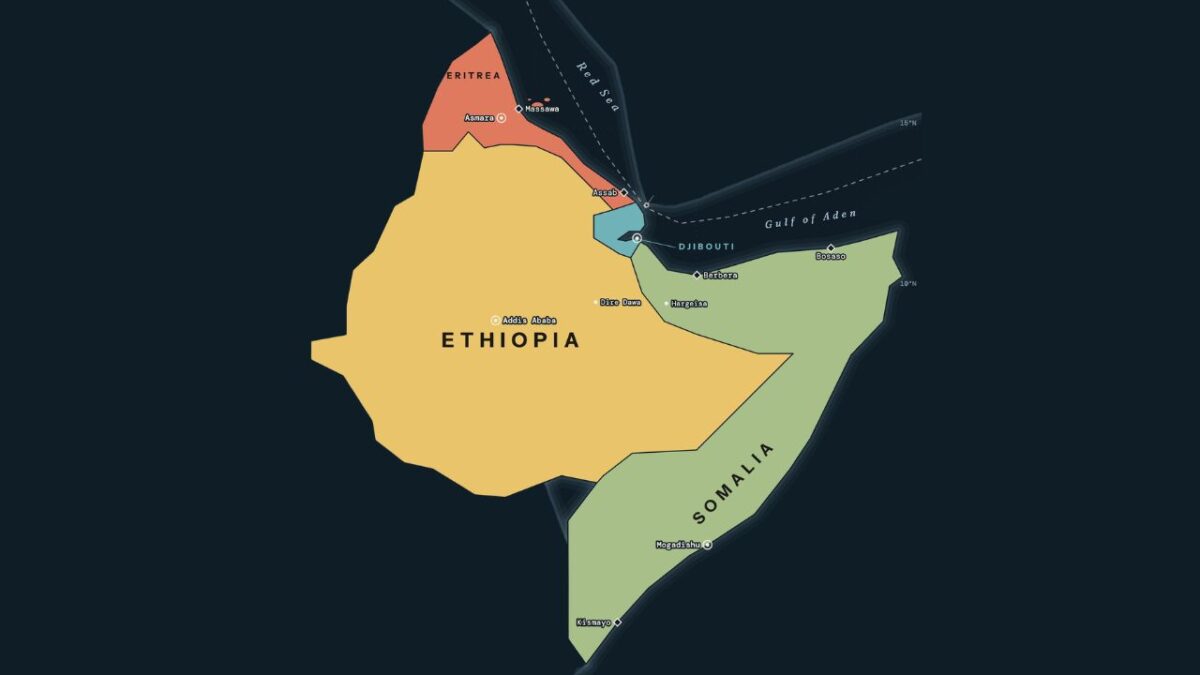
History in the Horn of Africa is rarely allowed to remain history. An ancient civilization becomes evidence of modern sovereignty. A medieval dynasty becomes proof of national continuity. Territory incorporated during one political era is later remembered as though it had always belonged to the state that governed it.
This habit has become especially visible as the Red Sea has returned to Ethiopian political discourse. Ethiopia is landlocked and has obvious economic reasons to seek dependable maritime trade. But there is a fundamental difference between negotiating the use of a port and claiming that a neighboring country possesses territory that properly belongs to Ethiopia. That distinction disappears when Assab is described as a “lost Ethiopian port.”
Ethiopia did not lose a sovereign port in 1993. Eritrea recovered sovereignty over territory that had been incorporated into Ethiopia after the violation and eventual termination of an internationally established federal arrangement. To describe this as Ethiopia “losing the sea” begins the story at the moment of Ethiopian possession and ignores how that possession came about.
This is what I mean by imperial nostalgia.
Imperial nostalgia is not merely admiration for emperors or attachment to an earlier age. It is a way of remembering political space. Territory once incorporated into an empire is remembered not simply as territory once governed, but as territory that naturally belonged there. Incorporation becomes ownership, ownership becomes entitlement, and independence can then be remembered as national loss.
Christopher Clapham’s notion of an Ethiopian “manifest destiny” is useful at the margins of this argument, although I invoke him cautiously and not to validate Ethiopian historical claims. The phrase captures a mentality in which expansion can stop looking like expansion when incorporation is presented as the fulfillment of history. Manifest destiny looks forward. Imperial nostalgia looks backward and imagines that a geography produced through expansion was the natural order all along.
The deeper problem is the projection of modern states backward into political worlds that did not organize themselves according to contemporary borders. Aksum is an obvious example. Its political and commercial world crossed territories that are now divided between Eritrea and Ethiopia and formed part of a much larger Red Sea system. UNESCO’s account of Aksum describes an ancient civilization. It does not describe a modern territorial state possessing a contemporary claim to the Red Sea.
Calling Aksum simply “ancient Ethiopia” imports the political geography of today into antiquity. Calling it “ancient Eritrea” would make the same mistake. Civilizations, languages, religions, trading networks, and archaeological landscapes regularly cross the boundaries of modern states. Shared history does not create shared sovereignty.
I explored this problem more fully in There Is No Timeless Eritrea or Ethiopia. The point is not to diminish the history of either country. It is to stop asking ancient civilizations to perform the work of modern territorial law. Aksum should be studied as Aksum rather than recruited into a contemporary argument over Assab.
Richard Reid examined this problem directly in The Trans-Mereb Experience: Perceptions of the Historical Relationship between Eritrea and Ethiopia. Reid is useful because he is skeptical of efforts on either side to recruit antiquity into modern nationalism. The same history can be arranged to prove a supposedly eternal Ethiopia or, in the opposite direction, an Eritrea with no meaningful historical relationship to communities south of the Mereb. Neither approach is good history.
Even the word Ethiopia should make us cautious. The Greek term Aithiopia did not refer neatly to the bounded territorial state called Ethiopia today. Recognizing this does not make modern Ethiopia less legitimate. It simply acknowledges that political names, communities, and territorial states change over time.
Eritrea should be approached in exactly the same way. Fred Halliday, writing in 1971 while the Eritrean war was still underway, acknowledged in “The Fighting in Eritrea” that Eritrea in its modern territorial form had been defined under European colonialism. That fact does not weaken Eritrean sovereignty. It places Eritrea within the history of modern Africa.
Most African states inherited territorial forms created or consolidated during European colonial rule. Political identities, institutions, and nationalisms subsequently developed within those territories. The colonial origin of a boundary does not give a neighboring state the right to erase it. Modern Eritrea did not exist from antiquity in its present territorial form. Neither did modern Ethiopia.
My late friend Professor Okbazghi Yohannes identified an important part of the problem in what he called the “mythical image of Ethiopia.” Adwa and Ethiopia’s resistance to European conquest gave the country an exceptional place in African and Black political consciousness. But that image also made it difficult for many outsiders to contemplate another possibility: that an African state celebrated for resisting European imperialism could itself exercise domination over another people.
John Markakis approached the question from another direction. In The Nationalist Revolution in Eritrea, he took Eritrean nationalism seriously without pretending that an Eritrean state had existed eternally. Eritrean nationalism developed historically. The struggle over Eritrea’s political future after Italian rule and Ethiopia’s determination to absorb the territory helped accelerate that nationalism.
There is no reason for Eritreans to answer a mythology of eternal Ethiopia with a mythology of eternal Eritrea. Nations are not artificial simply because they have histories.
The late Elleni Centime Zeleke’s Ethiopia in Theory makes a similar point from within Ethiopian political history. Her account of the student movement shows young Ethiopians in the 1960s and early 1970s arguing not simply about how Ethiopia should be governed, but about what Ethiopia was, how its nationalities related to the state, and what self-determination meant. There was no single Ethiopia moving unchanged through history. There were competing ideas of Ethiopia.
This should also make us cautious about treating Tewodros, Yohannes, and Menelik as though they were successive emperors of a completed modern nation-state. Their authority was constructed through dynastic rivalry, warfare, negotiation, regional loyalties, and expansion. Under Menelik in particular, the state expanded substantially southward, southwestward, and eastward. The Kebra Nagast and the Solomonic tradition mattered enormously in legitimizing rulers and organizing political memory, but genealogy is not territorial law.
Federation, Annexation, and the Red Sea
The history of Eritrea’s federation with Ethiopia becomes much clearer when the language is precise. United Nations General Assembly Resolution 390(V) did not transfer Eritrea to Ethiopia as an ordinary province. It established an autonomous Eritrean unit federated with Ethiopia. Eritreans themselves disagreed sharply about their political future. Independence, union, federation, and partition all had supporters.
The federal arrangement was also shaped by the strategic interests of the United States and Britain. The American documentary record is unusually revealing. A 1951 State Department document records Washington’s decision to give strong support to federation because the arrangement served American policy and American security interests in Eritrea. The United States helped develop the federation formula and secured British support for it.
One of the central American interests was Kagnew Station in Asmara. A 1971 United States government study of the Horn of Africa described Kagnew as a major determinant of the scale of American involvement in Ethiopia. Washington’s relationship with Haile Selassie and its strategic presence in Eritrea were therefore part of the political environment in which the federation was created and later undermined.
The erosion of Eritrean autonomy was visible even to American officials. A United States policy paper from the late 1950s acknowledged that Eritrean autonomy had been gradually reduced. Eritreans understood where this process was heading, and armed resistance began in 1961, while the federal arrangement formally still existed.
That chronology matters. Eritreans did not suddenly take up arms after an ordinary Ethiopian province decided that it wanted to separate. Armed resistance began while the federal arrangement was being eroded and violated. In 1962, Haile Selassie completed the process by annexing Eritrea.
The terminology is not simply an Eritrean interpretation written after independence. A November 1962 memorandum by Robert Komer at the United States National Security Council referred directly to the “formal annexation of Eritrea.” Another State Department communication from November 1962 stated that Washington could not commend Ethiopia for dissolving the federation.
The documentary trail matters because it strips away much of the later mythology. A political entity whose modern territorial boundaries had been defined during European colonial rule was placed in a federal relationship with Ethiopia. That arrangement was progressively violated. Eritrean armed resistance began in 1961. Ethiopia formally annexed Eritrea in 1962. The resistance continued for thirty devastating years.
John Franklin Campbell was already describing this as “Rumblings Along the Red Sea: The Eritrean Question” in Foreign Affairs in 1970, while Haile Selassie still ruled. Halliday’s “The Fighting in Eritrea”, published the following year, is especially important because he was writing when nobody knew how the war would end. He examined the erosion of Eritrean autonomy, Ethiopian rule, armed resistance, and the strategic importance of Eritrea and the Red Sea to Ethiopia.
Halliday did not require Eritreans to prove that an Eritrean republic had existed in antiquity. The legitimacy of the Eritrean struggle did not depend on discovering an ancient Eritrean political entity whose borders resembled those that later became internationally recognized. That is an important corrective to the way the argument is often conducted today.
The Eritrean case was also being developed publicly during the liberation struggle itself. In 1978, the Association of Eritrean Students in North America and the Association of Eritrean Women in North America published In Defence of the Eritrean Revolution: Against Ethiopian Social Chauvinists. Its Marxist language belongs unmistakably to its period, but the volume matters because it shows Eritreans constructing an extensive intellectual defense of independence while the military outcome remained uncertain.
After thirty years of devastating war, the entity incorporated into Ethiopia regained sovereignty. Ethiopia did not possess a timeless sovereign coastline that suddenly disappeared in 1993. Eritrea regained the territory that had been annexed, including Massawa, Assab, and its Red Sea coastline.
Ethiopia lost what it had annexed. It did not lose what it had legitimately owned.
Assab makes the contemporary problem particularly clear. Calling it Ethiopia’s “lost port” contains an entire historical argument in two words. It assumes that Ethiopia legitimately possessed Assab and that Eritrean independence took something Ethiopian away. But Ethiopia did not lose Assab in 1993. Eritrea recovered Assab together with the rest of the territory that had been incorporated into Ethiopia.
This is more than a disagreement over language. Once incorporation is treated as ownership, independence begins to look like dispossession.
The late Ethiopian international lawyer Dereje Zeleke Mekonnen understood the distinction. Dereje was not an Eritrean nationalist. He vigorously defended Ethiopian interests when he believed international law supported them. Yet in a 2019 interview published under the unusually direct headline “No way to make Assab part of Ethiopia”, he rejected efforts to transform Ethiopia’s maritime interests into territorial ownership.
Assab can be enormously important to Ethiopia without belonging to Ethiopia. Commercial interest and sovereign title are different things.
The years immediately after Eritrean independence demonstrate the point particularly well. Ethiopia continued to use Assab extensively and also used Massawa. The 1993 Transit and Port Services Agreement designated both ports for Ethiopian transit and exempted Ethiopian transit goods from Eritrean taxes and customs duties, although port and shipping services carried charges. The International Monetary Fund subsequently described Assab as a “free port for Ethiopia.”
Ethiopian use of Assab and Eritrean sovereignty were entirely compatible. What Ethiopia later lost was not sovereign territory. It lost a political relationship and commercial arrangements that had allowed extensive use of Eritrean ports. A country can lose favorable commercial arrangements without losing territory that belonged to it.
The experience of Bolivia and Chile provides a useful comparison precisely because the history is different. Bolivia actually possessed an internationally recognized Pacific coastline and lost it following the War of the Pacific. It eventually took the dispute to the International Court of Justice, arguing that Chile had assumed a legal obligation to negotiate sovereign access to the ocean.
The Court rejected the claim in 2018. It did not deny Bolivia’s strong interest in reaching the Pacific. It found that the diplomatic history before it had not created the legal obligation Bolivia claimed. The comparison should not be pushed too far, but one distinction is illuminating. Bolivia actually lost internationally recognized sovereign coastline. Ethiopia did not lose Assab in that sense. Eritrea recovered territory that Ethiopia had annexed.
The legal settlement after the 1998–2000 Ethiopia–Eritrea war makes the point even stronger. Both governments submitted their boundary to binding international adjudication before the Eritrea–Ethiopia Boundary Commission, whose members included some of the most distinguished international lawyers of their generation.
The Commission’s 2002 boundary decision examined treaties, state conduct, and competing territorial claims in enormous detail. Badme was disputed. Zalambessa, Irob, Bure, and other areas were disputed. Assab was not.
Ethiopia did not present a claim to Assab to the Commission, nor did it ask the Commission to award it a sovereign corridor to the Red Sea. This deserves far more attention than it normally receives. After a devastating interstate war, Ethiopia contested comparatively small pieces of territory before some of the world’s most accomplished international jurists. It fought an international legal battle over Badme. It did not fight one over Assab.
The contemporary Prosperity Party narrative therefore has to be understood against this history. If Ethiopia were simply seeking cheaper and more dependable maritime trade, there would be little reason for alarm. Landlocked countries negotiate transit and port agreements throughout the world, and Ethiopia itself has extensive experience doing so.
The problem begins when a commercial question is transformed into a territorial story. Assab becomes a “lost port.” Ethiopia’s period of control over Eritrea is treated as evidence that the previous political geography was somehow more authentic than the sovereign order that followed Eritrean independence.
That reverses the history of annexation and resistance. Eritrean independence did not strip Ethiopia of territory it had legitimately possessed from time immemorial. It ended Ethiopian control over a political entity that had been federated with Ethiopia, progressively absorbed, formally annexed, and eventually regained after thirty years of resistance.
To describe that outcome as Ethiopia’s loss is to narrate Eritrean liberation from the perspective of the state that lost its empire.
The Prosperity Party does not need to declare openly that it wants to restore an empire for imperial nostalgia to become politically dangerous. The work can be done through political language. Annexation becomes ownership. Independence becomes loss. A neighboring coastline becomes an inheritance. Territorial revision can then be presented as restoration rather than expansion.
This also belongs to a broader political story. In The Messiah and the Crowd, I examined the extraordinary investment in Abiy Ahmed as an individual and the dangers of substituting charismatic leadership for institutions.
The Red Sea narrative cannot be entirely separated from Ethiopia’s internal crisis. A government facing deep fragmentation at home can turn political attention outward and present territorial restoration as a national project. Meanwhile, the consequences are reshaping relationships throughout the Horn. In Tsimdo and the Changing Politics of the Horn, I examined the striking cooperation emerging among former enemies whose differences remain profound but who increasingly regard Abiy’s government as a common threat.
Why Borders Matter
International law matters precisely because the history of the Horn can be mobilized almost without limit. Which period should determine sovereignty? Which kingdom counts? Which conquest produces legitimate title? Which emperor, language, migration, or previous political association should determine a modern boundary? There is no neutral historical answer to these questions.
African leaders understood this danger early. The OAU’s 1964 Cairo resolution did not preserve inherited boundaries because colonialism had produced fair borders. It preserved them because reopening every African frontier according to competing historical claims risked turning territorial conflict into a permanent feature of postcolonial politics.
Judge Abdulqawi Ahmed Yusuf has examined the particular African approach to inherited boundaries. The precise legal terminology matters to specialists, but the underlying political insight is straightforward. Decolonization could not produce a workable continental order if every historical empire, migration, kingdom, cultural relationship, or earlier period of administration could become grounds for reopening sovereignty.
That principle protects Eritrea, but it also protects Ethiopia. If ancient association, former imperial administration, or cultural affinity were enough to reopen sovereignty, modern Ethiopia itself would become vulnerable to historical claims arising from the many processes through which its territory was assembled. History cannot be decisive when it enlarges a state and suddenly become irrelevant when the same reasoning could fragment it.
This leads to a distinction between recognition and acceptance. Ethiopia legally recognizes Eritrea. The two countries have exchanged ambassadors, entered agreements, fought one another as sovereign states, and submitted their boundary to international adjudication. There is no serious legal uncertainty about Eritrean statehood.
Political acceptance asks for something more. It means accepting that a neighboring political community exists permanently and equally, whether or not one approves of its government, agrees with its historical narrative, or regards some part of its territory as economically desirable. A neighbor does not become provisional because its existence is inconvenient.
This may be part of the unfinished work of decolonization in the Horn. Decolonization is normally described as something European empires had to undergo. But European withdrawal did not automatically remove imperial habits of thought from African politics. A state can have resisted European conquest while also possessing its own history of expansion and incorporation. Those facts do not cancel one another.
The historical record therefore does not require us to choose between competing claims to antiquity. There were kingdoms, empires, political communities, colonial boundaries, federations, annexations, nationalist movements, wars, and eventually internationally recognized states. Modern sovereignty begins from that complicated history rather than pretending it never happened.
Rejecting imperial nostalgia does not require Eritreans to manufacture an ancient territorial claim of their own. Eritrea does not need an ancient republic to justify its sovereignty. Its modern territorial form developed through the same broad historical processes that produced much of contemporary Africa.
Nor does Ethiopia require its own coastline in order to prosper. Ethiopia needs dependable maritime trade. Eritrea needs economic opportunity. Djibouti depends heavily on regional commerce, while Somalia needs stability and investment. Ports can be used without being owned. Railways can cross sovereign boundaries without erasing them. Economic integration does not require territorial incorporation.
The alternative is an argument without a natural endpoint. One side invokes an ancient kingdom, another invokes an emperor, another points to cultural affinity, and another cites a period of previous rule. Nearly every society in the Horn can enter that contest, and none can settle modern sovereignty through it.
Africa’s postcolonial settlement offered a harder but more workable principle. It did not require Africans to forget history or pretend inherited boundaries were fair. It required them to stop treating history as an endless source of territorial title.
Historical attachment does not create ownership. Civilizational memory is not a deed.
The challenge is not to abandon history. It is to stop forcing history to perform political errands. We can study Aksum without turning it into a contemporary territorial claim. We can acknowledge that Europeans defined the territorial unit called Eritrea without pretending this makes Eritrean sovereignty provisional. We can examine Ethiopian expansion without denying the legitimacy of modern Ethiopia.
We can also acknowledge what the more recent historical record shows. In 1993, Eritrea regained the territorial entity that Ethiopia had annexed, including its Red Sea coastline. To describe that as Ethiopia “losing the sea” is to tell the history of liberation from the viewpoint of the power that lost its empire.
The Prosperity Party’s present rhetoric risks doing precisely that. It takes the political geography of an earlier imperial order and presents its restoration as historical entitlement. That is not simply nostalgia for the past. It is imperial nostalgia.
Answering it does not require historical amnesia. It requires sovereign acceptance.
–
This article was first published by Democracy in Africa