|
Getting your Trinity Audio player ready...
|
“The Church must not move so close to the state, because you can get burned. The state is like fire. But the Church must also not stay very far from it, because you might feel a lot of cold.” That warning was passed down to Bishop Charles Ong’injo, of the Anglican Church of Kenya’s Maseno South Diocese, by a former archbishop. Balancing that closeness is difficult, he told me. But he was clear about where the danger has historically come from. “Each time the Church has felt very comfortable with the state, then you realize that people suffer,” he said. “If you read the history of revolutions in the world, be it the French Revolution or any other, you realize it was sometimes triggered by the comfort the Church was enjoying from the state.” Get too close to the fire, in other words, and it is not only the Church that gets burned.
I grew up believing the Church was where you went to learn how to live right. I did not expect it would also be where I would learn how easily “living right” could mean staying quiet.
Matthew 10:30 tells us that even the hairs on our head are numbered, a reminder of how closely God is meant to care about our lives. So, church leaders should care about the finance bills that have left many of us drowning in debt, unable to feed, clothe, or house ourselves. They should care that we cannot access healthcare because money meant for hospitals has been misappropriated, or afford school because public money is tied up in corruption scandals that will likely never be resolved.
I eventually found myself in a place I never wanted to be; I did not want to leave my faith, but I also could not remain in the Church. I have seen the sneer on people’s faces when they hear the comment, “I love God, I practise my faith, I just don’t go to church.” I understand. It’s been hard to do one without the other. I hate that I had to leave the Church and try to practise my faith outside of it. But how could I sit and listen to people who did not seem to care about my daily struggles, not as abstract issues, but as things I was actually living through?
I don’t have a roadmap for this. I have felt lost more times than I liked, but there’s still something there.
I do not know how this fits into my journey toward heaven later. With all of this sitting in me, I wanted to talk to someone who had chosen the harder side of that warning rather than simply theorize about it.
If the Church is meant to be close enough to society to know when people are hurting, what is it supposed to do when the country itself is in crisis? Kenya has been living through protests, abductions, and endless corruption scandals. “I think the role of the Church remains constant whether the country is in crisis or not,” Bishop Ong’injo said, “because the Church is the conscience of society. It must constantly remind its citizenry that they have a responsibility to be each other’s keeper, to ensure the rule of law, because our constitution gets its strength from God’s laws. When we are in a crisis, the Church must add its voice to all the other voices championing for justice.”
If the Church was supposed to be society’s conscience, then silence was not neutral. I shared with Bishop Ong’injo what I had noticed in my own church; leaders remaining silent while congregants grew frustrated enough to call them out. Was the burden of demanding a just and fair country ours alone, or did it belong to the people leading us, too? “Spiritual leadership entails that, first of all, you are standing in the gap,” he said, “and a spiritual leader is supposed to stand in the gap between human beings and God. Like the old biblical prophets, they are supposed to warn, warning of the dangers when we are not doing the correct thing. It can be very catastrophic, and therefore, they are not supposed to be reminded by their congregants of what to do, because they are supposed to be listening to the voice of God.”
Bishop Ong’injo illustrated this role with the image of the watchman. “The watchman might not be a soldier who will fight the enemy, but the watchman is supposed to warn that where you are standing is dangerous. The enemy is coming. Can you take cover? And, therefore, sometimes we may not do much, but we must shout like the watchman, because that is what we are called to do. You must warn people that you are in a dangerous situation. Just the way every Sunday we preach against sin, because it destroys life. I think that is a critical role that the Church must always stand to do, especially when lives are threatened, livelihoods have been brought down. Right now, in Kenya, nothing is functioning, be it health, education, abductions, and many other things. It would be wrong for the Church to keep quiet, or go to bed with the oppressor, because that is not the nature of the Church.”
I kept thinking about the watchman. What happens when the person whose job is to warn everyone else becomes afraid to sound the alarm?
Bishop Ong’injo did not romanticize the institution’s own record. His answer took me back to when the Church understood that role differently. Kenya’s one-party state years, he told me, left citizens with no alternative political voice, and the Church filled that space, becoming the place where dissent could still be spoken.
“But with multipartyism, I think we lost it somewhere,” he said, “because the parties that were supposed to be those voices, apart from the Fourth Estate, the press, some were swallowed in, and each party tries to please the powers that be. So, for a long time the Church also went into a lull, because it thought things were now good. But dictatorship is emerging from other corners, and the Church must wake up from its slumber, because when people are not being taken care of, and there is no alternative voice, the Church must point out the injustices taking place.”
That history complicated something for me. The Church had once been one of the places where dissent could be spoken when there were few other places from which to speak it. Yet I had experienced questioning power as a kind of spiritual disobedience. I needed to know where the Church actually drew the line between respecting leadership and enabling silence.
“Pointing out a wrong in society is not disrespectful. It depends on whom you are paying respect to. If the respect is owed to God, we must say what God intends, irrespective of who is standing before us. Biblically, we have examples of people who said it even [when] facing a burning furnace. It would be the highest level of hypocrisy to say that pointing out a wrong makes you disrespectful, because we are not paying homage to human beings. We are paying homage to God.”
That answer unsettled something I had been taught to accept. Respect, he was saying, did not mean obedience to power. If anything, faith could require the courage to tell power when it was wrong.
There’s a sentiment I hear constantly from people my age, which is that we have invested deeply in our relationship with God while walking away from church buildings. I have felt some version of that myself. Bishop Ong’injo heard that as a misunderstanding of what the Church actually is.
“The fact that I don’t agree with one church leader’s sentiments doesn’t mean I have hated the church, because that leader has certain influences in whatever they are saying, and they may not necessarily be right. What’s important is that a young person first invests in their relationship with God. Leadership of the church are human beings, and human beings are prone to err. When they have erred, we should not blanket condemn the church, because there are still visions, prophets coming for the church. And young people are also expected to come up as church leaders and bring the change that’s desired. The problem is that people shy away from taking up church leadership, and that gives room for some conmen to find their way into leadership.”
Bishop Ong’injo’s answer did not solve the problem for me, but it complicated the choice I had been making between faith and institution. Perhaps I had treated them as the same thing because I had only known them together.
Bishop Ong’injo has been consistently outspoken himself, even when it clearly angered people in power, so the question that remained was why so many other leaders chose silence instead.
“Everybody is looking for a good life,” he said, “and in Kenya, being close to the powers that be means you will be fed well, your pocket lined with money, and you will lead a good life. Most people want to live in comfort. Any time you speak against the ills in society, you’re compromising that comfort. Your security is threatened, and so you retreat to the comfort zone. I think that is where most of us are.”
There it was again, the fire. Staying close to power could keep you warm. It could also keep you comfortable enough to forget who was being burned.
I realized my question was bigger than whether church leaders should speak out. I was trying to understand what faith is supposed to look like when the world around you is hurting. If the Church is a conscience, a watchman, a voice for justice, what is the point of believing in a heaven of justice while accepting an earthly life defined by its absence?
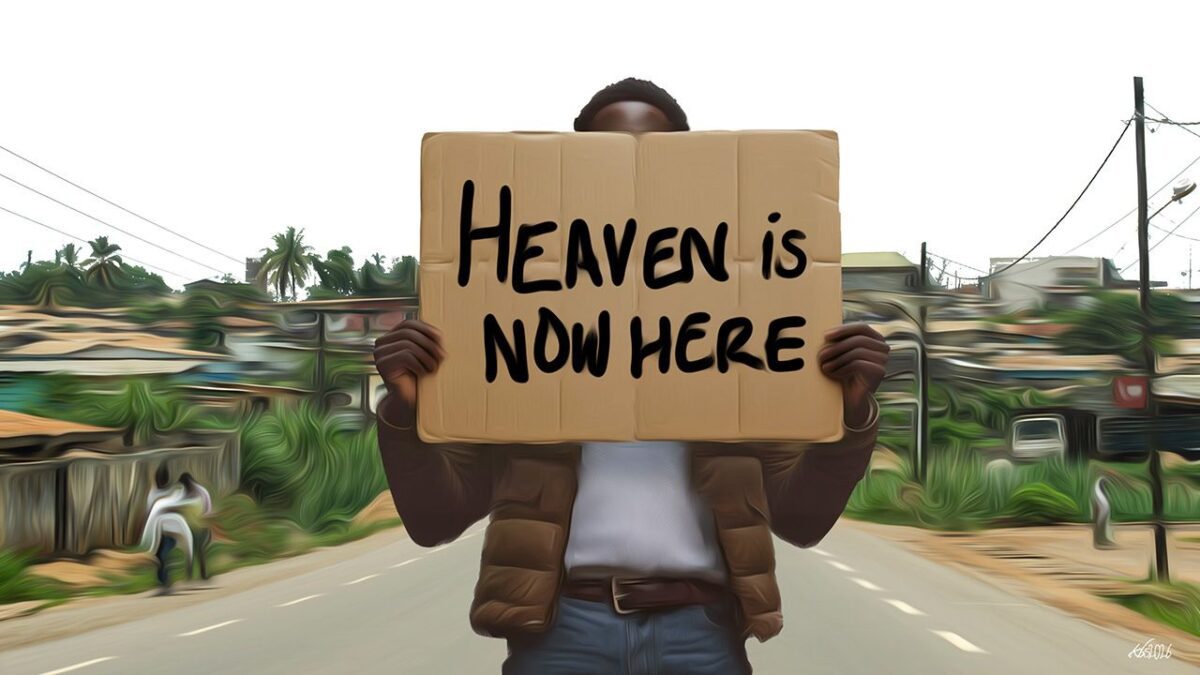
Long before this conversation, I had been wondering whether we are meant to experience some version of heaven now and not only after we die. So, I asked Bishop Ong’injo about that. “You are talking of experiencing a little heaven down here. If heaven is a place of justice, heaven is a place of love, heaven is a place where there is no wailing, no sorrow, then we must make the environment we are living in to be like heaven, and that is only possible if we refrain from acts that will injure our neighbour.”
Bishop Ong’injo brought the abstraction back down to what was actually happening; mothers unable to understand why their children had been killed, a lack of justice in the courts, and police brutality. If heaven is a place of justice, he argued, then human beings have a responsibility to create an environment of justice now.
“We sing ‘I’m Happy Today’, you know, that popular song we were taught in Sunday school,” he went on, “and when you are singing that song, it ends up saying the time to be happy is now, the place to be happy is here, and we are trying to make a little heaven down here. So it means all of us need to put effort in making the place where we are staying be a little heaven. Kenya cannot be a little heaven with corruption, when right now parents are struggling to take their children to university and they don’t know what really is happening, whether university is free the way it was announced, or whether they are looking for fees which they don’t know how much it is. That makes heaven be a mirage. But we must work for justice, and then we will create a little heaven down here.”
For once, heaven did not feel like an escape from everything happening here. It felt like a demand. If heaven is justice, then justice cannot only matter after we die.
So what needs to change?
“I think church leaders need to revisit their call and realize what God is speaking to us in the midst of such a situation, and then we will be able to be relevant, because sometimes we are not relevant. We have been taken away by other forces. We need to recollect ourselves and really ask ourselves that in such a situation, if Jesus were around, what would He have said to the powers that be? Because we are supposed to be agents of change, agents of reconciliation, and you cannot reconcile people to God when they are suffering. You must give them hope, and that hope must begin today, not tomorrow.”
Hope must begin today, not tomorrow. It felt like an answer to something I had been struggling to name: whether I could continue believing while disappointed in the people who were supposed to represent that belief. Maybe the question was not whether I could separate faith from church leadership, but whether I could allow my understanding of faith to become bigger than the failures of the people carrying its title.
For people like me still working through disillusionment while trying to hold on to faith, Bishop Ong’injo’s answer was simple: “Our faith is not pegged on our parents, [or] the church leader, but our faith is pegged on our relationship with Jesus Christ.” He urged young people to deepen that relationship through prayer, scripture and discernment, and to seek counsel from church leaders they believe are genuine. “When we want to look at our faith in the mirror of a certain church leader, then I think we will not make it.”
I still don’t have a full answer as to where all of this leaves me, or when I will walk back into a church building.
I don’t know that one conversation can undo everything that made me leave. It shouldn’t. Some of the questions that pushed me away are still there. But I left the conversation with a different question: What would it mean to live out the things the Church taught me to believe? That people matter, that injustice matters, that we are responsible for one another, that silence in the face of suffering is not the same thing as peace?
Bishop Ong’injo told me that faith cannot be pegged on a church leader. Maybe that is part of what I had been struggling to separate all along. I had confused my disappointment with the people who had taught and led me in faith with the possibility of losing my faith in what they had taught me to hope for. Perhaps faith is not always about finding your way back to where you started. Sometimes it is about carrying what was true with you, even after you have become disillusioned with the place where you first learned it.
We are trying to make a little heaven down here. Maybe that is the part of faith I can still hold on to, not the promise that everything will be made right someday as an excuse to tolerate what is wrong today, but the responsibility to begin making things right while we are still here.
Perhaps I am still somewhere between the church I left and the faith I am trying to find again. But I am beginning to understand that leaving the building does not necessarily mean leaving the work.
And maybe, for now, that is where my faith lives, not in having all the answers, but in refusing to stop looking for a little heaven down here.