|
Getting your Trinity Audio player ready...
|
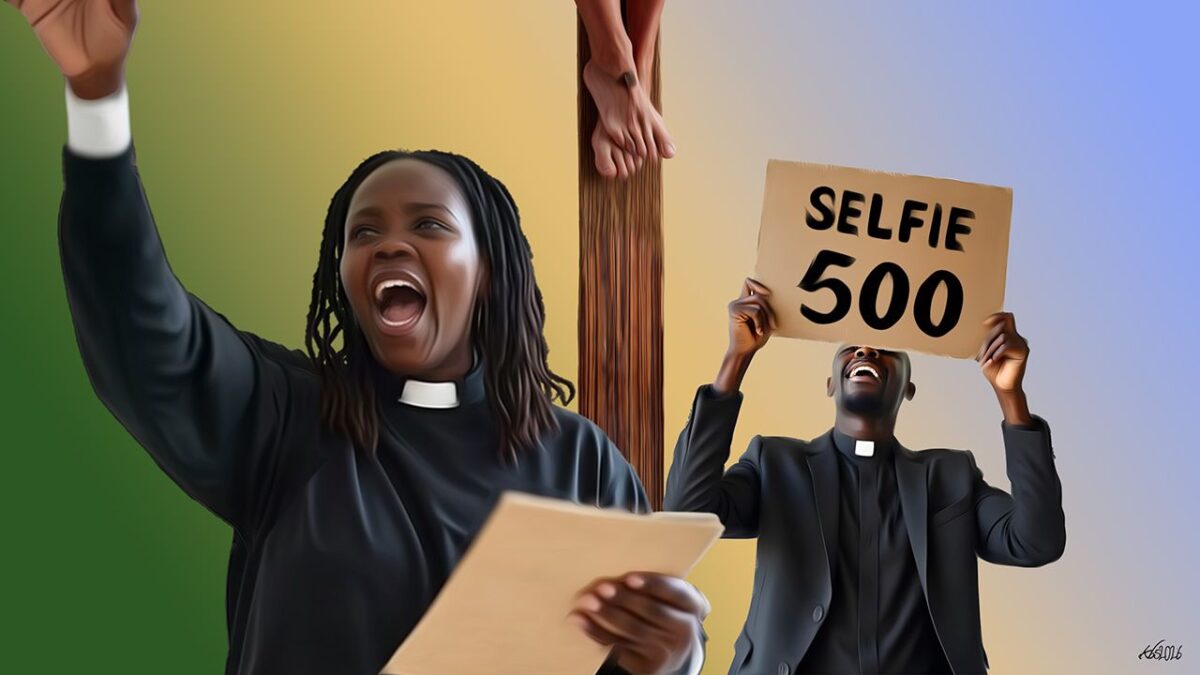
In 2024, a wave of youth-led protests in Kenya, which organizers and commentators came to call “Occupy Churches”, directed itself not at the state but at the country’s most visible religious institutions – its megachurches, its prosperity preachers, the whole apparatus of what scholars call the “neo-Pentecostal political economy“. And the question I keep circling is whether this movement is best understood as a crisis for Kenyan Christianity or as, in some sense, an event within it – i.e. not an attack from outside the tradition but an argument the tradition is having, urgently and in public, with itself.
This educated, digitally connected youth demographic had identified religious institutions as central pillars sustaining the oppressive political order. Youth activists asserted that church leaders had become complicit in state oppression by accepting money from corrupt politicians, surrendering sacred altars to political actors, and maintaining silence in a time of severe economic distress.
The political economy of extractive ministry and elite patronage
Religious authority in Kenya, and across much of the continent, has for decades functioned less as a moral counterweight to power than as its most reliable subcontractor. The alliance is old and almost structurally inevitable – a state that cannot always be trusted to deliver services will always find it convenient to borrow legitimacy from an institution that promises something even the state cannot: salvation, certainty, a story of individual transformation that, however politically convenient for elites, is also, for the person living it, a genuine and often quite beautiful thing. Pentecostal and Charismatic movements provide essential social networks, existential security, and personal empowerment in urban environments plagued by severe inequality and state neglect. Through emphasis on personal transformation, moral discipline, and individual efficacy, churches equip believers with practical survival strategies to navigate economic precarity.
However, most of these movements operate under a “Prosperity Gospel” theology, a framework that interprets material wealth and physical well-being as direct indicators of divine favour unlocked through financial contributions. Originating from international Pentecostal currents and adapting to indigenous spiritual frameworks, prosperity theology centres on seed-sowing economics. In this transactional framework, congregants are urged to yield financial offerings to church proprietors to activate supernatural returns. Where institutional financial records remain opaque and unregulated, extractive ministry thrives. Capital generated from millions of socio-economically marginalized adherents is accumulated tax-free by religious elites who showcase luxury assets and extravagant personal lifestyles. This accumulation model operates through a psychological apparatus that spiritualizes structural poverty, framing systemic economic failures as personal spiritual deficits resulting from insufficient faith or inadequate financial giving.
The financial imperatives of extractive religious institutions create a structural convergence with the political class. Political figures have routinely leveraged the pulpit to secure political legitimacy, purchase moral sanitization, and gain access to voting blocs. In exchange for substantial cash donations to church building funds and public fundraisers, politicians are granted access to church platforms during weekend services. From these sacred altars, political elites advance electoral agendas, defend unpopular policies, and evade accountability for corruption and governance failures.
This dynamic was prominently demonstrated in Kenya during the consolidation of President William Ruto’s administration. Tracing his political trajectory from youth evangelism in the North Rift Evangelistic Team to his presidential campaigns, Ruto deployed Pentecostal language and networks to build a powerful political coalition. Framed as a spiritual battle of the poor “hustlers” against elite dynasties, his political strategy relied heavily on church prayer rallies, frequent endorsements by evangelical prelates, and public declarations that his electoral triumph was a divine mandate. Following his election, this Pentecostalization of statecraft was institutionalized through regular interdenominational prayer services inside the State House, diplomatic prayer initiatives led by the First Lady, and state visits to various religious denominations. While state premises were increasingly utilized for evangelical prayer sessions, religious leaders engaged in a co-opted relationship with the state, remaining silent as the administration enacted aggressive fiscal policies and tax regimes that heightened the cost of living for ordinary citizens.
The perception that religious bodies had abandoned their pastoral duties was intensified during early street clashes when security forces deployed tear gas and live ammunition against peaceful demonstrators. This perception was further amplified when the Holy Family Minor Basilica in Nairobi initially closed its perimeter gates to fleeing, injured protesters seeking sanctuary – a decision that sparked intense public outrage and forced church authorities to reopen the gates to establish an emergency field hospital. Recognizing the pulpit as a key venue for political legitimization, youth activists launched parallel digital campaigns using hashtags such as #OccupyChurch and #OccupyChurches. The explicit objective was to monitor local places of worship on weekends, disrupt services that hosted political figures, and force the clergy to enforce an immediate separation between politics and religious altars.
The Kairos Document
It happens that a very similar reckoning was undertaken once before, in South Africa, in 1985, by a group of theologians and church workers under the leadership of Rev. Frank Chikane and Fr. Albert Nolan at the height of apartheid, who produced a short document under the pressure of an emergency titled the Kairos Document. The Kairos Document (hereafter referred to as KD) represented a radical theological intervention that challenged both the moral legitimacy of apartheid and the complicity of mainstream church structures. It drew its strength from liberation theology, presented in a way that urged Christians not to remain neutral but to side with the oppressed and the poor, and contextual theology, interpreting scripture through the lived experiences of oppression and resistance. The KD foregrounded the moral responsibility of churches during the height of apartheid repression in the 1980s. It asked what the Church should do when the State fails in its moral obligation to care for all its citizens, especially when the State itself is the oppressor.
The concept of Kairos comes from the Greek, meaning “the moment of truth or a given opportunity”. Allan Richardson, a prominent theologian, articulated that Kairos is “the appointed time in the purpose of God”, and in Paul Tillich’s theology, it refers to “those crises or turning points in history that demand specific existential decisions while the opportunity is still present”.
KD has an enduring relevance not only as a theological critique of apartheid but also as a model for ecclesial activism in times of crisis, presupposing that faith is fundamentally political, requiring engagement with the realities of suffering and struggle in pursuit of justice and human dignity.
The document identifies three distinct theological paradigms operating within the public sphere: State Theology, Church Theology, and Prophetic Theology. This approach urged Christian communities in the black townships across the country to adopt a praxis-oriented stance in solidarity with the oppressed.
State Theology is the KD’s term for the theological justification of whoever currently holds power – most famously enacted through a particular reading of Romans 13 (“let every soul be subject unto the higher powers”) that treats obedience to the state as more or less identical to obedience to God, framing state law as divine order. Under State Theology, dissent is both illegal and impious, where exercising a civic right by protesting an unjust law is akin to blasphemy, and the state’s use of force to suppress is sanctified as necessary for law and order.
Church Theology is the theology of the middle ground, characterized by moral compromise, lack of structural analysis, and institutional self-preservation. Church Theology’s signature move is the attempt to remain neutral in terms of political conflict, advocating for peace, reconciliation, and dialogue without addressing the power imbalances or systemic injustice that produced the conflict in the first place. The KD’s argument is that this apparent neutrality functions as a kind of tacit endorsement of the status quo, reducing morality to private, individual ethics (such as sexual purity, marital fidelity, or personal piety) while remaining silent on public sins like land grabbing, state murder, economic exploitation, and systemic corruption. This theology offers spiritual abstractions as solutions to concrete socio-economic crises.
Prophetic Theology begins by reading the “signs of the times” (kairos) in solidarity with the oppressed, i.e., reading the actual social and economic situation with historical honesty, and naming specifically who is being harmed and how, and refusing the false comfort of a peace that hasn’t been earned by justice. In lieu of issuing bland pastoral statements calling for calm, prophetic theology calls for direct action, civil resistance, and structural transformation to bring about a social order reflecting human dignity, equity, and liberation.
This taxonomy, composed under one particular emergency, describes with startling precision a great deal of what has happened in Kenya in recent years, a testimony to how persistent these temptations are, in any society where religious authority and political power find it convenient to lean on one another. State Theology is visible enough in the practice of describing an electoral victory as divinely ordained so that to question the government’s conduct becomes, by a kind of theological sleight of hand, to question providence itself, and the ordinary citizen who protests a tax or a killing is made to seem to be not a person exercising a legitimate grief but a rebel against God’s anointed authorities, while the clergy use the pulpit to sanctify state policies.
Simultaneously, Church Theology remains the dominant mode of engagement for many mainline and evangelical umbrella bodies which often issue statements calling for calm after state-sanctioned violence against peaceful civic protesters, and for reconciliation before any accounting of wrong has taken place. I do not think the church leaders who fall into this pattern are, for the most part, cynical; perhaps frightened, given the history of Rev. Timothy Njoya and others who dared to rail against the state; or better yet, clueless and comfortable, willing to be complicit in their silence as long as political patronage serves their interests. However, by prioritizing institutional peace over structural justice, Church Theology inadvertently stabilizes the oppressive status quo.
The aforementioned political patronage manifests as a financial entanglement between religious institutions and political power, a practice documented by scholars who have studied Kenyan public religion closely, of politicians making conspicuous donations at church services, so that the pulpit becomes, in effect, a kind of endorsement, purchased and delivered in the same hour. Money is rarely a neutral thing in scripture, and an institution that has arranged its finances so that its moral independence depends on the goodwill of the powerful has already compromised something it cannot easily recover, however sincere its preaching may otherwise be.
It may seem a considerable distance from Nairobi to Burkina Faso, and I do not wish to draw the comparison too tightly, because the two situations differ in a great many particulars that matter. But it is worth noting that Captain Ibrahim Traoré’s insistence, in his own country, that religion not be permitted to become an instrument of division, and his wariness of foreign religious patronage operating outside the oversight of the state he leads, belongs to the same family of concern that animated the young people occupying church courtyards in Kenya, namely, the recognition that religious authority is too consequential a thing, too firmly entrenched in the public consciousness, to be left carelessly in the keeping of whoever happens to hold power, whether that power is domestic or foreign, elected or self-appointed.
The Burkinabé Assembly unanimously passed the Religious Freedoms Law in June 2026. Comprising 112 articles, the law established regulatory mechanisms for religious bodies while guaranteeing freedom of worship, introduced mandatory financial transparency rules and anti-money laundering audits for all religious organizations, criminalized forced child begging associated with unregulated religious schools, and mandated the immediate suspension and criminal prosecution of religious leaders who deploy sermons to promote hate speech, extremist violence, or sectarian division. However, this state-led secularization policy generated friction with conservative religious authorities, leading to the arrest of prominent clerical figures, such as Imam Kindo of the Grand Sunni Mosque in Ouagadougou, and sparking localized protests. This shift illustrates the structural tension within military-led secular statecraft: while the government uses secular regulation to safeguard national cohesion against violent extremism, strict controls over religious discourse risk infringing upon civil liberties and alienating faith-based communities.
In East Africa, the push for state oversight of religious institutions was accelerated by the Shakahola Forest massacre discovered in Kilifi County, Kenya, in early 2023. The discovery that over 428 followers of the Good News International Church, led by self-proclaimed pastor Paul Nthenge Mackenzie, had starved themselves to death under radical indoctrination exposed major regulatory failures within the state’s security and civil registration systems. In response, President Ruto established the Presidential Taskforce on the Review of the Legal and Regulatory Framework Governing Religious Organizations alongside a Senate Ad Hoc Committee investigation. These bodies identified major structural vulnerabilities under the existing Societies Act, under which churches operated as simple societies lacking independent legal personality, corporate accountability, or enforced financial compliance. The final report of the taskforce advocated a hybrid regulatory paradigm combining state oversight with institutional self-regulation, proposing the creation of a Religious Affairs Commission, conferring corporate legal personality to faith organizations, enforcing compulsory annual financial returns, and establishing minimum accredited theological qualification standards for religious leaders.
Translating theory to praxis
The imperative for the contemporary African church is to dismantle State and Church theologies in favour of a Prophetic Theology. This requires a structural critique of political economy, an unyielding commitment to human rights, an active refusal to let faith platforms be co-opted by state patronage, and reform across institutional, theological, ecumenical, and civic dimensions.
What, then, would it mean for a Kenyan church to take up the discipline the Kairos theologians called prophetic, to move beyond academic theory and effect actual transformation in Kenya and the broader African continent?
Specific pathways for operational praxis must be developed, grounding faith in public ethics and democratic accountability.
Institutional separation and banning pulpit patronage
The primary mechanism through which political elites capture religious authority in Kenya is the financial dependency constructed through political harambees and megachurch donations. To sever this extractive link, ecumenical charters must establish strict institutional bans prohibiting politicians from making cash donations, funding church building projects, or addressing congregations from the pulpit during worship services. Worship spaces must be preserved strictly as sanctuaries for spiritual nurture and critical civic ethical reflection, free from political campaigning.
Simultaneously, to counter extractive economic practices within churches – where vulnerable congregants are coerced into giving “seed money” to enrich individual pastors – churches must adopt public financial accountability standards. Independent lay boards, rather than autocratic charismatic figures, should oversee church finances, publishing open annual audits to ensure funds are directed toward community welfare rather than private wealth accumulation.
Reform of theological curricula and re-centring the social gospel
A primary reason neo-Pentecostal pastors remain vulnerable to political co-optation or lean heavily on individualistic prosperity doctrines is the lack of rigorous theological training in socio-economic analysis and public ethics. An overhaul or reform of the curricula in theological institutions, seminaries, and Bible colleges across East Africa to include mandatory modules on political economy, human rights, African Christian history, civil society, and environmental stewardship will help train new pastors as public intellectuals capable of critically analyzing state budgets, tax policies, governance structures, and social inequality instead of the typical evangelists or business administrators.
Furthermore, church practice should pivot from transactional “faith healing” and wealth creation doctrines toward concrete community development projects, mobilizing their social capital to address tangible needs – such as water scarcity, local health clinics, public sanitation, and community education – without exploiting congregants’ economic anxieties.
Ecumenical reconstruction and broad-based civic alliances
Similar to how, during Kenya’s struggle for multi-party democracy in the 1980s and 1990s, ecumenical bodies such as the National Council of Churches of Kenya (NCCK) and the Catholic Bishops’ Conference served as crucial sanctuaries for democratic activists and human rights defenders, mainline Protestant, Catholic, Evangelical, and Pentecostal associations must establish an independent, non-partisan Civic Action Coalition.
This body ideally should monitor human rights violations, evaluate legislation, track government corruption, and issue joint pastoral statements based on systematic socio-legal research rather than political expediency.
In alignment with the principles of secular governance highlighted in broader Sahelian discourse, faith leaders must collaborate across religious lines – with Muslim councils, indigenous groups, and secular human rights organizations – to protect the neutral, pluralist nature of the democratic state. Interfaith coalitions can jointly demand executive accountability, oppose police brutality, and resist the state’s use of religious rhetoric to divide citizens.
Cultivating critical citizenship and intimate justice
A prophetic church must recognize that political oppression is deeply linked to social, generational, and gender-based marginalization. Rather than framing youth political protest as disorderly or immoral, churches should provide physical and institutional cover for young people advocating for economic justice, transparent governance, and employment, thus transforming their youth ministries from spaces of passive conformity into centres for civic literacy, human rights education, and social leadership.
As D Parsitau and A van Klinken demonstrate, religious institutions often construct highly restrictive frameworks around gender and women’s bodies. Challenging misogynistic power dynamics within both Church and State structures is imperative to a prophetic political theology. By defending reproductive rights and combating gender-based violence, churches can practice internal justice, ensuring that their public calls for state accountability are matched by institutional equity within their own halls.
By recovering the analytical rigour of the Kairos Document and translating political theology into concrete operational praxis, faith communities can break free from the twin traps of State Theology and Church Theology. The path forward requires a structural commitment in enforcing strict separation between political patronage and church pulpits, reforming theological education to centre public ethics, establishing transparent financial governance, and building broad interfaith solidarity in defence of democratic rights. Concurrently, state regulatory frameworks must protect public safety, financial integrity, and secular governance without curtailing fundamental rights or targeting minority faith communities. By establishing a clear separation between the political podium and the sacred altar, African societies can cultivate a re-enchanted civic space – one where faith functions less as an instrument of elite patronage or political depoliticization, but as an institutional resource for critical citizenship, social justice, and lasting democratic responsibility.