|
Getting your Trinity Audio player ready...
|
She ignored her father’s gift for thirty years. He offered it to her, wrapped in a box, at her graduation party, as she stood in front of strangers, holding a roll of paper that said she had a degree in something. Perhaps the paper had her name, Anyeri, or perhaps it was defaced with the name he gave her, Labeno. She had not opened it since the chancellor gave it to her five hours earlier, for she did not unroll toilet paper until she wanted to use it. A figment of her mother’s spirit haloed above her, giving the party a semblance of happiness, hugging her just as it had over the last many years. The only recognizable face in the tent was that of her littlest brother, Ocora, and she smiled at him for he had her mother’s face.
The tent stood uneasily in their front yard, after a storm earlier in the day had nearly uprooted it. The cheap decorations were reduced to strips of colored polyester wrapped on poles, fluttering in the breeze like rags. The ‘high table’ was soaked, and the red plastic flowers struggled to make it look chic. Whatever beauty the artist had intended to conjure in arranging them around the white cake was lost, for the cake resembled a mound of millet bread. But the faces in the tent did not mind. They showed all their teeth in happiness, for the smell of kongo brewing in a neighbor’s compound promised them a wild night. To warm up, they held little glasses and cups, oozing with the stench of crude waragi. They were her father’s friends, his relatives, his people. This was his party, not hers. He was celebrating something he had no right to celebrate.
Why did I come here?
She swallowed the lump in her throat, which threatened to send angry tears onto her cheeks. Her father’s voice squeaked out of old speakers, competing with the generator, and she fought hard to follow the words as they fluttered about like papers in a whirlwind. He held a wrapped box, and his grin was so big that teeth showed through his cheeks. He talked about the gift, but all she heard was him yelling at her to marry the drunkard son of politician, after a therapist had advised that a wife would help the boy overcome his addiction. She had escaped from home that night, five years ago, and lived with an aunt since then. Why am I here? Why isn’t this party at Aunty Atim’s home?
“He wants to make amends,” her aunt had said. “He is sorry. Go home.”
And yet, he had not apologized for bullying her throughout her childhood, and encouraging her brothers to shame her for bed-wetting. He said the shame would make her stop, that getting married would force her to keep the bed dry since she would share it with someone. Perhaps if she listened she would hear his apology, but when she turned to him, the speech ended and the crowd cheered. He held the gift to her, his grin growing impossibly bigger.
Was it an apology? The box was small, the wrapping made it look delicate, and new, contrasting his callous hands, which were blackened from years of working in a garage.
“Take it,” he said, perhaps noticing her hesitation. His grin now appeared to be sculpted on his face. “I give it to you, though you are a woman, because you are the only child of mine who has gone to university. You’ll know what to do with it.”
She squeezed her diploma hard and the papers cracked in her palm. The eyes in the party shot lasers at her, but her mother’s spirit swirled around like a cool breeze.
“Take it, Labeno,” he said, his grin so stiff that it betrayed pain.
She heard the jeer as if it came from someone else. She walked away, her shoes sucking into the mud. The crowd murmured; his voice hissed venom out of the speakers, but now it was garbled. He had called her Labeno. Imbecile. Because she wet her bed. Because she liked being alone. Because she did not like speaking to him, or her siblings, or anyone else. He was not sorry, otherwise he would have called her the name she preferred. Anyeri. I’m laughing at you. She gave it to herself since, in spite of everything he thought about her, she had triumphed.
She walked out of the gate to find a couple of bodaboda riders idling at the roadside. She climbed onto one, urging him to ride away. Her father came charging out, yelling her name. Labeno. Imbecile. Come back. The boda man looked at her uncertainly.
“Go!” she hissed at him.
He kicked his motorcycle to life and roared away. She threw her diploma into a roadside drainage, and the muddy water swept it away. She did not look back.
#
Thirty years later, the call came from Ocora. She tolerated him for he had been too young to have joined in bullying her. He was now married and had children, and whenever she wanted to feel like she belonged to a family, she visited him.
“He’s dead,” Ocora said. She did not have to ask who. “You have to bury him.”
She put her phone down and stared vacantly at the TV, where a comedy played, but she could not make sense of the pictures. She waited to feel something, relief, sadness, anything, but thirty years had numbed her to his existence. He was a stranger, someone who made her childhood a nightmare. She tried to remember his face, but could only see a mess of beards and a permanent frown like that of a cartoon villain.
Had he ruined her life, making it impossible for her to connect with other people, or was it just her nature? Once, she nearly got married, but she feared she would wet her bed and her husband and children would laugh at her, though it had last happened when she was nineteen. Did this fear make her a recluse, or was it something else? A few months into any relationship, sometimes after only a few weeks, boredom would set in. Talking to the same person every day was such a chore! She never understood why they got upset when she did not respond to their texts or calls. She would get very angry and end the relationship when they learned her favorite music, or that she liked knitted sweaters, or that she enjoyed snacking on kabalagala. She never understood why, until she learned about autism. Then, she stopped blaming him. I don’t even know what you look like anymore! Perhaps they bullied her because she preferred books to playing with other children, because she never said more than a few words to anyone. Only imbeciles don’t talk to people. He once yelled at her for avoiding eye contact. “You look at people the way witches look at people!” Through the corner of her eyes and only for fleeting moments. Perhaps their bullying made her wet her bed.
She set up an out-of-office auto-response email, since she would be unreachable for a few days. She made graphic novels, a career she loved for it gave her solitude. Then, she packed a bag and made for the door. She hid behind the curtains and peeped into the courtyard for signs of neighbors. The compound had six rental homes, arranged in two rows facing each other, three in each row. There was no adult about, just children playing a hopping game. She could handle them for they would not insist on a chat. Still, she held her breath as she opened the door. The children stopped to stare, perhaps shocked that the weird old lady had emerged from her cave. She smiled and nodded in greeting, and walked quickly to the gate.
Ocora waited outside in a solar-van that was already full of his family, his wife and their four children. They squealed in happiness on seeing her, asking if she had finished the new graphic novel with fire-farting abiba. She squealed in return, saying they would read it next month, and then she exchanged greetings with the wife as she settled on the front passenger seat.
“Is that all your luggage?” he asked, frowning at her backpack. It had only a laptop, five t-shirts, three trousers, and a change of underwear. Enough to last her two or three days at most.
“We are not going for a whole month,” she said. “Three days, maximum.”
She would have preferred not to go, but while it was okay to avoid her father all her adult life, it was problematic not to attend his funeral.
#
She could not recognize her other siblings, who she had not seen in over twenty years. They, too, had moved on with their lives. Other than a brief moment of ‘oooh, you are so grown’, they left her to herself. The first day exhausted her. Talking endlessly to people she could barely remember, especially to children who were thrilled about her books. She was surprised that some had read all her graphic novels, and they wanted her to mentor them. I should become a better aunt! She was over fifty. Soon, she would be too old to earn a living and when the royalties petered out, she would need some kind of social support.
The evening after the burial, they discussed her father’s will. He had written her a letter, and thankfully he addressed her as Anyeri, not Labeno. One of her brothers read the letter to the gathered family, and now she learned that the gift was a piece of land.
Land? And seven acres of it? He had held a small box wrapped in shiny paper, had it contained a land title?
“You’ve never even come to ask me where this land is,” the letter said, which meant that he had mentioned it in his speech. “I still want you to have it. You are the only one in our clan to have written books and traveled to many countries.” Ah, so he followed her career? “Please accept the gift and learn the song that comes with it.”
A song? She bit her lips, not knowing how to react. Perhaps her elder brothers, who were now grandfathers with many male children, would object, insisting that a woman can’t inherit family property since her husband might take it. She wished they did.
“It’s yours,” said the eldest brother, the new family head. His smirk told her the land had no commercial value. Perhaps it was barren, or perhaps it was so far away that it would be a pain to manage it. “We won’t fight you over it.”
And a song?
“Where is this land?” Ocora asked on her behalf.
“In Agoro,” the new family head said. What is his name?
“That is far,” Ocora said.
Far, Anyeri soon learned, was three hours away from the nearest civilization, with no actual road, just a footpath cutting through bushes. A useless piece of land.
And the song?
She heard it the next day, during the last funeral ritual. A grand-aunt, an old woman with so many wrinkles that Anyeri could not tell her mouth from her nose, sung in a croaky and surprisingly strong voice. The lyrics did not make sense, and might have been something children played with. It was about someone only identified as ‘min gang’, which Anyeri understood to be ‘mother of home’, ‘or mother of the village’.
/ the mother of home eats rices with sticks / the mother of the village lies on her back, counting stars / the mother of home dreams of traveling to the moon / the mother of the village is far from her hut, looking for the way to the sky
Was it a riddle? What did it have to do with that useless piece of land?
“It’s our family song,” the old woman said. “It’s about our ancestor whose praise name was min gang. She is our mother.”
But why was she eating rice, a foreign food? Why was she counting stars, a useless task?
#
Perhaps the land was not useless after all. Anyeri lay in her bed all night thinking about it, and daydreaming about going off the grid. She could work from anywhere, as long as she had electricity and internet. With solar, she could power water pumps and install satellite internet and transform any bush into a comfortable home. Perhaps she should look at the land and see if she could make use of it. Otherwise, she would just continue to ignore his gift.
#
She persuaded Ocora to take her on a visit to this property before heading back to the city. They drove for four hours, mostly because the road was bad, though they had covered only about a fifty miles from Gulu city, and stopped at a nondescript trading center, where the road ended. A long mud building and a few stalls marked this market. A few people idled in front of the empty shops, looking at the car as though unable to decide whether it brought death. After Ocora talked to them, they became friendly and generous with directions. The property was eight miles away and the road that once led to it had overgrown, turning into a large footpath. Only motorbikes could access it. There were six bodaboda in the area, and all operated in a town an hour away. They made calls and after Ocora promised to pay more than what they made in a whole day, two riders agreed to come over.
The bodaboda men arrived after one and a half hours, in bikes so old that some parts were missing. Anyeri thought walking would be a better idea, but it was getting late. They rode over sandy footpaths, which she feared would turn into rivers of mud during the rains. The only good thing was that the place was not completely deserted. There were gardens and homesteads, just spread far apart from each other. Good! Though she desired a place without nosy neighbors, she did not want to be a hermit.
When they reached, a caretaker welcomed them. She was a distant cousin, a bubbly woman who made Anyeri wary of such a neighbor. Her praise name was Min Laker, named after her first daughter, a cheeky girl with cornrows and dimples.
“We couldn’t come for the burial,” Min Laker said. “My child was sick. But I’ve never seen you, so how do I know you are Ojara’s children?”
“Call someone and ask them about us,” Ocora said.
She excused herself to make a phone call, leaving them on stools under a mango tree in her front yard. The homestead had five huts with neatly trimmed grass-thatches. The walls were painted with black clay, and had chalk drawings of flowers. A few chicken and ducks pecked at the ground, and birds called from a distance. Palm trees encircled the homestead. It was a peaceful place and Anyeri thought she could spend the last of her days here.
“So,” Min Laker said, walking back to them after a ten-minute phone call. “He left you this land? It’s strange that you are interested. No one wants it. If there was a road people would come but – eh, let me show you. We start with the hut.”
“The hut?” Anyeri said.
“The oldest hut in the world,” Min Laker said, walking briskly. “They say Min Gang lived in it, but it must be hundreds of years because even my grandfather, who was very old, said that his grandfather found it there, and it was already very old. So you can imagine.”
“Min Gang,” Anyeri said. “That’s the woman in the song. What was her actual name?”
“Who knows,” Min Laker said.
“What does that song mean?” Anyeri said.
“Who knows,” Min Laker said. “Whoever composed it thought we would know the meaning, but we just sing it and pass it on to our children.”
She led them through a bush to a wooden gate, which was strange for no other homestead in the area was enclosed, certainly not with a thick thorny hedge, over six feet tall.
“There are no thieves here,” Min Laker said. “There’s nothing to steal, but we have to keep the things safe.”
They went through the gate into a compound, which like the others was bare earth, the wind raising whiffs of dust. Strangely, there were no domestic animals. No goats, no chicken, not even children running around. A banana plantation grew wild to hide the hut, which looked like any other hut, though a little bigger. It did not appear as old as Min Laker claimed it was. The only strange thing about it was the door. It was made of fine, exotic wood, not simply planks, an ancient art piece decorated with geometric designs. She had seen such doors in Old Mombasa and in Zanzibar. She frowned. What is it doing here?
Min Laker pushed it open, and they entered a darkness. She opened a window, which was small, about only two feet wide, but the sun shone directly through it, and Min Laker placed a mirror right on the beam, flooding the hut with light.
A large object, about the size of a car, occupied most of the space. It appeared to lean against the center pole of the hut, which, along with the roof beams, were made of the same type of wood, and had geometric designs on them. Anyeri thought the object was a gigantic gourd lying on its side, or perhaps a bottle. It was made of the same strange timber, with the same designs.
“They call it opokotuk,” Min Laker said. “The flying gourd.”
Anyeri chuckled. “So it can fly?”
Min Laker shrugged. “It can go to the stars,” she said.
That knocked the smirk off Anyeri’s lips. She did not know whether it was a joke, but Min Laker was a peasant who had perhaps never heard of space travel, or seen films like Star Wars and Dr Who. How could she make such a joke?
“Does it explain the lyrics of the song?” Ocora asked.
“Yes,” Min Laker said. “They say Min Gang went to the stars in this thing, but it was so long ago no one knows how to use it. The stories have to be true because – look inside.”
She opened a circular door on what would have been the mouth of the gourd, and Anyeri peeped to see a tunnel, just large enough for her to crawl through, leading into the darkness. A cool and sweet-smelling breeze blew out of the bottle, as if something inside was exhaling after so long. Anyeri shone the torch on her phone into the gourd, and saw a mirror-like surface. Mercury? There were things inside the gourd. Stools? Was that a handlebar? Pedals?
“Can I go in?” Anyeri asked.
“No,” Min Laker said, closing the circular door. “You need to smear a certain medicine before entering. When I was a child one of your uncles thought it was mercury. He tried to scoop it, and it burned him. His flesh peeled off, leaving only bones. Look at this.”
Min Lakeri pirouetted from the gourd to a collection of nine pots. Each had a lid and sat on a base of the fine wood. She removed the lid of one to reveal three stones blueish inside.
“These stone are for making rain,” Min Laker said. “Don’t touch them.”
Anyeri had read about rainmaker stones in old books, that they were mined from the bottoms of rivers and could not be touched with bare hands. Perhaps they were some kind of mineral that could influence the weather in a process similar to cloud seeding. The knowledge of rainmaking was lost, mostly because Christianity made it seem evil, since only rwot or ajwaka performed it. If the stones were in her family, were they rainmakers?
“No,” Min Laker said. “We are not of a royal clan,” she added. Anyeri wanted to correct her, that there was no ‘royalty’ in Luo for rwot were not chiefs or kings. The little she knew, back then rwot had to have rainmaking skills, perhaps symbolic of leaders blessing their people.
“So are these things of jok?” Ocora asked.
“No,” Min Laker said. “I don’t know. Ajwaka say there is no jok here. When I was a girl an ajwaka from Putimi – you know that’s where Jok Langol first possessed a man. Jok Langol fell from the sky and broke his thigh, you heard the story? This ajwaka knew a lot about this jok from the sky, but he never understood these things. Then recently an ajwaka came from Labong – you heard about Jok Abayo? The rock that fell from the sky and buried dancers? She also looked and could not understand what to do with these things. She told your father that perhaps an educated person would know what to do with them. That’s why he gave you the land.”
“But someone has to know,” Ocora said. “How can no one know?”
“When our ancestors became Christians,” Min Laker said, “our things were considered satanic. The last person who knew about them died without passing on that knowledge.”
“But someone kept these things,” Ocora said.
“Yes,” Min Laker said. “I think Christians ignored these things since no jok activity happens here. But look at this.”
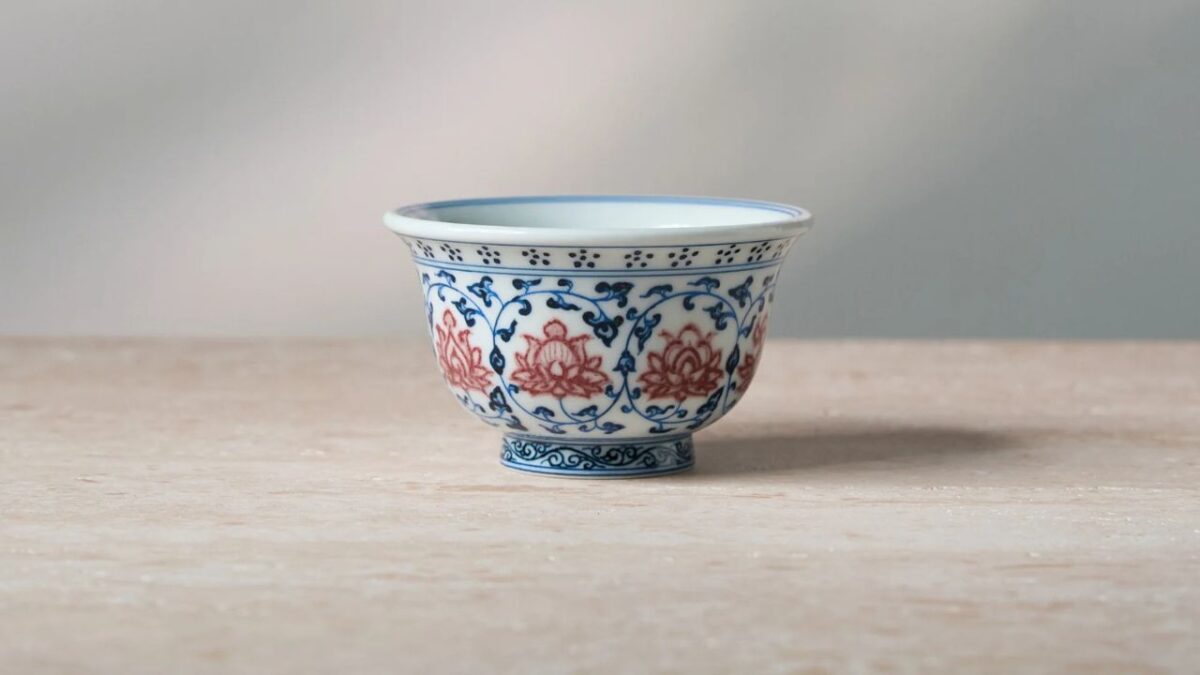
She pointed to the only item on a single shelf on the wall. A teacup. It sat there as if it were in on display in a museum. It was small, with motifs of the passion flower. Anyeri thought she recognized it as something from ancient China, according to the wiki of one of her favorite graphic novels.
“What is it doing here?” she asked.
“Who knows,” Min Laker said.
On the floor below the shelf, was a box with shinny paper wrapped around it. The same box her father had tried to give to her on her graduation day. It was opened, the gift removed.
“That’s the last time he was here,” Min Laker said. “He wrapped the cup to give it to you, but he brought it back when you refused it. He said you had gone to school and you might understand these things. So, well, it’s good that you are now interested.”
#
Back home in Kampala, though tired from mixing with people for many days, her bones aching from the torturous journey on rickety motorcycles, the first thing she did was upload a photo of the teacup onto an image search engine, and in a few clicks she found similar cups! They were indeed Chinese, from the Yongle era in the 1400s. One website said a similar cup was a family heirloom in Pate Island, near Lamu in Kenya. This family descended from shipwrecked Chinese sailors, the crew of the explorer Zheng He, who took gifts of giraffes back to his Emperor. But how did the teacup end up in a village over a thousand kilometers from the coast?
It struck her that, perhaps, Min Gang was not the praise name, min gang, the mother of the village. Min and Gang were both common Mandarin names, and like many other Mandarin words, they sounded like something in Luo. The lyrics of the song now made a lot of sense! Eating rice with sticks, counting stars – did that imply a Chinese astronomer?
She emailed a Ugandan who was pursuing a linguistic PhD in China. Perhaps they would help her unravel the mystery for Anyeri couldn’t find anything else online. Someone in a Chinese university might access better sources and know if an astronomer called Min Gang had traveled with Zheng He, and continued a thousand kilometers inland. The song was proof that the astronomer, and not just the cup, made the journey to her ancestral land in Agoro.
Monu, the student, responded almost instantly. She was back in Kampala for a short holiday, and they had coffee at a small café. Monu was a bit skeptical. A gourd that was a spaceship? An ancient Chinese cup more than a thousand kilometers from where it would have made sense? It seemed surreal, but she promised to look around her university and visit museums. If an astronomer was involved, he most likely was employed in a palace, and if he left any records, it would be in a palace museum somewhere.
#
Months passed and Anyeri did not hear from Monu. She sent a reminder email to no avail. Maybe Monu had given up chasing after the wind. Anyeri thought of visiting Pate Island, but she doubted she would find anything that she had not yet seen online. She looked through old books but found nothing about a Chinese astronomer visiting her ancestors. She however discovered a lot of star travel lore, and the one about Kiir, who fell from the sky in a gourd, thrilled her. Was it similar to the gourd in the hut? The colonialists thought that her ancestors were primitive, but if that was so, then their myths would have characters going to the sky on the back of birds, or using wings like Icarus. Yet only a few tales where animals were central characters used wings. All the stories with human characters made the journey on gourds, pots, and stools. Or they walked to a place where they could access the sky. A portal? Were these spaceships? They had no engines, or fuel, or the complicated designs of modern rockets. Opokotuk was certainly not the Millennium Falcon, not even the Apollo 11 Command Module which was only slightly bigger than it, for it did not go to the stars through space. It used portals, like the TARDIS. Did Dr. Who steal the idea of such a spaceship from their folklore?
Could Opokotuk still go to space? If yes, then how could she drive it, given that the knowledge was lost, forever, because her people converted to Christianity and thought it evil.
She poured her energy into moving to Agoro. She bought solar panels and a water pump, which Min Laker thought was wasteful since there was a river hardly two hundred meters away. An engineer built her a house using mud, wood, bamboo, and materials she could easily find in the village. She watched a lot of farming videos and learned to grow her own food. She thought of building a lodge, perhaps fellow artists could use it as a residency, or a few tourists could come by to see the strange hut. She hated it that her father was right about her figuring out what to do with the family heirloom.
#
About a year later, she migrated to Agoro and she was happy for the first time in her life. The nearest neighbor was Min Laker, about a hundred meters away, so she could get out of her house without fear of someone chatting her up. She could enjoy the sun and the breeze, and did not have to stay cocooned for weeks. She discovered a love for birds and thought of getting a camera with a telephoto lens.
Then the email surprised her. Monu had found the astronomer’s diary, and her university was enthusiastic about an account of a Chinese person visiting present-day Acholi in the 1400s, long before the Arabs came for slaves and ivory, and long before the Europeans came to colonize. The university promised to send a team to visit Agoro.
Anyeri froze in pure joy as she read a translation of the diary, which had detailed notes and illustrations. The astronomer was called Min Wang, which sounded like ‘the mother of eyes’ to the Acholi, and so, perhaps over time, it changed to a more sensible min gang, ‘mother of the village’. He was a minor astronomer. His father traveled with Zheng He and bewitched him with many tales, one of them was about people who traveled to the stars. Intrigued, Min Wang begged to accompany his father, and so he was brought along on the fifth treasure voyage. On reaching Lamu, he got off the boat. His father gave him some wealth and blessings for the adventure, which would last several months. They bade each other farewell, knowing Min Wang might never make it back home.
He joined a trade caravan heading searching of ivory, but it stopped in the Turkana region and Min Wang made his way to the land of the Acholi with the help of two guides. He ended up in Agoro for that was the nearest place that the guides had heard of that practiced star-travel. He lived in Agoro for three years, long enough to learn the language, long enough that many songs were composed about him, one of which survived for hundreds of years. He learned the secrets of star travel recorded every detail, the plants used to prepare medicines (which Anyeri thought were chemicals) for the trip, the processes of opening portals, how to drive the gourd to Polo, the world in the sky, and how to return. He was frustrated that Jo’Agoro did not want to study the stars like he did. They thought the universe was a ball, with their world on one side, and Polo on the other. The stars, the moon, and the sun were in between. Jo’Polo were humanoid creatures with tails, but they could even speak their language and intermarry with Earthlings. Min Wang never visited Polo, however. The gourd took only one person at a time, yet the process of opening a portal lasted about a whole month. Only a few select people went, and only for serious purposes like finding solutions to calamities like drought, or for medicine. They never went for fun, not even for research. So Min Wang recorded everything hoped to replicate the process back at home.
After learning everything he could, Min Wang headed for Nubia, for he could find caravans going northwards, not eastwards. He did not have much resources to pay for his way, and so relied on the mercy of strangers, which made his travel much slower. On reaching the Red Sea, he hopped from boat to boat until he reached China, ten years after starting his adventure. He found his father dead. No one believed him, for he had lost all the herbs and samples he had taken from Agoro and could not build an opokotuk, or even open a portal. All that remained was his meticulous notes.
Anyeri was grateful for his diary was a detailed instruction manual.
#
Over the next many months, Anyeri split her time between her graphic novels, growing her own food, and Min Wang’s diary. Finding the plants he wrote about was a nightmare for some were extinct, but it was a good thing that he recorded their native names. Min Laker traveled to herbal gardens of Ajwaka, searching and finding appropriate replacements.
“So Min Gang was not our ancestor?” she had said when Anyeri had told her the truth.
“They just made a song about this visitor and his weird habits,” Anyeri said.
“I used to dream about her,” Min Laker said. “So my dreams were wrong?”
It took them about a year to find all the ingredients. It turned out that it was safe to enter opokotuk without any protections. The rumor about its dangers must have been to discourage nosy people from entering. When Anyeri pressed her, Min Laker confessed she had not actually seen the uncle whose hand was ripped off. The stones in the pot, however, were a rare mineral and caused a severe itch when touched with bare hands. Min Wang had recorded all the ways they could be used to influence the weather and Anyeri thought it might come in handy in the face of the climate crisis.
When they were ready to open a portal, she arranged the nine pots in a circle around a large cow skin mat, thirty feet in diameter. Min Wang’s diary had mentioned buffalo skin, but an ajwaka suggested cowhide or goat hide were an acceptable replacement. They smeared the mat with a specially made oil. Then, she stuck a pole in the middle, and on the tip of this pole she placed a ball of herbs. Vines ran from this ball into each pot, which she filled with a paste.
Then, they waited for rain. When lightning struck the ball of herbs, fire shot through the vines into the pots, which spewed green flames for a brief moment, before sizzling to nothing.
Anyeri stood under an umbrella, beside Min Laker and two ajwaka who had helped them. They watched the performance dwindle to an anticlimax and they exchanged puzzled glances. Min Wang had written that a portal would appear after the flames, ‘like a painting of the night sky on the buffalo skin mat’. But there was nothing. Just rain, which poured down with a fury. Had it all been for nothing? Had the stones lost their potency after so long?
The rain petered away, and the sun burst out strong, and then, the cow skin mat changed into something resembling a pond of black water. Perhaps the results were different from what Min Wang described since they had replaced some ingredients. Anyeri approached it, cautious, a smell, like burning wood, wafted from the pots. The night sky, Min Wang wrote in his diary, but on the ground. Now, Anyeri studied the mat, and though it was midday, she saw faint stars twinkling in the blackness.
“Are you going?” Min Laker asked.
Anyeri’s heart pumped so fast that Min Laker’s voice was muffled. What was left to do with her life? She would be sixty in a few years, and what did she have to look forward to other than graphic novels and wine? This was an adventure she could not resist.
Min Wang had not called it ‘charging’, but wrote that opokotuk needed time in the sun before it could work. Anyeri left it in the sun for a day, and its color changed from that of pale wood, to a bright green hue. She thought it ran on photosynthetic power, given what she knew of biophotovoltaic panels. Inside, the mirror-like walls became transparent.
She crawled in through the narrow neck, the glass-like walls were warm. Opokotuk had its own internal atmosphere, cool and dewy, with a breeze coming from little pores. She had followed Min Wang’s instructions on how to drive it, and she had flown around the homestead several times until she was very familiar with it. The steering mechanism was as simple and easy as that of a bicycle. Its handlebars were like a bull’s horns, with a pedal pump under it. To start it, she flipped the pedal to an upright position and pumped it with her foot, and the craft vibrated, a slight shaking. Min Wang had written that ‘it shook like a bee in a palm’. To take the craft into the air, she pulled the handlebars toward her, and to speed up, she pedaled harder and faster, just like a bicycle. Min Wang never understood how opokotuk worked, or, as he put it, ‘I don’t know what makes it sail in the air, but it is not magic. There is a secret mechanism.’
Many people had gathered to watch, including Min Laker and her children, who stood with their mouths wide open. They could not see her while she was inside the vehicle, but she could see them, though it was a milky view. Adyeri took the craft a little higher, just above the trees, and then gritted her teeth and pushed the handlebars away from her, and the spacecraft nose-dived into the portal.
In a wink, she was in darkness, in a star-field of frozen shooting stars. She panicked. She expected to see a world like hers, not this abstract painting. Min Wang had never made the journey, so he did not describe this part of it, though he had recorded what the travelers had told him. But there was no mention of this star-field –
Ah! A light!
Up ahead, as though she were in a tunnel and had seen the proverbial light. It looked more like a cloud, and she thought it was roughly shaped like the cow skin mat. Before she could pursue the thought, opokotuk shot through it, and she was in the other world.
It looked very similar to home. The tall grass that could be sorghum, the trees sagging with leaves, the rocks soaring above the vegetation like sculptures of pestles. The sky was blue, too, but it had three moons.
Humanoid creatures sat under a tree. They wore no clothes and had long tails that swished away flies. Their faces were long and thin. They had round eyes and slits for mouths, but appeared not to have noses. Their tails were bushy, but they did not have hair on any other parts of their body, and though they had breasts, they had no visible genitalia. Jo’Polo! Their cattle, with single horns like the rhino, grazed nearby. In the distance, other opokotuk flew about.
The humanoids rose to their feet, waving at her. One shouted, but her heart beat so fast that she could not make out the words or figure out if it was in her language, as the stories suggested. She could not tell if they were surprised to see her, or if it was normal for things to come out of portals. They could not see the inside of opokotuk, so perhaps they did not know she was an alien.
They half-trotted toward her. Could they tell that her craft was strange? What would she do once they reached her? How would she even interact with them, yet she hated conversations with strangers. They would ask questions like ‘What is your name? Where are you from? How are you? Do you have rain over there? Ooof, it’s been hot here.’
Nope! I won’t endure that.
She twisted the handlebars and the gourd spun to face the portal. On this side, it was the same shape and color as the mat. She dived in, and again she had the sensation of passing through a field of frozen shooting stars before a cloud of light appeared. The craft shot through it, and she flew above familiar trees. Min Laker and her children, and several other villagers, were on the ground shouting and jumping up and down in joy.
She brought the craft down, and crawled out, and everyone was laughing and shouting, and she could not help herself. She laughed along with them. They hugged her, and for once she did not mind that other people were touching her, though their skin was sweaty and dirty. Thankfully, they stopped hugging her before she became too uncomfortable.
“You went!” Min Laker screamed.
Anyeri thought about the tailed people and wondered about interacting with them. Why did they not come to her world? Were there other worlds? Did Jo’Polo have a worldview similar to that of her ancestors, and so they never traveled for fun or frivolities like research? She had to close the portal until they knew how to interact with the tailed people, or even what to do with this recovered knowledge. A piece of the cow skin had not changed color. She grabbed at it and yanked, and it was like pulling a rock that weighed a tone, and Min Laker joined her in yanking, and then suddenly it weighed nothing, and they fell backward on impact. Laughing.
“I went,” she said, breathless. “And we shall go again.”
–
*This piece has been awarded Second Prize in the category of fiction in the Second Global China-Africa Writing Competition (2026) held by CASIN (China-Africa Shanghai International Network). The competition is managed by Dr. Flair Donglai Shi (Shanghai Jiao Tong University), under the directorship of Dr. Jodie Yuzhou Sun (Fudan University). The judging panel of 2026 consisted of Dr. Lifang Zhang (Tsinghua University), Dr. Kaiyang Xu (China Foreign Affairs University), and Mr. Eric Mupona (Zhejiang University). The piece was originally written in English. The Elephant has permission from both CASIN and the author to publish it first. For more details about the competition and CASIN, contact us at casinwriting@gmail.com.