|
Getting your Trinity Audio player ready...
|
In her August 2022 column for The Nation magazine, Nanjala Nyabola, arguably my generation’s most prolific non-fiction writer, delivered a stark declaration: Kenya is a kakistocracy. Kenya, she said, had never been more distant a democratic country than it was now at the beginning of the 21st century and it stands at the brink of an ominous and bleak future. A few weeks later, I was invited to give a talk on the implications of the elections on the country’s political economy. The group present at the convening was civil society’s top brass. What struck me, however, were the many present in the meeting who found it hard to believe the election outcome. The eerie silence that filled the room was telling. That President William Ruto, a man who had earned his political pedigree, first as a young stalwart in the rank and file of YK92 (Youth for Kanu 1992), and later joining ranks with former President Uhuru Kenyatta, as ICC indictees, to form the Jubilee government, was now the fifth president of Kenya and was enjoying massive political support despite his political history was an aberration in their minds given Kenya’s democratic trajectory.
At the time, one commentator on X (formerly Twitter) lamented Kenyans’ lack of political education, while another argued that deep-seated spite for Uhuru Kenyatta and fear of Raila Odinga among sections of society had driven events in that direction. These explanations certainly gesture towards important underlying factors, but they do not tell the whole story. In this essay, I argue that a deeper, largely overlooked dynamic has been shaping Kenya’s political discourse – and it is this neglected layer that I seek to foreground.
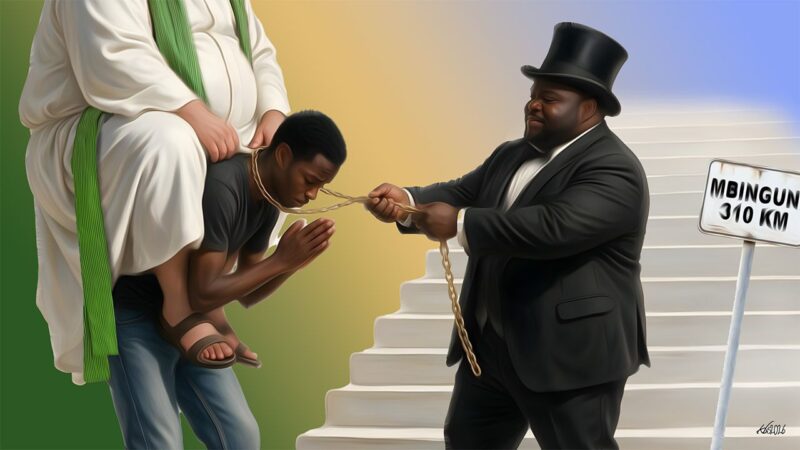
Mahmood Mamdani, in his book Neither Settler nor Native: The Making and Unmaking of Permanent Minorities, troubles conventional narratives of the origins and the character of the modern nation-state. He argues that the narratives beginning with the 1648 Treaty of Westphalia have often described the modern nation-state as a tolerant and secular political institution that overcame European religious strife are incomplete. Rather, Mamdani notes that the modern nation-state and the colonial state were co-constituted in the 15th century by three intertwined processes: ethnic cleansing (the Reconquista), overseas colonization (the Americas), and the enslavement and displacement of Africans that created permanent political frameworks for exclusion and violence. Emphatically, as Willie James Jennings notes in his book The Christian Imagination: Theology and the Origins of Race, the social imagination prevalent in pre-enlightenment Europe that created the modern nation-state and the colonial state were not imbued out of secular thought but rather through a Christian theological imaginary.
Consider Gomes Eanes de Zurara’s account of Prince Henry of Portugal’s exploits in “Chronicle of the Deeds of Arms in the Conquest of Guinea” (1457), a text that marks a founding moment in the making of the state as a theological project. In this Guinean chronicle, Zurara recounts a slave raid and auction in the form of a prayer.
O, thou heavenly Father – who with Thy powerful hand, without alteration of Thy divine essence, governest all the infinite company of Thy Holy City, and controllest all the revolutions of higher worlds, divided into nine spheres, making the duration of ages long or short according as it pleaseth Thee – I pray Thee that my tears may not wrong my conscience; for it is not their religion but their humanity that maketh mine to weep in pity for their sufferings. And if the brute animals, with their bestial feelings, by a natural instinct understand the sufferings of their own kind, what wouldst Thou have my human nature to do on seeing before my eyes that miserable company, and remembering that they too are of the generation of the sons of Adam?
Zurara is not simply soothing his own conscience; he is helping to script the theological imagination of the emerging colonial state. By reading a slave auction through the lens of divine providence, he turns raw economic and military power into a “sign” of God’s ordering of the world. He asks how to understand the suffering of Africans, but the form of his question is already captured by imperial interests: he seeks from God not a rebuke, but an interpretive key that will make European domination appear morally necessary and even benevolent. In effect, he forges a theodicy in which Black suffering is folded into a story of God‑ordained European preeminence. This is where the colonial state’s imagination is born. Providence and immutability – doctrines meant to anchor trust in a faithful, unchanging God – are redeployed to stabilize a colonial order.
Zurara’s chronicle offers more than a private meditation; it offers a template in which a colonial order is read as a visible trace of invisible divine favour. The state can then imagine its violence as participation in a providential design: conquest as mission, slavery as salvation, hierarchy as orthodoxy. Divine immutability no longer holds together the cries of the oppressed; it becomes the guarantee that the structures producing those cries are fixed, natural, and blessed. This twisting of doctrine into an ideological tool is precisely what gives the colonial state its theological depth. It is not only that laws and guns enforce the colonial order; it is that imagination itself is catechized to see black flesh at the auction block as evidence of God’s will, and European power as the necessary instrument of that will. Zurara stands at the point where exegesis, empire, and the state’s self‑understanding converge.
Zurara ends this chapter and this important episode in the chronicle with Prince Henry bringing a holy coherence to the whole matter:
The Infant was there, mounted upon a powerful steed, and accompanied by his retinue, making distribution of his favours, as a man who sought to gain but small treasure from his share; for of the forty-six souls that fell to him as his fifth, he made a very speedy partition of these; for his chief riches lay in his purpose; for he reflected with great pleasure upon the salvation of those souls that before were lost. And certainly his expectation was not in vain; for, as we said before, as soon as they understood our language they turned Christians with very little ado; and I who put together this history into this volume, saw in the town of Lagos boys and girls (the children and grandchildren of those first captives, born in this land) as good and true Christians as if they had directly descended, from the beginning of the dispensation of Christ, from those who were first baptized.
Zurara employs a rhetorical strategy of containment and death, holding slave suffering inside a Christian story. African captivity leads to African salvation and to Black bodies that show the discipling power of the faith. Here, the doctrine of the state as a monopoly of violence is birthed, a necessary condition for the corralling of the native, a theological imperative. As Christ suffered, so must the African suffer – a bizarre salvific fate. Another crucial narrative is the central role of death. Christ takes on death to overcome it, while Africans are bound to death – by being killed and by having death used as a threat to subdue them. That is a reversal of the reversal, a Christological deformation. The body of Jesus will ultimately indicate the victory of God over death, but in this horrific scene, the African body indicates the ultimate victory of death – the triumph of the colonial.
This narrative and logic would be recycled by countless theologians, journalists, colonial administrators, civil servants, and intellectuals of every colonial nation. In Kenya, this logic crystallizes in the formation of what E. S. Atieno Odhiambo called the “ideology of order”, and what the Cameroonian philosopher Achille Mbembe names “necropolitics”. Death, destruction and displacement are legitimized so long as the state sanctions them, and thus it is possible to trace the long line of government policies, from the advent of colonialism to the present, that are anti‑people and yet still enjoy official sanction.
******
The 2007/08 Post‑Election Violence (PEV) is widely regarded as a searing watershed in Kenya’s history. For years, the country had been celebrated as an island of peace and stability in Africa, which made the shock all the greater when, from 28 December 2007, less than twenty‑four hours after a fiercely contested presidential poll, violence erupted across the country, leaving more than 1,300 people dead and displacing at least 650,000 others. But this moment fractured something deeper within Kenya. As pointed out above, a core to the doctrinal logic of the colonial state is its monopoly of violence and the control of it. However, the widespread violence that erupted during the 2007–8 post-election crisis, and the state’s catastrophic inability to contain it across the country, thrust the state’s doctrinal raison d’être into a profound theological crisis. Within the Kenyan imaginary, the colonial state occupies a godlike status. When that god fails, the crisis becomes Nietzschean: if God is dead, and the state has inhabited that godlike position, what replaces it? And more urgently, what must we do?
In Thus Spoke Zarathustra, Nietzsche argues that the death of God and the collapse of Christian moral frameworks thrust European society into nihilism. To escape this nihilism, Nietzsche proposes the Übermensch – the man who chooses his own path and destiny, rejects the simplistic comforts of old morality, and embraces the painful reality of his existence. The 2007 theological fracture burst forth precisely as such an atmosphere: the conditions for the emergence of the Übermensch. Within the Kenyan context, this figure took the archetype of four central actors who were pivotal to the post-election violence and who have curated the contours of our public theological life ever since: the Judge, the Prophet, the Prince, and the Warrior. Each embodies a different response to the death of the state-as-God, each offers a different path out of nihilism, and, until 2024, each dominated our political-theological imagination.
The Judge
In Hebrew theology, Samson is often read as a tragic figure: a Nazirite endowed with extraordinary strength to deliver Israel from the Philistines, yet ultimately undone by unchecked appetites, broken vows, and disastrous judgement. His life becomes a cautionary tale of squandered potential, an emblem of what happens when a divinely entrusted vocation is betrayed, yet he is still remembered among Israel’s Judges, and even honoured in later traditions.
In Kenya’s post‑election context, Mwai Kibaki can be seen as inhabiting something like this Samson archetype. His early presidency carried immense promise: economic growth, expanded education, and the hope of a break with the Moi era, including an end to entrenched tribal favouritism. Yet, like Samson, he presided over a tragic unravelling. His administration became marked by ethnic bias and patronage, and under his watch, the 2007–08 post‑election violence exploded, exposing how deeply the state had failed to tame the forces of tribalism and to protect the fragile national dream of shared nationhood.
Still, in the public imagination, Kibaki often occupies a conflicted space: praised for roads, free primary education, and macroeconomic gains yet rarely named plainly as a leader whose choices and silences contributed to a national trauma from which the country has not fully recovered. In that sense, like Samson the Judge, Kibaki in our own political – theological imagination stands as a tragic figure – celebrated for his achievements, but shadowed by a refusal to fully confront the cost of his failures.
The Prophet
Former Kenyan Prime Minister and veteran opposition leader Raila Odinga died aged 80 on 15 October 2025 while receiving treatment in India. News of his death travelled quickly across and beyond Kenya, and the state funeral that followed drew thousands of mourners, foreign dignitaries, and a visibly grieving nation. For several days, the country seemed to pause, as if aware that something central to its sense of itself had been lost.
In that moment, many Kenyans appeared to grasp the magnitude of who Raila had been for the republic. He was, in a sense, more fully recognized and honoured in death than in life, echoing the biblical proverb that a prophet is not without honour except in his own home. Raila’s post‑ 2007/08 presence on Kenya’s political landscape was defined by this paradox: a leader widely seen as uniquely suited to the presidency, yet one who never quite secured the seat despite five attempts.
Raila’s enigmatic persona – at once revered, feared, loved, and misunderstood – was carried by a political idiom saturated with promise: taking the people to “Canaan”, to the “promised land”. This self‑presentation resonated with the biblical prophetic tradition: a solitary, insistent voice in the wilderness, calling a people to a future they could half‑see but never fully enter. In our theological and political imaginaries, Raila comes to occupy that complex space – both symbol of an unfinished promise and figure through whom the nation wrestled with the meaning of its own democratic hopes and disappointments.
The Prince
On 9 April 2013, at the Moi International Sports Centre in Kasarani, Uhuru Kenyatta was officially sworn in as Kenya’s fourth president. For many of his supporters, especially within the Kikuyu community, his presidency was seen as the return of a dynastic presence – the restoration of the Kenyatta family to the centre of the state. He was widely cast as the prince who would move Kenya forward with progressive momentum. Among his most ardent backers, it was not uncommon to refer to him as mũthamaki, Kikuyu for “king”, or to remark on how royal, polished, and statesmanlike he appeared.
Yet the failure of his presidency to steer the country decisively forward, both economically and politically, was met with deep disdain and even spite from many, including some of Uhuru’s earliest supporters. The rejection of his candidate in the 2022 elections did not carry the usual anger or bitterness that often follows a loss, despite his appeals and interventions. Instead, the outcome can be summed up by the biblical proverb: “Woe to you, O land, when your king is a child, and your princes feast in the morning!” (Ecclesiastes 10:16). For many Kenyans, Uhuru’s presidency had brought despair, lack, and struggle rather than the stability and prosperity they had been promised. In that light, the 2022 result was read not merely as a political defeat but also as a national recognition that the “king” had not grown into his calling.
The Warrior
President William Ruto came to power under the banner of dismantling the dynasties – the elite network that, he told Kenyans, had held them back from progress and development since independence. Self-styled as a hustler and a man from humble beginnings, Ruto has framed his political career as that of a warrior who, against all odds, emerges victorious in every political battle. So deeply has he embraced this identity that he even christened himself Arap Samoei, attaching himself to the Nandi warrior leader Koitalel Arap Samoei. Within Kenya’s political grapevine, it is rumoured that Ruto possesses warrior-like leadership attributes and a habit of crushing his political enemies and bringing them to heel. It was this warrior-like status that enamoured many to him in the run to the 2022 elections, along with his promise to remedy Kenya’s political, social, and economic problems. But by 2023, it was clear that this warrior was not hellbent on changing the fortunes of Kenyans. Rather, he was keen to amass enough booty and showcase his newfound wealth.
****
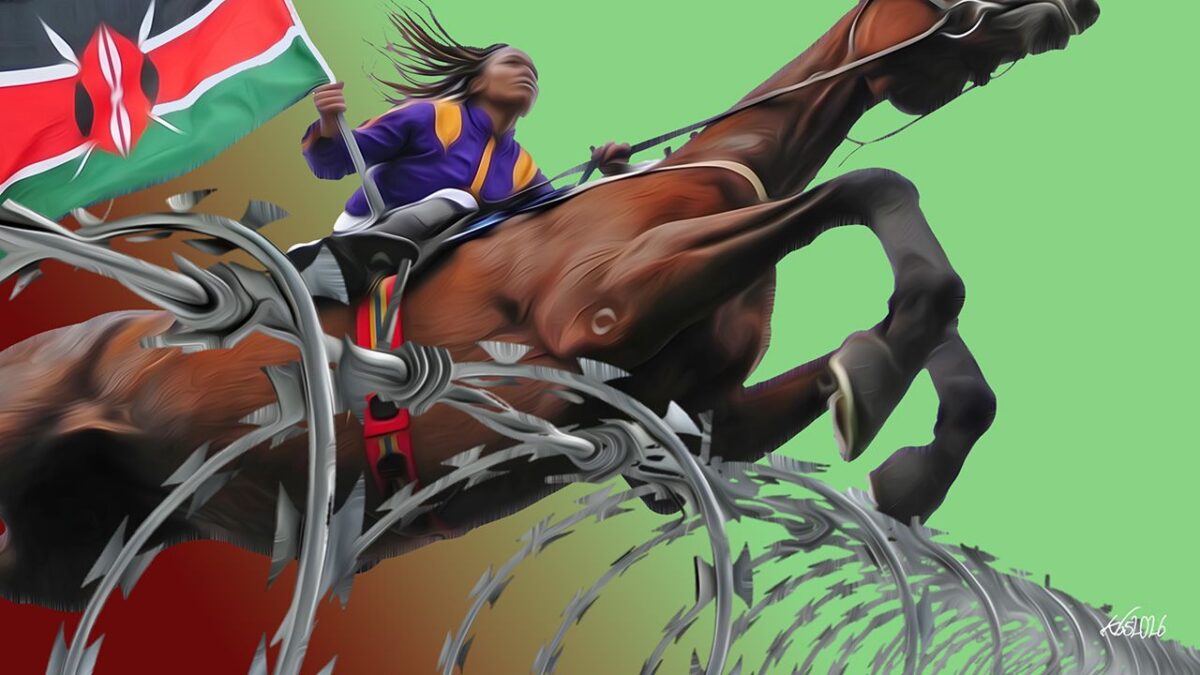
The sense of betrayal by William Ruto’s promises turned to a rage that, by 2024, found younger generations thrust into deeper economic distress. Fuelled by the rejection of the Finance Bill 2024 and the violent suppression of those who demanded its withdrawal, Kenyans took to the streets. But within that revolutionary fervour, something unaccounted for emerged: donned in the colours of the national flag, Kenyans from all walks of life voiced their demands in the streets’ revolutionary energy: FEARLESS, LEADERLESS, TRIBELESS… WE THE PEOPLE SHALL. These were not slogans. They were new theological categories, birthed by a new native.
As noted earlier, the state’s ability to imagine its violence as participation in a providential design – conquest as mission, slavery as salvation, hierarchy as orthodoxy – twisted doctrine into ideology. Black flesh at the auction block became evidence of God’s will; European power, the necessary instrument of that will, was sanctified through the ideology of order. This created conditions where the native could participate in the liturgy of the state only if he accepted three conditions: first, that he lives in a perpetual state of fear; second, that his legitimacy is curated through recognition by a tribal chief; and third, that his identity is codified within a tribal matrix. Within these conditions, the native was accepted as a “good native”, worthy of redemption.
The younger generations’ rejection of these liturgical conditions did not merely end the Nietzschean crisis of value deepened by the 2007–08 post-election violence; it thrust open the very foundations of the colonial state and created a theological possibility. This possibility is perhaps best articulated by Kenya’s towering historian, the late Bethwel Ogot: before the colonial construction called Kenya Colony existed, there were people. We had not been invented; we were. And because we were, we the people shall. A renewed self-respect and self-dependence have emerged, turning Zurara’s logic on its head. The native who in times past was spoken for, is now speaking for himself, asserting his humanity not as a comparative prerogative to justify his existence, but rather, as a self-assured new man – a new kind of self-expression, and spiritual development that now moves towards the unfinished task of material and communal progress towards the Kenyan idea. A journey towards the full initiation into the Kenyan Republic’s democracy. The attainment of a significant new phase of group development: a spiritual coming of age.