|
Getting your Trinity Audio player ready...
|
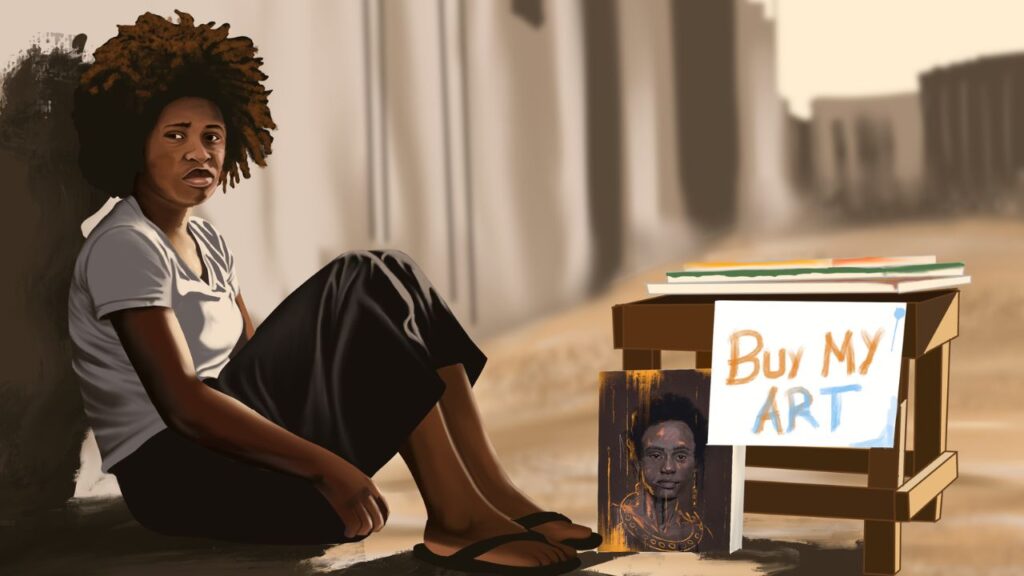
Now, more than a decade after leaving high school, we have made it a routine to frequently meet in a movie store, almost every evening. We are weary and jarred by the despair of our current situations. In our minds, the country outside of this movie store is guilty of most of our miseries. We know that we have done our best, and our papers are proof of this. But the government, the systems, the leaders have failed us. “Jobless Corner” is the moniker we have given this movie store.
We who gather here include a mechanical engineer, an electrical engineer, a computer scientist, a teacher of English and Literature, a journalist. Our host, the movie guy, is a doctor. We were all classmates in high school. Often, we recount our days in high school. We think of the big hopes we held; how the order of our lives revolved around early dawns, late preps, sometimes trans nights. Our commitment to hard work was grounded in the rewards promised. “Do well. Get into university. Graduate. Get a job. Live happily ever after.” This was the script; the euphoria. We did well, went to university, some of us even studying courses that took more than four years to complete. We have hunted for jobs, sent out our résumés and CVs. We have asked for connections, exhausted our networks. Nothing has come of it. Nothing seems to be coming of it.
If you found us in this movie store, you’d assume that we are here to collect movies. No. We gather here to share our despair. Our interactions are often tinged with irritation, stress, bitterness, frayed tempers, and bad humour. We are examples pointed at by men and women, even school dropouts. “They went to school, but see, they are just as useless.” Chiding laced with derision are constantly directed at us.
“This country manze!” Alvin, the teacher, blurts out one evening as we are seated in our Jobless Corner. He says this as he slaps away a film of dust from his legs and sucks his teeth on noticing that he has nicked his lower leg with a fingernail. A spurt of blood stands on the cut. I hand him a piece of tissue paper. He wipes the blood away. It is not a big, serious cut. We all look at Alvin’s cut in silence – except for Powell, the mechanical engineer, who snorts. He was never like this when we were in high school. Back then, he was reserved, collected. This change in character might be due to his heavy smoking. Powell’s lips have blackened, and the tips of his fingers are stained with resin. He is unkempt and dishevelled, but so are we. These days, he jokes too much, with so much juvenile silliness. He drags his sandal on the earthen floor, causing more dust to murk the air.
“Wacha hizo,” Alvin, whose voice is ever solemn, reprimands Powell.
“Sawa,” Powell responds, sneering at Alvin.
“Si you connect me to your WiFi?” John, the software engineer, requests Mboya, the doctor. John’s claim is that he is trying to install some software that he needs to use overnight. Unemployment has rendered us insomniac, even I, who always struggled to keep my eyes open after 10:30 p.m. in high school. We have been forced to become nocturnal, always up during the wee hours, monitoring our emails to see if there are any online writing opportunities. These opportunities have greatly reduced now that many of our clients are opting to use Artificial Intelligence. Also, some of these clients are reluctant to assign work to us following a recent documentary that exposed how we shadow scholars, mill essays, and do assignments for university students in First World countries.
We are not only forced to be nocturnal, we have to be alert during the day, too; diurnal. Work could be calling at any time.
Mboya connects John to the WiFi.
We ask to be connected, too.
It is while Mboya is feeding the WiFi password into my phone that Mali Ya Mungu walks in. Mali has slumped shoulders and always hikes his trousers up past his waist. He lopes towards us carrying his broken sandals, reeking of Chang’aa.
“Ahhh Mbooosh!” The familiarity with which he salutes Mboya suggests one thing: he needs some cash to go sort himself. Sorting could mean buying food or any of the substances he uses. His request is always as little as ten Kenyan shillings. Mboya warms to Mali Ya Mungu. They bump their chests, then he asks Mali to wait for a bit. Mali Ya Mungu stands aside, his hands crossed behind his back. He hawks up phlegm loudly. A few months earlier, he would have spat in our presence. He can’t do this anymore. Not after the caning he received in the market for such nasty behaviour. After Mboya is done putting the WiFi password for us, he walks back to his desk, gets a twenty-shilling coin, and hands it to Mali Ya Mungu. Mali flatters Mboya. He declares blessings over Mboya. As he walks away, he finally spits a big glob of green phlegm. We know that the green is from the miraa he chews.
Four weeks after I receive an email asking me to write an article on Structural Adjustment Programmes and their implications to the Kenyan economy, I sit with Mali Ya Mungu in a car wash bay. In these four weeks I have thought long and hard, searched for an angle from which I can best approach the subject. I have bounced story ideas with the commissioning editor, and we have agreed that I should write about my unemployment situation. I have read articles and researched endlessly on SAPs, looked closely at their effects on the Kenyan economy. All through, I have panicked at the possibility of losing out on this opportunity. I need it. I need the honorarium that I will be paid. I am broke, and any money goes a long way.
Tracking Mali is always a problem. He has no fixed place of abode. He moves, stays, leaves, driven by his “demons”. When I find him at the car wash, I don’t let him off without interviewing him. Shouts of “Maliiiii” from children passing by filter through our conversation. I have had to buy him breakfast, Black Tea, and Mandazi, to lure him to talk to me. Buying him a meal is the ultimate way to his heart.
I start with Gothenburg; what took him there? Everyone in Riat – our market – knows how much Mali talks about his time in Sweden. His conversations are almost always about his time in Sweden.
“I went to Sweden on a student’s scholarship,” Mali says, his words shaped by the frolics of nostalgia.
“Do you remember who gave you the scholarship?” I ask, flicking the nib of my pen in readiness, should he remember the name of the organization. He doesn’t remember.
I only know of SI scholarships which fly students to Sweden, but on searching further, I realize that SI started in 2018. Mali Ya Mungu, according to his story, was in Sweden in the early ‘80s.
“There was a period when a number of young Kenyans were leaving. The economy was falling. Abroad, anywhere abroad, was a great place for any young person to go try make it.” He pauses, allowing a reflexive silence to occupy the air between us. His eyes have a shadow of sadness. I wait for him to continue. In the pause, I think of a paragraph in Binyavanga Wainaina’s memoir One Day I Will Write About This Place. “My parents are worried,” Binyavanga writes, “the government, pressed by IMF, is about to stop subsidizing university education.” Could this be the reason Mali also sought a scholarship to study abroad? I wonder, my eyes intently fixed on him.
“When did you leave for Sweden?” I ask.
“I left on 25th January 1985, at 12:04 p.m.” The preciseness of the date and time confers on his response the gravity of truth. Mali stands, brushes off dirt from his behind then walks away limping. “I am going to my office,” he mutters. I know that he has no office. I know that he is deluded. In his head, Mali is still listening to the sounds of a life lost years ago. I remain seated as I watch him walk off. His limping doesn’t hide the furtive manner of his movement. I feel frustrated that I have not been able to complete my interview with him.
Mali is part of that generation that was affected by SAPS 1.0. He used to work for a subsidiary of a multinational company that retrenched him without offering him sustainable compensation. He sued his employers, tried all he could. But his efforts were futile. Eventually, his finances were depleted and he was left jobless, hopeless, eventually becoming mentally unstable.
“Mali returned either in 1989 or 1990,” a surviving relative of Mali’s tells me. She is his sister-in-law who was already married into Mali’s home when he returned. What contributed to Mali’s degeneration,as she says, was because he couldn’t find a job despite his excellent academics and work ethic, which was evident at his previous workplace. She says that Mali tried all he could after he lost his job. When nothing came forth, he resorted to using substances. At first, in small doses to manage his stress, then he became a heavy user. His family fell apart. His wife left with his daughter, moved away.
“It was really painful witnessing all this,” Mali’s sister-in-law says in a defeated voice.
Ugandan writer and journalist Yusuf Serunkuma writes about the pain his family bore after his father’s retrenchment. “We are the children of these men and women. By their dreams being suddenly and permanently shattered, their children were direct victims. We carry their deferred dreams in our souls, and their pains and frustrations continue to shape our daily realities.” Yusuf’s context is Uganda but the observation is true for Kenya as well. I am the child of a man who turned to working in the informal sector despite being a trained engineer. Frustrations from job hunting pushed my father to the wall, and together with a peer, he opened a kiosk in downtown Nairobi to sell motor vehicle parts and repair motors. Two decades later, I am stuck in these same throes. Maybe even worse with the rolling out of SAP 2.0.
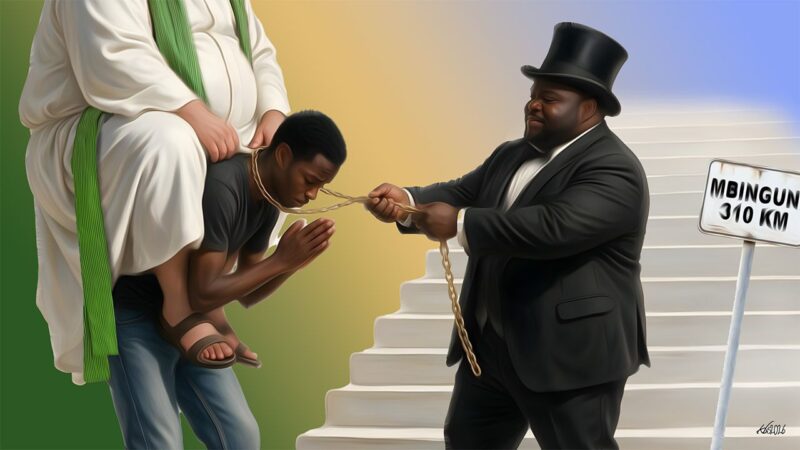
“Truth,” as Franz Fanon puts it, “is that which promotes the emergence of a nation.” It is a quote that has stayed with me ever since I started thinking about and analyzing the emergence of Kenya. The truth about the Kenyan economy is that it has been run by governments whose interests are rarely pro-people. The leaders we have are always ready to cut deals and do handshakes that auction Kenya. The Bretton Woods institutions understand this and have for long ridden on our leaders’ gluttony. Unfortunately, we, the native, the diligent citizens, are the ones left to suffer. What is the object of our suffering? Do the IMF and World Bank revel in our suffering? These are the questions that keep disturbing me when I think of Kenya’s financial situation.
Mali still languishes. I am languishing. My generation is languishing. The prevailing realities we encounter every day never cease to remind my generation of our stolen future. Isn’t it said that futures lost make us protest any other possible futures? Wanjeri Gakuru puts it better when she writes about why SAPs require poor countries to reduce spending on things like health, education and infrastructure, while debt repayment and privatization become the priority. Her article explains why, in effect, the IMF and the World Bank demand that poor nations lower their people’s standard of living. And this, to us, is a tragedy.
For me and my classmates with whom I sit most evenings at our jobless corner, I hope that we shall mend our broken dreams. I cling to the promises we made to ourselves when we could still see a light in our future. I can’t wait to see the mechanical engineer, the doctor, the software engineer, the teacher, and I, the journalist, all of us able to make ends meet. May we still whistle, dance, debate, seek opportunities, until we reap what we have sown all these years.