|
Getting your Trinity Audio player ready...
|
Two nights 141 years apart capture the heart of the unending darkness that is Ugandan history; the first, on the 9th of October 1884, largely unknown outside specialist history circles, has been baked into the genesis of the country’s modern crisis. Without it, the second crisis that will define the country for decades, the night of 15 January 2026, would not have happened.
On that early October night, all the more fateful for falling on the same date as Uganda’s independence would 78 years later, the capital which would in another age become known as Kampala, did not sleep. Day after day, for months, the many settlements of Swahili, Arab, European and Buganda chiefly households had armed their followers in readiness for the expected rupture that the death of Kabaka Muteesa would throw the kingdom into, the habitual orgy of bloodletting and pillage that followed the death of a monarch. These many settlements, by which Kampala was already cosmopolitan, had informants, some of them aristocratic allies in the court, who kept them apprised of what was happening. Through that night, these practised performers of shadow-slinking showed up at windows and whispered, “Sultan amekufa”.
That long ago, Kiswahili was already an official language of the capital, and all who went there for serious business, including the missionaries, even Captain Frederick Lugard himself, learnt to speak it out of necessity. Kabaka Muteesa reportedly spoke it and wrote it, in the Arabic script.
That night, the expected trouble after Muteesa’s death did not materialize. The implications would have been unpredictable and serious. The last time a Kabaka had died, in 1856, there had been no international presence in the capital. Now there were several well-armed camps. Credit for the unusual, peaceable passing of Muteesa, and the accession of his son Mwanga to the throne, was attributed to Katikiro Mukasa, the Prime Minister, perhaps the most capable man to have ever held that office, and whose own tragic death in 1888 fills you with immense sadness. But a more pragmatic explanation was given by missionary and writer, Robert Pickering Ashe who, in his book Two Kings: Or Life by the Shores of Victoria Nyanza, explained that all who could have caused trouble had barricaded themselves defensively in their stockades expecting to be attacked. It was calm by default as much as by the capabilities of Mukasa.
Visions of what that night would have been like have long haunted my mind, but through the days before the January 15 election, they kept coming. The harrowing knowledge that the country we had always known was going away forever. A comparable period of transformative terror would be the 1966 fighting at Lubiri when Obote and Muteesa’s great-grandson, Muteesa II, fell out. On the night of this year’s election, the silence, the fear and the communication blackout, made for a night worse than any during the 2020–2021 COVID-19 curfews. For straight weeks since then, masked demons have prowled Ugandan neighbourhoods, leaving wailing and death in their wake.
We were never a democracy. But once more we are a terror state.
There are uncomfortable, contextual parallels. By 1884, the gathering dark clouds of international intrigue had fully descended upon African societies, not unlike what the world is today. In Buganda, internal factors that would blow up as a concealed revolution in the guise of religious wars, were already simmering by 1884, and not unlike they are today. Only the guile and experience of Kabaka Muteesa kept things from blowing up. Looking at his potential successors, his death at this inopportune moment scared everyone.
Within a month of his death, in November 1884, the first meetings in the Scramble for Africa would be held in Berlin. It was a foregone conclusion that Buganda was headed for a messier colonization than other societies. Her bad luck was that she sat at the source of the River Nile, and whichever European power got there first stood to control the world. This is in fact what the Mmengo wars were about, for France and Britain fought it out through the proxies of French Catholicism and English Protestantism. In a telling moment, the Catholic White Fathers were caught gunrunning, a matter that chafed the Germans in Tanganyika, through which the Victoria-Indian ocean route still passed. (After Tanganyika was fully occupied by Germany, Britain was forced to develop the Mombasa-Victoria route.)
Earlier in 1876, Muteesa had hosted representatives from Bunyoro and Zanzibar in what was arguably the first Upper Nile Basin conference to discuss the threat to their sovereignty via the river. After the meeting, they decided to send a delegation to Cairo. They got only as far as Lake Kyoga, a five-day walk from Lubaga, and were dismissed by Maj Charles Gordon, Governor of Khedive Ismail’s Equatorial Province, who in a letter to his sister described them as dirty.
Muteesa had managed to contain whatever threat he thought Christianity might bring. By 1884, the missionaries had sat for years and not scored more than five recorded conversions. They were kept close to court, away from the general population. Muteesa’s closest allies, the Zanzibaris, were fearful of Egypt. (Looking back now, the Egyptians were not cut out for imperialism; too clumsy, they were unable to separate religion from politics. ) Khedive Ismail stated openly that he wanted to take over the lucrative trade in ivory and slaves which the Buganda court controlled.
As R. P. Ashe described it, the default mood in the capital was fear of a powerful, deadly world closing in. He wrote:
“Knowledge of the vast hordes of Muhammedans in the Sudan had always hung as a dark cloud on the northern horizon, making thoughts of the future of Uganda gloomy in the extreme, since it seemed morally certain that, sooner or later, these hordes of Muhammedans would make their way southward to Uganda.”
Ashe’s poor and inaccurate perspective is a deeply embedded Eurocentric fear of Islam, and if any echoes of the latter day “war on terror” are therein, it is because he and his contemporaries projected their own fears upon the emerging colonies in Africa. More accurate would have been to say that the feared dark cloud for these societies was the one he and his compadres brought with them. It is remarkable that hardly any of the European chroniclers admit this, or their role in the deaths of Christian converts even when their reckless continuation in communicating with the hated Egyptians from their stations in Buganda directly led to the killings. But that is a story for another essay.
What we now think of as the international system was by the mid-1880s on the very brink of a full-blown crisis. World powers – and in 1884 this applied majorly to Britain, France, and Germany in our context – were everywhere on the prowl. The arrival of news that a White pasha was rapidly advancing from the Congo with a full army was one of the factors that precipitated the massacre of Christian converts in Buganda. (As it turned out, this “pasha” was explorer and colonial agent Henry Morton Stanley himself, who had earlier visited Muteesa but was now in the employ of Belgian Monarch King Leopold II, laying claims over Congo; by this frightening period, he was marching towards the Nile, and placed in Darfur. ) This rumour of colonialists closing in was now coming from all directions: From the north along the Nile; from the East where parties of English travellers were beginning to breach the once feared, direct, Mombasa to Nyanza route; from the South where the German empire, by occupying present-day northern Tanzania, had cut off Buganda’s presumed control of Lake Victoria.
The urgency of these fears was brought closer home by the fact that Gordon had managed to establish a steamboat service linking Cairo to what the British already referred to as the Albert Nyanza (but a lake the Bantu-speaking locals call Muta Nzige and Nilotic speakers, Onek Bonyo). In Bunyoro-Kitara, Omukama Kabalega immediately arrested an Egyptian representative, Gaetano Casati, over the matter.
These events were beyond the control of Muteesa. But what he still had under his control was his kingdom. Its unity held out the possibility that it might, with luck, resist these marauding, imperial forces. If he died so soon, even that unity would be gone.
After two decades on the throne, Muteesa had grown adroit enough to keep the many political plates spinning over the kingdom’s future from crashing down. He had contained Christianity, for good reasons as events after his death were to prove. He kept Zanzibari traders constantly at court because they were his eyes and ears about the goings-on in the high seas. This did not mean that he really trusted them, but they heartily told him what deadly intentions lay behind the benign exterior of these men of the cross. If anybody understood the violence of Christians, it was these Busaidis, with no little memory of what the Portuguese had done to them in the Strait of Hormuz, to say nothing of battling them in Mombasa and Malindi. The one limit for Muteesa was the Egyptians. He detested them. Testimonies and observations of the time record the extent to which Muteesa hated the Egyptians. After an Egyptian party sent by Gordon and led by one Aga Nur planted the Egyptian flag over Kampala in 1876, they were no longer welcome to the kingdom. They called him a kaffir and dismissed his claims to being an imam, which he was by leading Islamic prayers. Insulted, Muteesa abandoned Islam and fell back to Kiganda religion. He would never again trust that a foreigner’s religion was not laced with imperialism. All that was associated with Egypt immediately came under suspicion.
Egypt had openly declared that all territory of the Nile Basin belonged to it. Upper Nile countries, from Buganda, Bunyoro, Lango, Acholi, to Bari in present-day South Sudan as well as north Sudan, were effectively at war with Egypt. Egypt had its work cut out for it; they made her riparian imperial ambition too costly. When she failed, colonization was the ironic price she paid, via a debt trap. The many, many White warriors, engineers and administrators Ismail paid did not come cheap.
The Church Missionary Society made the fatal error of sending their second batch of missionaries through Port Sudan, which meant passing through Egyptian-controlled territory, the so-called Equatorial Province. Worse, they were hosted and briefed by Gordon himself. Muteesa had his spies along the Upper Nile Valley who kept him informed of their progress and was told that they were escorted by Gordon’s Egyptian officials as far as his northern border.
If any man embodied the nervousness at the capital, of Egyptian designs, it was Gordon. Brash, arrogant and a poor judge of character, and finally suicidal, Gordan had in that 1876 “mess”, as he called it, nearly gotten the troops of Aga Nur killed in Kampala. It was mostly over the fear of Egypt that Muteesa, through his famous letter to Queen Victoria, asked for closer relationships with Britain as a counterweight against Egyptian threats. Contrary to Christian propaganda, Muteesa never asked that England send missionaries. But in making this demand, he was merely following the Zanzibari playbook, not inventing a new strategy. The Busaidi dynasty, which maintained a diplomatic link to Muteesa, had leveraged friendship with the British for decades since 1827 when they overthrew their rivals, the Mazruis. For Zanzibar, the alliance proved long-lasting and kept other European powers from vandalizing what the sultanate saw as its territories.
Much was in balance. The Zanzibaris fought hard to find a cure for Muteesa’s illness. The many settlements in the capital very well understood the ruthlessness of Muteesa’s temper. In 1876, he had ordered the execution of nearly a thousand Muslim converts after Egyptian clerics fomented a rebellion against his government, in a martyrdom far worse, but unheralded, compared to the massacre of Christian converts ten years later by his son and successor, Mwanga. In contrast, the accomplished Zanzibar Muslims understood the difference between geopolitics and theological fixity and did not interfere with Muteesa’s interpretation of Islam. They appreciated his firm handle on his government, and his diplomatic skills kept things on an even keel. He was, in his 40s, a grand old statesman already. As long as he remained in charge, Buganda could rely on its policy of strategic ambiguity, appearing to say yes to everyone but never delivering the final goods they desired.
This strategy broke down on the 9th of October 1884. By their preparations (including the Christian missionaries carrying revolvers), all understood that the death of Muteesa would spell catastrophe.
In 2026 Uganda, as in 1884, a steady, nervous breakdown is descending on the country. But the momentousness of what this means finds few parallels. The January 2026 elections were neither ordinary nor routine. The National Unity Party presidential candidate, Bobi Wine, tapped into buried impulses and hopes denied Ugandans since the advent of colonial rule. This time round, the very act of voting was itself a ritualistic performance, the real war of which few in the country were fooled about. All who lined up to vote understood that their ballots would be manipulated; the real reason for their turning up in the first place is what ought to concern us immensely.
The 2026 elections drew a long period in the country’s modern history to an end. But what are the implications? The parallels between what became of Buganda between Muteesa and his son Mwanga might offer some leads. The events after Muteesa died are fairly well known and need not be repeated here. But it is not worthless to indulge in a what-if scenario.
What might the country that came to be called Uganda have turned out to be had Muteesa remained on the throne for at least another decade, until, say, 1900? He was only 47 when he died. What would have happened had his long-serving Katikiro Mukasa not been murdered in 1888 by the Muslim forces of the short-lived reign of Kalema in that year? How might Muteesa have handled the coming of Captain Lugard in 1890?
It is unlikely that Muteesa, unlike his son Mwanga, would have signed the 1890 Boxing Day treaty forced on him by Lugard to accept the Imperial British East Africa Company as arbiter of Buganda affairs. Had he been alive, he would have been a mere 53 years old when Lugard arrived from Mombasa. He would most likely have kept Lugard languishing on the sidelines with promises of future friendship with the Imperial British East Africa Company.
But, even with an alternative history, that is going too far. It is likely that Captain Lugard might not have come to Buganda in the first place. The religious wars that broke out after Mwanga failed to contain the spread of Christianity were the pretext under which Lugard marched to Uganda. If Muteesa had been alive that long, some spread of Christianity might have happened, but it would have been tightly regulated. Then again, it might not have spread because the subjects of the Kabaka followed his religious affinity, and he had resolved to follow Buganda religion. The missionaries would not have dared cross Muteesa as they did Mwanga.
In similar vein, what if the Katikiro Mukasa had still been Mwanga’s Prime Minister in 1890, rather than Apollo Kaggwa, would Mwanga have signed that fateful treaty? Suppose he had still been the Katikiro in 1900, how would he have handled the relationship with Sir Harry Johnston, who drew up the infamous Anglo-Buganda Agreement of that year?
Mukasa, like Muteesa, would have kept Johnston waiting and distracted. No 1900 Agreement would have been signed. It might have been titled the 1910 Agreement instead, by which time Buganda would have bought time enough to win a better place under the 20th century sun. But again, it is unlikely that things would have gotten that far. Once again, the failure to contain the Christian contagion was what led to the fatal land quagmire that was the essential element of the Agreement, and which quagmire has contaminated Buganda ever since.
The years between 1884 and 1892 was the period when the kingdom most needed level-headed and experienced leadership. Instead, it had as a Kabaka, a teenager, and as a Prime Minister, 20-year-old Kaggwa.
Through this brief, futile, what-if exercise, it becomes clear what went wrong. Largely speaking, the curse of Uganda is that the British created its formative colony in response to the post-Muteesa collapse of central, unitary and traditional authority in Buganda. When you break it down, the 1900 Anglo-Buganda Agreement divides evenly between the first 14 articles addressing the fall-out of the Mmengo wars, and the rest stitching together a kingdom that would respond to British needs.
It was largely created to protect the gains of the Anglican Protestant faction that emerged victorious from that conflict. In this, it succeeded spectacularly. But the immense economic and political clout of this small class, alas, came at the expense of Buganda and Uganda at large. Because the ruling, pro-Britain class in Uganda emerged via brute military force, it has had to periodically use the same force to continue its hold on power.
Another what-if scenario:
Suppose the epicentre of British colonization of what came to be called Uganda had not been Buganda? This is less a what-if scenario than a real life description of what very nearly happened in early 1892.
As early as January 1892, the grinding impact of the religious wars, which were more violent than one can imagine, and the threat of the IBEA Co withdrawing from Uganda, led Lugard into considering withdrawing with his forces and taking with him the bulk of Protestant converts to found a new state anchored in Toro, in western Uganda. This would have left Buganda firmly under French, Catholic control. The kingdom would likely have become a French-speaking enclave today, as small and as isolated as Rwanda and Burundi.
In a similar vein, what is today Uganda would have been called a completely different name. It would still have linkages to Kenya and Tanzania, for Lugard’s intention had been to keep the parts of Buganda closest to Toro and Ankole (he had intended to enjoin Ankole to the new country) – that is, the province of Buddu, for access to Lake Victoria. He would have joined Busoga to this country, for the Basoga chiefs, who had welcomed him and kept the new Fort Kampala supplied with food, had won a place in Lugard’s heart, so much so that he went out of his way to ensure that Buganda no longer interfered in Busoga affairs. Article 2 of the Agreement, which is largely a ratification of Lugard’s analysis of the kingdom, is very specific about this. It says:
“The Kabaka and Chiefs of Uganda hereby agree henceforth to renounce in favour of Her Majesty the Queen any claims to tribute they may have had on the adjoining provinces of the Uganda Protectorate.”
A great deal of Buganda’s wealth came from tribute collected from Busoga.
Might this possible country have been influenced by the political culture of Toro rather than of Buganda’s tempestuous kings? What might that have been like?
If it had even been conceivable at the time that the centre of the colony could have been placed in eastern or northern Uganda, what might have happened? To start with, the lowland plains of eastern and northern Uganda were not considered European weather and so we would have to imagine a different kind of colony. But the colonial administration in present-day Uganda, in the pre-World War I years, extended as far into modern Kenya as the Kedong Valley, and so the question is not academic. What is today Uganda might well have been part of the planned but aborted East African federation, which Buganda successfully opposed. Toro, with its high altitude, was and continues to be an attractive place for the British. But just imagining that it might have been centred in northern or eastern Uganda, Uganda’s politics would have been influenced by a republican, rather than monarchical, structure and culture, much like Kenyan or Tanzanian politics.
It would not have been perfect, but it would have been less class riddled, less characterized by competing, republican-monarchical tendencies. Decades of civil wars, arising from the fraught relationship between Buganda and the Uganda central government, might have been avoided. The kingdoms would still exist, but they would have been no more effective than say Nabongo Mumia or the coastal residues of the even more powerful sultanate. They would have been inutile sub-regional curiosities. Compromise and horse-trading, rather than civil war, would have characterized Ugandan politics.
The layout of Kampala City itself seems to suggest such a possibility. Much as the kingdom was revived in 1993, the accelerating economic and cultural infrastructure has left the epicentre of Buganda politics, Mmengo, in a time warp. You only have to move deliberately from Kampala west to Kampala east to be shocked at the difference. Kampala west, which was once the capital of the Kingdom, is still stymied by the 1900 Agreement land reforms. Rather, east of the River Lugogo, is where the city sparks to life. The dynamic, the young, the dreamers, the hip and upwardly mobile, live in Kampala east. And it continues to expand.
This is what-ifery. As things happened in real life, on the 9th of October 1884, Muteesa did die, as did Katikiro Mukasa in August 1888. The IBEA Co did not withdraw from Kampala. The Church Missionary Society rallied the English into pouring some £416,000 in 1892 (£68 million in 2026), as Eugene Stock wrote in How Uganda Was Saved, to rescue the Kampala entrenchment of Lugard, but of Kenya as well. This was an astounding amount of money. But given that the company seemed more involved in warfare than in trading, perhaps it makes some sense.
What is the point of this exercise? To start with, the events did not leave my mind throughout the week during which Uganda was cut off from the world, which means that there lay some resonance therein.
Perhaps the reason is that the parallels between the Kampala of 1886–1927 and the country between 1986 and 2026 are striking. Now as then, we are on the precipice of a far-reaching political earthquake; chances that there might be no Uganda after President Museveni cannot be discounted. Not President Milton Obote, not even President Idi Amin, dreamt of bringing their families into government the way President Museveni has done. Apollo Kaggwa and Museveni, who held political powers in these periods, won it militarily; they were understood to be facilitators of imperial rule against their own people. The profound political ideologies of these disparate periods emphasized market capitalism and, towards the end of both periods, the unravelling came from threats of global conflicts.
But more seriously, the succession to the thrones of both Kabaka Muteesa and President Museveni came after both men caused severe crises in how both their countries were governed. In the case of Museveni, the destruction of constitutional guarantees against tyranny with the removal of presidential age limits, and before that the removal of the two-term limit, cratered confidence in the state and has led to the destruction of public life. This has left Uganda extremely vulnerable to the coming age of global conflict.
Less well known is the fact that Kabaka Muteesa did something similar in 19th century Buganda. And through the series of conflicts brought about by Victorian imperialism, Buganda was left with little of the internal unity which was the only viable defence line that might have saved it from colonialisation. It happened in unusual ways.
Since the reign of Kabaka Kamanya from 1814 to 1832, as scholars in Buganda narrate, including Prof Abdul Kasozi in his 1974 doctoral thesis at the University of Santa Cruz, California, The Spread of Islam in Buganda, 1844–1945, a standing conflict had developed between the Buganda throne and its priests. Others place the beginning of this conflict with Kabaka Kyabagu. Kabaka Kamanya, the father of Kabaka Ssuuna (1832–1856) and Muteesa’s grandfather, began the undermining of Buganda’s religious fabric by challenging long-held traditions. Under the influence of Islam that had arrived by at least the mid-1840s, Ssuuna continued to erode this power by ordering that the ancient, Bunyoro-Kitara cult of the monarch’s jawbone be scuttled. Muteesa in his time ordered that no one should in future be possessed by a Kabaka’s spirit. What did these actions mean?
As Prof Kasozi argued, the total sum of their actions was to “confuse” society as a whole. Kabaka Ssuuna rejoined the jawbones of dead, past Kabakas to their bodies. This was already a serious realignment of the spirit realm. The separation of the dead Kabaka’s jawbone from the body had been a serious act by which the spirit of the departed was kept here on earth, to be with the living – spiritual ideas that in earthly terms were checks and balances against tyranny and a guide to the living. Ssuuna, had in effect, expelled the spirits of his ancestors from presiding over court and kingdom; in other words, constituted safeguards against tyranny were revoked.
Muteesa went one further and ordered the exhumation and reburial of past Kabakas, reuniting the tomb and the temple of the Kabaka. The jawbones had been kept in their own temple, separate from the tomb. Muteesa did not stop at reordering the past. He changed the future. He left instructions that his own jawbone not be detached at his death, and by stipulating that his spirit not possess anyone after his death, effectively ended the cult of the Kabaka. After Muteesa, the society was cut adrift from its spiritual past. He was undermining his own and his ancestors’ thrones; he had dissolved the kingdom’s theology, and with it, its spirituality. Such drastic measures had already thrown the metaphysics of the kingdom into turmoil. It would have been a surprise if the decades of catastrophe did not follow. The spirit realm was in much direr turmoil after all. By the time of Kabaka Mwanga, there was little metaphysically attached to the throne. What was to be done with the spiritual spaces so thoroughly evacuated by Muteesa? How were they to follow a Kabaka who was no longer sacred? This was the highly complex reality of the capital that Kabaka Mwanga inherited.
The straight answer is that Islam and Christianity filled the void. This was not unique to Buganda. In this narrative, Muteesa is starring as the priest Ezeulu, Chinua Achebe’s fictional priest of the Igbo god, Ulu, in the novel, Arrow of God, who challenged both man and God by refusing to allow a well-known rite to proceed, driving the people into the arms of Christianity.
The parallel that makes immediate, visceral sense is the Museveni family seeming to line up his son and Commander of the Ugandan Land Forces, Gen Muhoozi, as heir apparent. The descriptions made of Kabaka Mwanga by his contemporaries read almost like a character sketch of Museveni’s son – an entitled, arrogant motormouth not beyond boasting about how many people he has tortured and killed. Like Kabaka Mwanga facing Britain, Gen Muhoozi seems to think that because his own father has life and death powers over Ugandans, this means he has the same powers over humanity and cannot imagine that the USA is a power of another magnitude. Like Kabaka Mwanga, Gen Muhoozi is fatally blind to this kind of realpolitik, as the former’s misjudgement of Captain Lugard, comparable to Gen Muhoozi’s belittling of US Ambassador to Uganda, shows. But it gets worse for Gen Muhoozi. His self-reference of being “Chwezi”, a mythological cult in Bunyoro-Kitara, already maps his psychological terrain, a place of profound inferiority complex for which violence is used as compensation for the centuries of derogation. He suffers a disabling god complex, and for that, there is no political remedy. There can only come a fall.
Events in Uganda already show that someone other than Museveni is in charge. The overt use of the military right inside polling stations is not something Museveni would have done. The large-scale kidnapping and torture of opposition politicians and supporters is more Gen Muhoozi than Mr Museveni. The confiscation of the national flag from private Ugandans, not unlike Kabaka Mwanga personally using French Catholic forces in 1891 Kampala to attack his own government, was the final straw that alienated Ugandans from the Museveni leadership.
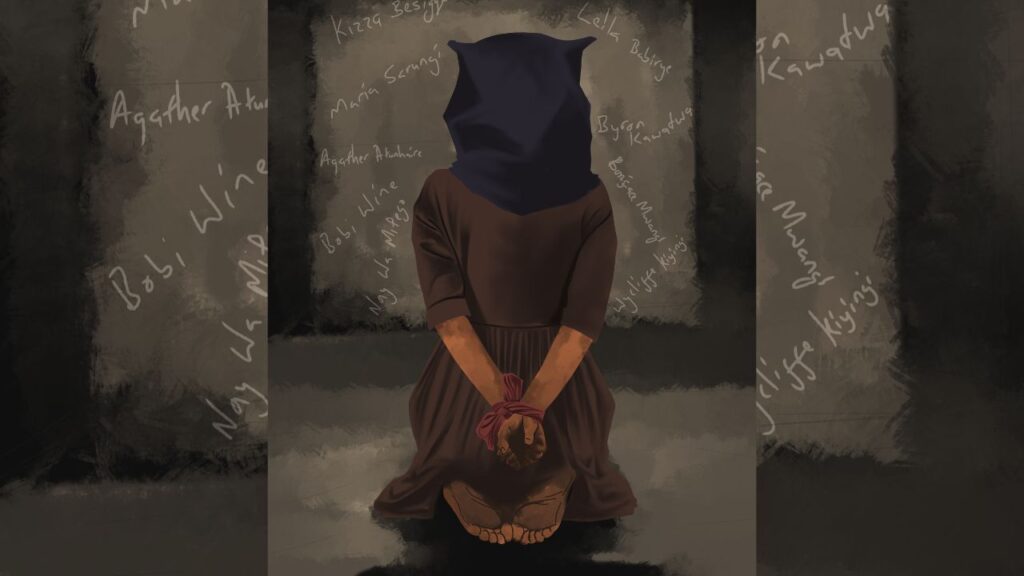
On the night of January 15, I personally felt what was going on when a platoon commander ordered a soldier to body search me. What was I doing at the vote count so late dressed up in biking gear? Was I an undercover journalist or electoral monitor? Later, when I returned home and opened the gate to go down to the shops, I met a line of masked soldiers and jumped right back in. There was something about their match of impunity that raised the hairs on your body. From behind the gate, I heard the cries of young men being caned for simply being out there. I counted up to 30 shots fired that night. In the morning, I learnt that a young man had been bundled up in a sack and thrown into the boot of a car in broad daylight, with guns fired to scare away his friends. This went on for four nights. Under the cover of an Internet blackout, we only learnt of hundreds, perhaps thousands, of young men held in what can only be described as vote-preventive detention in military barracks. This has not happened before and there is no doubt it was Gen Muhoozi’s machinations.
It is very likely that Gen Muhoozi will attempt to become president of Uganda. He and his supporters have said so. If this happens, the massacres like those by Mwanga in 1886 will start immediately. They have started already. The internal strife that befell Buganda in 1888 will follow very fast. Just like in 1888, when first the Catholic and Protestant converts were expelled by the triumphant Muslim forces of Kalema and in revenge the same were expelled by Christians, we can expect in a post-Museveni Uganda that the actions of Gen Muhoozi will lead to ethnic pogroms. His highly disturbing statements about teaching torture victims to speak “Runyankore” in his basement is the seminal disaster that throws dark clouds over the future of Uganda.
There will be repercussions unless drastic steps are taken to counter this morass. But as long as Bobi Wine remains in hiding, we do not know what happens next. Muhoozi has tapped into the powder keg of ethnicity in ways his father is more careful not to touch. All this is happening against the background of a collapsing global system. One of the powers will eventually use the resultant turmoil in Uganda to either occupy it or place its government under administrative supervision.