|
Getting your Trinity Audio player ready...
|
In 1989, when he was the deputy speaker of parliament, Kalonzo Musyoka, the former vice president and now an opposition leader, was a man who would not brook criticism of the one-party state under KANU and President Daniel arap Moi.
In June that year, Kalonzo engineered a vote in Parliament to get Nation Newspapers, now known as the Nation Media Group, banned from covering parliamentary proceedings.
The ban was the culmination of a highly charged debate in the Daily Nation and its sister papers and management that saw MPs accuse the group of being anti-government, disrespectful to Kenya’s leadership, and frustrating pro-establishment politicians, as well as perpetuating tribalism in its employment policies.
Nation Newspapers had been highly critical of the government and MPs, ever since the highly controversial 21 March 1988 General Election in which voters had used the queue-voting method, also known as Mlolongo, to elect MPs instead of the time-honoured secret ballot system.
The newspaper publicized accusations from the Church and civil society that the Mlolongo system had resulted in voter intimidation and enabled fraud during the election. There were also loud accusations that the public voting was “a mockery of justice”, which had rattled the state.
In August 1988, the government had arrested and sentenced Bedan Mbugua, the editor of the influential Beyond Magazine, to nine months in jail. Beyond was owned by the National Council of Churches of Kenya (NCCK) and was seen as the voice of the Church. Its editorial pages had been outspoken and critical of election practices during the Mlolongo poll.
It was in this intolerant political climate that Musyoka’s motion to ban the newspaper group was passed unanimously, with Speaker Moses Keino saying he hoped other journalists had taken note and would, “from henceforth tread carefully”.
During the debate, Kalonzo claimed that Nation Newspapers had persistently and deliberately misrepresented matters discussed in parliament and had also attempted to portray a negative image of the country by reporting on government corruption.
He accused the paper’s reporters of being unpatriotic and said they had deliberately attempted to divide Kenyans and create social disorder.
Kalonzo took particular umbrage with a satirical column by the late satirist, Wahome Mutahi, in which the writer had dared to suggest the country was divided between the haves and have-nots.
Following the ban, Nation Newspapers directors held an emergency meeting after which they expressed deep concern about the statements made in parliament and promised that the accusations would be investigated.
However, Kalonzo was not finished with the newspaper yet. A week later, he claimed the Nation was carrying out a vendetta against him for publishing a photograph of him napping at a presidential function.
The ban on the Nation was only lifted four months later, in October. During the debate on whether to allow the paper to resume publishing, MPs noted that there had been “a marked change” in its reporting and its editorials were now toeing the party line, literally and figuratively.
As a mark of how people can change positions, opening a conference on Media Law in June 2012, Kalonzo, who was now vice president, made a call for greater media freedom, which he said would accelerate Kenya’s socio-economic transformation.
In 2024, the same Kalonzo said: “We are standing with the free media. We need to remain united and ensure that we continue to speak the truth to power. That is the only way we can ensure the country grows and the democratic space is maintained.”
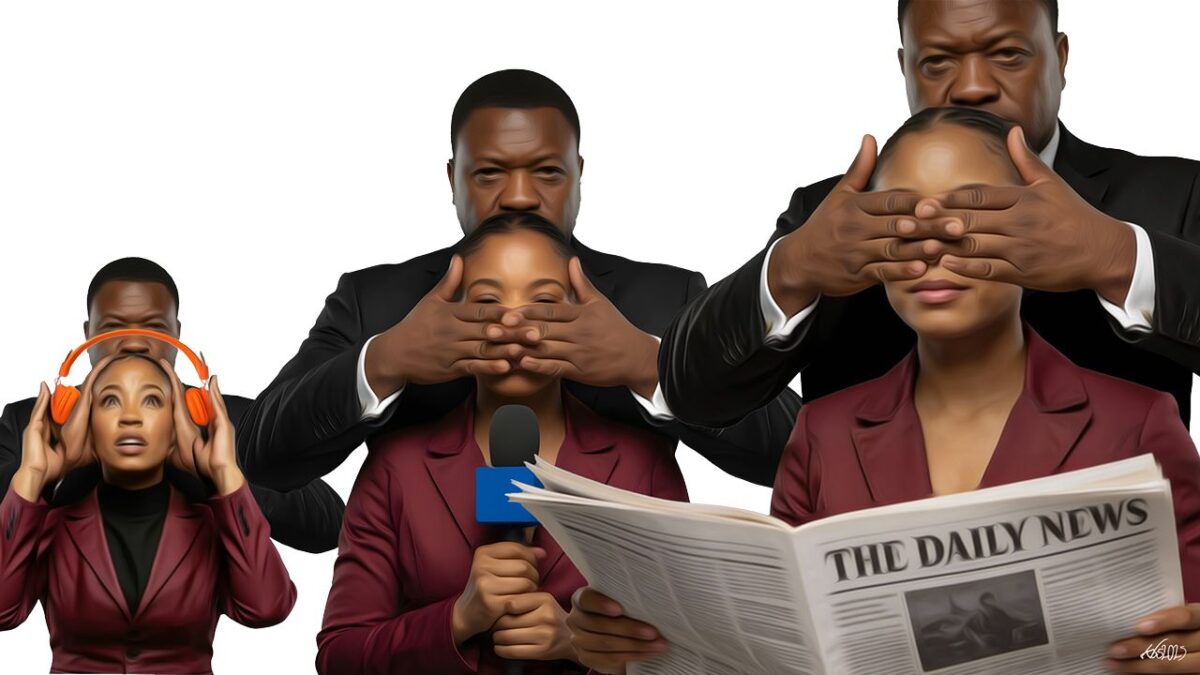
Censorship is a term that often sends alarm bells ringing in the minds of media practitioners, human rights activists, and social libertarians, who believe that the government has no right to impose its tastes and morals on the public. At the basic level, such critics of state censorship argue that people who are old enough to vote can decide for themselves what they want to see or read.
In the analogue era, censorship was conducted through overt, centralized control of physical media. However, the digital era has introduced unprecedented challenges to information control, forcing censors to develop advanced methods, such as cybercrime laws, to manage the vast volume and speed of information flow.
While cybercrime laws are not inherently censorship, governments around the world have weaponized them by broadly applying vague definitions of “false information” or “hate speech” to target opinions or news they disagree with.
This fear of misuse is the root of the problem that many journalists, social media users, and civil society at large have with Kenya’s recently enacted Computer Misuse and Cybercrimes (Amendment) Act, 2025. The Amendment Act, signed by President William Ruto on 15 October 2025, stands accused of containing vague provisions that can be abused by the authorities to suppress dissent or punish protected speech under the guise of combating cybercrime.
There is a legitimate worry after events such as Albert Omondi Ojwang’s abduction and subsequent death in police custody, which was alleged to have been sparked by a post that supposedly upset an influential individual, that the Amendment Act could lead to censorship.
The fear is that Kenyans from all walks of life might be forced into a situation where the legitimate fear of legal repercussions leads them to self-censor, withholding their opinions and views online to avoid potential punishment.
As one who lived through that age, it would be abysmal if we were to return to the analogue or pre-digital era, where censorship was accepted and orders from above to journalists, be they from politicians or media owners, were more common than not.
In the 1990s, news and information sources were limited to broadcast and print media, and from the late 1980s onwards, the facsimile machine, better known as the fax, also played its role, much to the chagrin of the KANU government.
For the benefit of those born after the 1980s and 1990s, the fax machine could be described as a combination of a scanner, a printer, and a telephone that allowed you to send a document to another fax machine at a different location to be printed out.
By allowing for the transmission of images and handwriting – and not just text, like with the previous technology, the telex – fax machines were considered a revolution in business and for newsrooms.
I can remember exactly when the fax machine proved to be a game changer for the Kenya Times Media Trust (KTMT) where I cut my journalistic teeth. It was during the time of the 1990–1991 Gicheru Commission of Inquiry, which was led by future Chief Justice Evans Gicheru and sat in Kisumu. The inquiry was a judicial investigation into the mysterious disappearance and death of Foreign Affairs Minister Robert Ouko.
Until the company purchased a fax machine, our team in Kisumu had to rely solely on the telex machine to send copy on the goings-on at the inquiry, and because of the time this took, a full verbatim account of the inquiry was impossible if we were to make it to print on time.
From the day the fax machine arrived (housed in the Editor-in-Chief’s office), the Kenya Times was back in the game and was eventually the only one of the three English dailies (the Daily Nation and the Standard were the other two) to give a full verbatim account of the commission’s proceedings.
Other than transforming journalism and business, the fax also changed the way government opponents – in the single-party era when there was no official opposition – got their message out not just to the media but to friends and supporters in the public. This was the real fear for the authoritarian governments of that time.
For instance, in the run-up to the campaign for multiparty democracy in Kenya, from 1990 to 1992, youthful opposition figures, particularly those in the Forum for the Restoration of Democracy (FORD) christened the Young Turks by Kenya Times Editor-in-Chief Philip Ochieng, were particularly adept at communication, and their mode of choice was the fax.
Apart from being young professionals, many were lawyers, journalists and economists; they had to be communication savvy because the KANU government did everything it could to prevent the opposition’s message from getting out.
KANU did this by preventing state-owned broadcaster KBC, which had national reach, from airing any positive opposition stories. When the second free-to-air television station, KTN, began broadcasting, it was part of the majority KANU-owned KTMT stable. While they had a little more leeway than KBC, because they were not yet broadcasting to the entire country, they still had to toe the party line, literally.
Nevertheless, although the KANU government did not outright ban fax machines, it did effectively censor and control their use in the late 1980s and early 1990s as part of a broader effort to suppress independent communication and media.
During this period, the KANU/Moi regime heavily controlled the state broadcaster and attempted to control all other media outlets through a variety of tactics. These included controlling access to telecommunications via the state-owned Kenya Posts and Telecommunications Corporation (KPTC). They did this by making it difficult for individuals and non-government entities to acquire and operate communication technologies like fax machines, which, by their very design and operating method, prevented them from monitoring information.
The difficulty in obtaining and using fax machines, combined with the general climate of censorship and surveillance, meant that the government had effective control over the technology without needing an outright, specific “fax machine ban”. This control was a significant factor in limiting the flow of information during a time of political repression.
Other censorship mechanisms in the government’s arsenal included banning publications and intimidating journalists. The government frequently banned opposition publications and arrested, fined, or forced critical journalists into exile.
One infamous harassment action involved Society, a political newsmagazine set up by former Nation Newspapers journalist Pius Nyamora and his wife Loyce.
In June 1992, for instance, just six months to the first multiparty election since the banning of Jaramogi Oginga Odinga’s Kenya People’s Union in October 1969, police impounded more than 10,000 copies of Society magazine at a printing firm in Westlands, Nairobi, during a mid-morning raid. Talking to reporters at the time, Nyamora said the police action was taken to “discourage us from publishing”.
On that occasion, according to a story published on the front page of the Kenya Times of 15 June 1992, the cover of the magazine featured a story on then Minister of State in the Office of the President, Maalim Mohammed, and then military Chief of General Staff, General Mahmoud Mohamed, suggesting that the two senior government figures were at loggerheads over politics in the then North Eastern Province.
The control of information flow was a primary objective of such actions, and as such, another weapon in the state’s censorship arsenal was the use of colonial-era laws, such as the Official Secrets Act and the Film and Stage Plays Act. These were used to great effect to suppress freedom of expression and information dissemination.
I spent the early 1990s reviewing films, art exhibitions, and stage plays in Nairobi. This was on top of my other duties as a reporter, columnist, and trainee sub-editor. I loved doing the reviews, and often marvelled at the fact that I was getting paid to enjoy the pursuit of my favourite activities.
The only thing I objected to in my job as a reviewer was the ever-present shadow of the Film Censorship Board. The government made liberal use of it to curtail free speech and curb any ideas of dissent through plays and films.
I had grown up in a time when the government of the day thought nothing of banning a stage play and jailing its writers.
For instance, in 1977, the Kenyan government banned the play Ngaahika Ndeenda (I Will Marry When I Want), co-written by Ngũgĩ wa Thiong’o and Ngũgĩ wa Mĩriĩ and detained Wa Thiong’o without trial for good measure.
In 1982, a restaging of Joe de Graft’s Muntu was banned even though it was a secondary school set book and had been performed several times in schools and at theatres across the country. This particular production by Kenyatta University College, which was being staged as an aid for examination candidates, was banned by the Ministry of Higher Education, allegedly because it was “too violent”.
In February 1991, as the clamour for the return to a multiparty democracy in Kenya grew, the government banned the play Shamba la Wanyama, based on George Orwell’s Animal Farm. My generation had studied it as a set book in school.
Other plays that were banned by the state censor in those troubled times included Oby Obyerodhyambo’s Drumbeats on Kirinyaga, a provocative African folk tale criticizing greed.
In April 1991, at the height of agitation against single-party rule and still eight months short of Kenya’s return to multi-party politics, The Fate of a Cockroach by the late Egyptian writer Tefik al Hakim and written in 1966, was banned in Nairobi.
This is a three-act play that uses the contrasting worlds of insects and humans to create a symbolic and absurdist critique of societal and political issues. The play is the story of a cockroach who, by virtue of his extra-long whiskers, becomes king of the cockroaches. However, while on a scouting mission with his aides, he slips into a bathtub. His struggles to get out of the bathtub engross the human characters in the play, and in this cockroach, they find much with which they can identify.
The play satirizes ineffective leadership, explores themes of existential struggle, and uses the cockroach’s futile attempts to climb the slippery wall as a metaphor for the human condition and the flaws of society.
When the play was banned by the censors using the Act, I wrote an article in The Sunday Times quoting the late Gichora Mwangi, who had directed the play that featured actors from the Friends Theatre Company.
Mwangi, who had a way with words, said: “The fate of a cockroach has been sealed. The insecticide of the government censor has proved stronger than the will of Friends Theatre’s stage production.”
The play had been set to open on stage at the end of March; however, the men with the red pens at Nyayo House put their collective feet down and said no to the play, much to the disappointment of theatregoers and those who were to have acted in it.
Mwangi told me that the Friends Theatre Group had received notification that their application for a licence to stage the play had been rejected. There was no explanation given for the decision, but it did lead to the waste of a lot of hard work by a group of dedicated young artists.
Following that debacle, Mwangi and the Friends Theatre Group applied for a licence for their next production, Nongogo, one of anti-apartheid playwright Athol Fugard’s early plays, which explores themes of social injustice, the impact of the past on the present, and the hopes and struggles of individuals living under the apartheid regime.
In a press release at the time, Mwangi said they hoped that “both God and the censors willing, the play would be staged”.
Despite proof that censorship is bad for the government’s pocket, some governments, such as Kenya’s under Kanu and Moi, were quite happy to cut off their noses to spite their faces.
It was 1995, and a few years on from Gichora Mwangi’s experience with the Nyayo house Censors. Multi-party politics had become a reality, but the Kanu government was still in power and overly sensitive to how it was portrayed in the media, especially in the foreign media, which pulled no punches. At that time, even though the Kenyan print media was praised as one of the freest in Africa, the state, the ruling party and, as such, the government, still had a big say in broadcast media that it could and did make its presence felt.
In that year, Kenya’s state broadcaster KBC got into trouble with Britain’s state-funded BBC for censoring television reports it had aired as part of a rebroadcasting deal the two broadcasters had entered into.
The issue had first arisen with the rebroadcast in late July of a BBC report on a donor meeting with the Kenyan government in Paris. Some viewers charged that the negative aspects of the story were crudely removed, and critical remarks by the then British Minister for Overseas Aid at the time, Baroness Lynda Chalker, had disappeared from the BBC report. The same remarks had been widely reported in Kenya’s national newspapers, and so were in the public domain anyway.
In London, the BBC started an investigation, stating that it did not allow any interference with the editorial content of these programmes. British newspapers reported that BBC lawyers had warned KBC that it would withdraw the service unless it received an assurance that such editing would end.
The deal with the BBC had been the KBC’s response to the hugely successful – at the time – rebroadcast deal KTN had entered into years earlier with the US world news broadcaster, CNN.
Writing on the issue for The East African in 1995, I wrote that the KBC could lose heavily in financial ratings terms if the row that exploded with the BBC that August resulted in the loss of the nightly World Service television news programmes from London.
For the whole of the previous year up to that point, the popular hour-long hard news broadcast had become KBC’s most formidable weapon in the battle for audiences, with their only rival in the national TV broadcast space at the time, KTN.
KBC’s commercial managers had built a significant quantity of advertising around the 10 p.m. BBC News slot, then considered peak viewing time. If the service were withdrawn, much of the advertising would also disappear. At the time, KBC had a similar deal with the German broadcaster Deutsche Welle, but those programmes went out from 1 p.m. to 1:30 p.m. and did not attract anything like the same viewership.
Kenya’s then Information and Broadcasting Minister Johnstone Makau responded sharply, saying in a statement, “We will never accept being blackmailed or intimidated. No government will allow a medium to continue killing its leadership through news items that are tailor-made to discredit it.”
The minister claimed the year-long contract had already ended, and the BBC was at liberty to withdraw the service.
Media experts at the time said they believed the KBC would be the loser if the news show were withdrawn or axed. The fee of 18,000 pounds per year might have been peanuts to the BBC, but the savings to the KBC would not match the drop in anticipated ad revenues, according to one analyst I spoke to at the time.
An ironic footnote to the story was that the then newly launched KBC Channel Two, which was part of a subscriber service deal with Multichoice – which operated DStv, then a brand new satellite television service in Sub-Saharan Africa – would offer the same BBC World Service news report. However, this version could not be censored because transmissions were beamed from South Africa, via satellite, directly into the homes of viewers who used their decoder to unscramble the signals.
Still in the world of broadcast journalism, although KTN – which began life in 1990 as a part of the KANU-owned Kenya Times Media Trust – was somewhat freer to broadcast political news than KBC, it took a bold incident to gain that freedom.
Things changed dramatically for KTN in December 1991 when, on Christmas Day, then News Editor Rose Lukalo took the momentous decision to air Mwai Kibaki’s resignation from President Daniel arap Moi’s cabinet. Until his resignation, Kibaki had been Health Minister and, before that, VP for a decade.
With that bold announcement, the shackles of state censorship over the party-owned broadcaster were cast off.
Fast-forward to August 2003, when the Kenya Film Censorship Board was relaunched even as critics of the new Board said it sent the wrong signal to media practitioners, human rights activists, and civil libertarians, as it would deny Kenyans the right of choice.
In Kenya, the film censorship board was a creation of the government and was generally assumed to be the gatekeeper of the public’s morality, at least when it came to what cinema and to some extent TV audiences saw on their screens.
When Tourism and Information Minister Raphael Tuju relaunched the 12-member KFCB, he said that Kenyan broadcast media needed regulation. “There must be parameters which are defined on what content is aired, as what is aired is sometimes wrong.”
An official from the ministry later clarified in a BBC interview that the ministry was responding to complaints, especially from religious leaders who had complained about pornographic magazines in the streets of urban areas. The ministry spokesperson denied Tuju’s statement had been a veiled attempt to curb the freedom of the free flow of information.
“We are not returning the country to the dark days of censorship. All we’re asking is for the media houses to be more responsible.”
The KFCB relaunch came at a time when censorship across the continent was a topical story.
At about the same time, Malawi’s parliament had voted to ban the reality TV show Big Brother Africa from its public airwaves. Defending the ban, the Malawi Parliament’s Media Committee chairman said, “The images from the show were corrupting the morals of his nation’s children.”
However, well-off Malawians with access to DSTV had the show beamed into their homes regardless, making a nonsense of the government’s ban.
A week before that, Namibian President Sam Nujoma had also criticized the show, saying it should be taken off air. However, his country’s national TV station simply ignored him.
Looking back, regulation, as Tuju and the Malawi MPs meant it, was really just a euphemism for censorship.