|
Getting your Trinity Audio player ready...
|
The death of Raila Amolo Odinga, RAO, just a few days before Mashujaa Day 2025, was hyperbolically described as a seismic moment in the global political and social landscape; it was certainly a major occurrence in Kenya and Africa. Raila was not simply a politician in the manner of the modern-day legislator or executive seat holder; he was this and a lot more. He was multi-faceted and, as such, was for close to forty-five years among the most talked about individuals in Kenyan politics.
RAO was the most sung about politician while alive. He was caricatured and parodied more than any other political actor in Kenya, and when his demise in India was announced on the 15th of October, 2025, there was an outpouring of creative tributes. It is said that Prince Indah spent an entire night in the studio to ensure that, before RAO’s body was repatriated to Kenya, he had recorded a tribute to his idol. In the next few days and before he was buried, several artists had released songs in RAO’s honour. The only time such tributes had been rendered for a departed Kenyan politician – and with such speed – was when President Jomo Kenyatta passed away, and Darius Mbela of the St. Stephen Church Choir released Tribute to Mzee Kenyatta within days of the president’s demise.
It was said, with a hint of mischief, that RAO had shaken hands with all of Kenya’s presidents except Jomo Kenyatta. He cooperated with Moi, the second president of Kenya; he formed a coalition with Kibaki, the third president; he shook hands with Uhuru, the fourth, and formed a broad-based government with Ruto, the fifth president. To any artist, all this in a single lifetime is the stuff of legend, food for a hyperactive creative imagination.
In 1982, when Raila’s high-octane political career began, Kenya’s population was approximately 18.9 million, and by the time he bowed out of the scene, 34.4 million Kenyans had been added to the population. More than a quarter of Kenya’s population today has known RAO as the enigmatic, charismatic, indefatigable political operative. These multiple identities provided fodder for creativity and imagination and it is no wonder that RAO was the most nicknamed politician: Tinga, Enigma, Hammer (or Nyundo), Agwambo, Jakom, Jamba, Joshua, People’s President, The Fifth, The Sixth, Baba, owad g’Akinyi, wuod ny’Alego, okew g’Oneya, and even derogatorily, Jamaa wa Vitendawili and Mganga. Kijana Wamalwa once famously said that Raila elicits extreme emotions in people – either Railamania or Railaphobia; one either offered him near-cultish love or loathsomely demonized him. His polarity provided inspiration for artistic expression and material for professional creatives.
Politics and art make either good bedfellows or estranged, but share a bed they must, since both are in the business of reflecting on contemporaneous social issues while seeking to persuade and develop alignment to specific perspectives or causes. There is no agendaless artist or politician and non-aligned art is a misnomer. It was Chinua Achebe who famously opined that art for art’s sake is like deodorized dog-shit. Art as self-expression is founded on the desire to express individual freedom; the freedom of conscience, freedom of expression and freedom of speech and political action, and politicians are either committed to enhancing or curtailing these very same freedoms, thus opening up fissures of dissent and disagreement or love and cooperation. Upon critical scrutiny, RAO’s political praxis during his long and chequered career reveals a rich dalliance with artists and art that he used to advance the political ideals that he stood for.
RAO as content for artists
RAO’s entry into the political limelight as a suspect in the planning of the 1982 coup catapulted him to pole position as the poster boy for agitprop (agitation and propaganda) art. Considered a pariah regime, the Moi dictatorship was already struggling under pressure to open up the political space and allow political pluralism. RAO was arrested and charged with treason, an offence that carried the death sentence. In March 1983, after seven months of a judicial charade that deepened the public’s notion that he was facing political persecution, RAO was thrown into detention, thus confirming to all who cared to read between the lines that RAO’s prosecution and subsequent detention were meant to intimidate and punish his father, Jaramogi Oginga Odinga.
Although Raila’s autobiography would later reveal that Jaramogi knew about the August 1982 coup, it was common belief at that time that Odinga’s clamour for a return to political plurality was the cause for his persecution which included detaining his son. RAO immediately attained the status of a martyr, his plight seen to mirror that of Africa’s most famous political prisoner, Nelson Mandela. As RAO languished in detention, defiant musicians like DO Misiani released cryptic songs warning the Moi dictatorship that high-handedness would lead to open rebellion and even civil war.
RAO was in detention for six years, back again for a year in 1988, and again for another year until his final release in 1991 after which fear for his life led him to flee to Norway to seek political asylum. Raila returned to run in the 1992 elections and was elected MP for Langata. Raila was in the opposition until the NDP (National Development Party) merger with KANU and this period marked the onset of a wave of artistic and creative interpretation of his political moves; the merger itself inspired tons of cartoons, the most memorable one featuring a tractor (the Tinga symbol of the NDP party) being swallowed by a cockerel (the KANU symbol). When Tinga caused the implosion in KANU, cartoonists depicted a roaring tractor tearing out of the cockerel’s innards. When RAO teamed up with other parties to form the National Alliance Rainbow Coalition (NARC), cartoonists found more grist to their mill. As a headline maker, RAO’s political moves regularly made it into the editorial cartoons of the national dailies. Raila had an exceedingly thick skin upon which successive generations of creatives built their careers as editorial cartoonists.
Raila, the artists’ benefactor
The period after the 1982 coup highlighted RAO’s political career as a die-hard oppositionist, and his likeness to his father blossomed. More and more artists composed praise songs for him that became popular and, to a great extent, determined the financial trajectory an artist’s fortunes took. RAO’s political exploits and heroics offered artists material that went into creative endeavours bordering on adulation. There is no evidence that RAO commissioned any of the songs but the cult figure he was meant that a well-executed song could propel one to financial success. To put it in context, in the Luo culture to which Raila belonged, singing a praise song for a revered individual is normal. These songs are not always at the behest of the subject who might never even meet the artist. In some cases, the fan base of a famous person might facilitate the composition of praise songs. The story of Collins Omondi Okello demonstrates how RAO contributed to an artist’s financial success.
Collins, a self-taught artist and a RAO supporter, is a direct beneficiary of the generosity of the opposition leader. His work earned him recognition but financial success came as a result of his connection to RAO. Collins executed a pencil portrait of RAO that drew a lot of attention online, eventually reaching the politician who then invited Collins to a presentation ceremony. The artist was flown to Nairobi for the presentation ceremony all expenses paid and it is rumoured that he received two million shillings for the portrait. He has continued to receive commissions from RAO supporters for private collections.
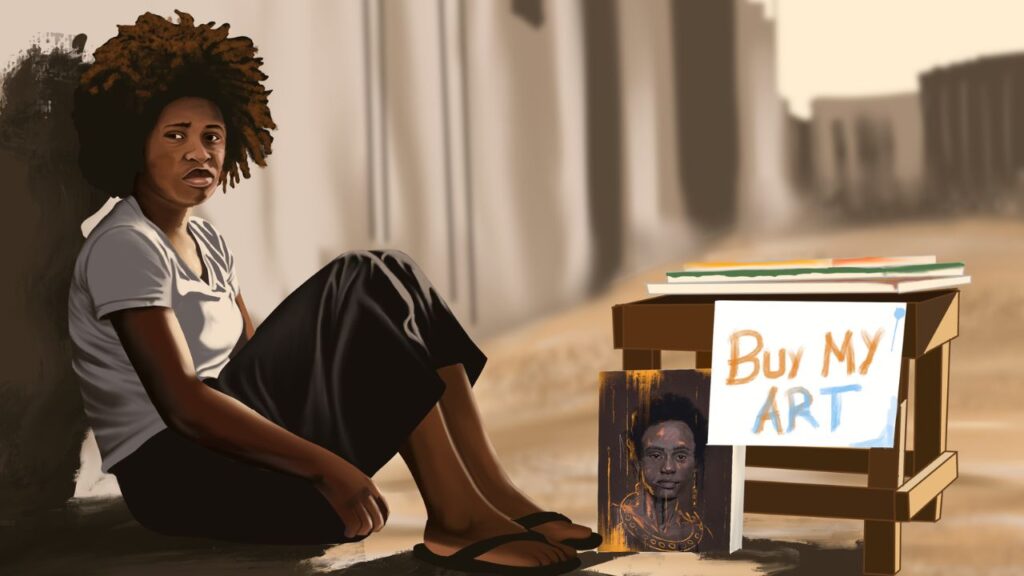
Five years ago, 11-year-old Sheila Sheldon, a model, poet, and designer who has created portraits of important figures, presented RAO with a portrait at his Capitol Hill office. RAO offered the young girl words of encouragement and appreciation and although there is no evidence that she was paid for the artwork, the exposure must have benefited her financially.
Soapstone sculptor Daniel Ombasa Apepo had created a sculpture that he intended to gift RAO but he died before Daniel could do so, missing the opportunity to see a change in his fortunes. Perhaps a Railaphile will emerge to offer Daniel a good reward.
RAO was a five-time presidential candidate – running in 1997, 2007, 2013, 2017 and 2022 – and during every election, art and artists played a key role. In 2002, RAO was central to Kibaki’s presidential election campaign under NARC during which the opposition adopted as an anthem to defiance GidiGidi MajiMaji’s Unbwogable. The protest song – translated to un-intimidateable, unshakeable, un-scareable – described the mood of the opposition and its supporters. In 2007, Raila was the flag bearer of the ODM Pentagon which was made up of Musalia Mudavadi, Joe Nyaga, Najib Balala, and William Ruto, and which later included Charity Ngilu, a political grouping for which Onyi Papa Jay produced a popular praise song that went viral. The song’s refrain, “Mnataka nani? Wakenya, mnataka nani?” would resound at political rallies, with crowds shouting the response “Chungwa!”
Onyi Jalamo’s Nasa Tibim became a major hit countrywide in 2017, propelling him from relative obscurity to fame. The same year, Helena Ken released Mambo Yabadilika, a gospel song promising change, while in 2022, Emannuel Musindi released Rero ni Rero. These two songs spoke of the inevitability of change.
It is reported that Diamond Platinumz earned a staggering 10 million shillings for performing at a RAO rally, while co-star Emma Jalamo who appeared alongside him was paid an undisclosed sum. Soon after releasing He Must Go in support of the Gen Z protests, and following the formation of the Ruto/Raila broad-based government, Onyi Jalamo released a remix of Tibim to celebrate the reunion of Raila and Ruto. The use of art in political mobilization had a direct impact on the financial fortunes of the artists, directly or through the massive exposure they received.
According to the Daily Nation, musicians performing at political events or those who had their songs adopted by political parties as campaign anthems were reaping handsome financial rewards. But many more were the songs that were recorded extolling the exploits and virtues of RAO. An AI search of the most sung about politician in Kenya brings up RAO’s name. The number of works – songs, poems, spoken word, plays, portraits, cartoons and sculptures – inspired by his person cannot be quantified and, following his demise, new pieces of music were recorded as tributes by singers from all over the continent. RAO’s personality not only inspired artistic creation, but also provided the opportunity for artists to earn from their compositions.
RAO, the performing artist
“Haaya! Haaya!”
A visiting American political science student eager to experience political discourse in Kenya attended a RAO rally. The crowd responded with thunderous cheers to RAO’s “Haaya! Haaya!”, prompting the American student to inquire what the words that had warranted such a rapturous response meant. Ever the consummate creative performer, RAO had given the Swahili word for “OK” another meaning in the political context, and unless one were imitating or parodying RAO, “Haaya” was not a word that could be used across the political spectrum like “Viva!” or “Aluta continua!”; only RAO’s “Haaya!” meant what it did, and like the seasoned performer that he was, he used the art form strategically to charge up the crowd. His theatrics served him politically energize his political base and provided artists with material to work with.
After President Kibaki took over from Moi, performing artists lamented that, unlike Moi upon whom the Redykyulass comedians had built a career, Kibaki was staid, boring, and not easily caricatured. Apart from when hurling his comedic “Mavi ya kuku” barbs, Kibaki’s businesslike demeanour was unentertaining, while from behind his microphone, RAO could wrap his audience around his finger. RAO had a greeting for every audience; he would excite crowds in the local language, laced with a heavy Luo accent, making no effort to blend in.
RAO’s speeches were narrative performance sessions filled with tales and historical anecdotes, using history to explain political occurrence and precedent and also to legitimize his decisions. None of RAO’s peers mastered the art of historicizing politics like he did. This ability enabled him to wade into political constituencies perceived as hostile to him, where he would paint political allegories that would leave the audience befuddled and often in stitches. This is why he was known as the enigma.
RAO’s performance of vitendawili, or riddles – which earned him the derogatory “Yule jamaa wa vitendawili” moniker from his political detractors – can be categorized as belonging to the ngonjera genre. Ngonjera is a genre of Swahili poetry much like the Gĩkũyũ Gĩchaandi, where a rhetorical contestation goes back and forth between the actors. RAO would build a political allegory to explain a confounding political event or phenomenon, such as joining KANU, the handshake with Uhuru Kenyatta or joining the broad-based government, and invite audience participation and endorsement of his decision.
When RAO wanted to make a political point, he used a kitendawili to explain. Musalia Mudavadi recalled this gift at his funeral and reminded the audience about when RAO explained the “nusu mkate” power-sharing arrangement by asking the audience to reflect on whether oxtail is meat. One could argue that RAO used vitendawili as a form of political participation and also as protection because he could call out political enemies without being crude. His audience always understood what or whom he was referring to, and like for any performer, this provided feedback about the extent of his connection with the audience.
RAO used football commentary and metaphor in his political discourse, using football anecdotes to galvanize his audiences. It was RAO’s way of informing an audience of his preferred first XI, the way a coach would pick a football team. In eulogizing him, Musalia Mudavadi stated, “If you wanted to know where your political fortunes were, wait until you listen to him [RAO] narrating soccer on a political podium, then you would know whether your goose is cooked or you had a chance.” RAO’s parodies of football commentary entertained the audience while signalling those whose political ventures met with his endorsement. A fledgling musician, Onyi Jalamo, used RAO’s chosen line-up in a song that was used to electrify NASA campaigns, elevating the artist to national status and bringing him a financial windfall.
RAO was also a master at appropriating songs to fit into his political agenda. When he was on the BBI (Building Bridges Initiative) campaign trail, Nobody Can Stop Reggae by Lucky Dube became the anthem of the campaign. So infectious was his appropriation that even in court presentations, the move to halt the BBI crusade was referred to as a move to stop reggae. In the long list of appropriated songs, Harry Belafonte’s Jamaica Farewell became RAO’s swan song. RAO loved the song and had sung it on many occasions and so, upon his demise, Belafonte’s lines took on a poignant melancholy.
I’m sad to say I’m on my way
Won’t be back for many a day
My heart is down
My head is turning around
I had to leave a little girl in Kingston Town
The “little girl” left in Kingston Town may well be the thousands of artists for whom RAO was an inspiration, a source of creative content, an ardent consumer of art, and a consummate entertainer who raised the profile of the arts and artists. RAO will be eulogized like no other, and he will be missed like none before.