|
Getting your Trinity Audio player ready...
|
There is a particular quality of stillness that precedes recognition—the instant before the eye understands what it is seeing. The world experienced that stillness on a Houston tarmac in the summer heat of 2026, when the Democratic Republic of Congo’s national football team descended into a Western port of entry. The cameras and journalists were ready, but what came through that door was entirely unexpected.
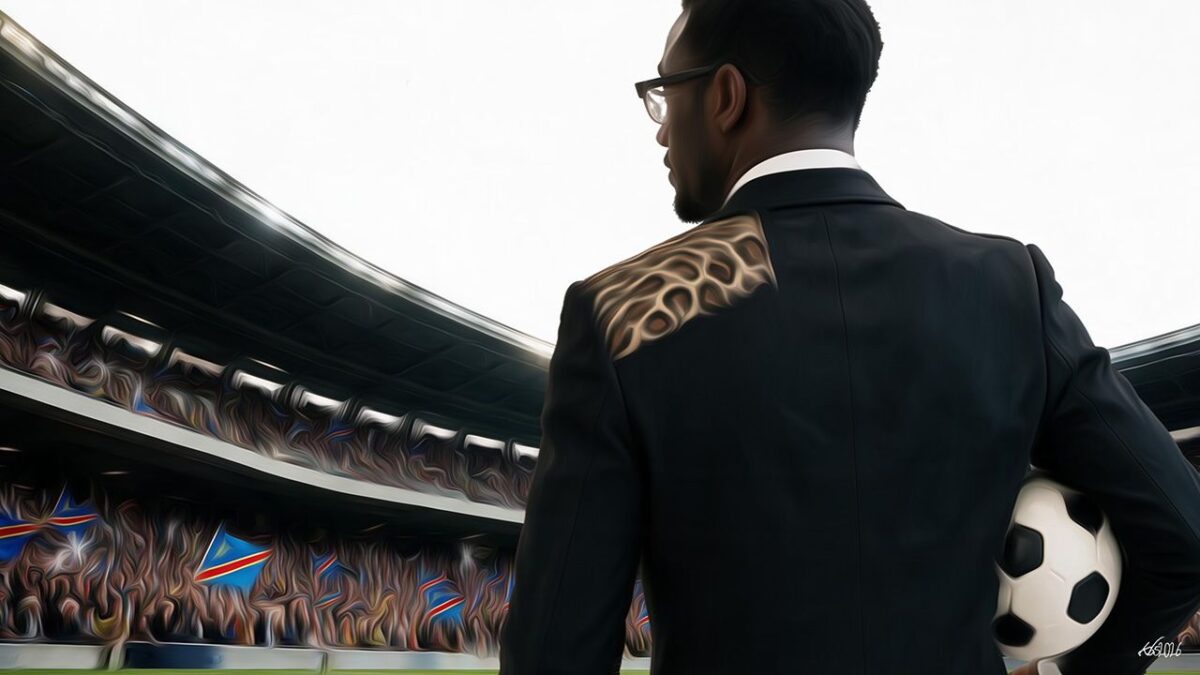
They moved in a phalanx—not as athletes arriving to represent a nation, but as a delegation arriving to declare one. Dressed in custom single-breasted black blazers designed by Alvin Junior Mak for JmakxParis, their shoulders carrying an asymmetric wave of obsidian and gold leopard print, the crystal panther brooches at their chests catching the terminal light, Les Léopards did not merely arrive; they materialized.
To the casual eye scrolling through a social media feed, it read as the World Cup’s finest fashion moment. But there is another way of seeing—one that requires a longer memory and a particular attention to what images carry beneath their surfaces. From that vantage point, this was not a fashion statement; it was a dispatch from a deep, unfinished history.
Before a single ball had been kicked, the Congo had returned on its own terms, in its own skin, and in its own symbology. To understand the weight of that presentation, one must travel backward from the blinding glare of stadium lights, away from the digital velocity of viral clips, and slip into the dappled, ancient quiet of the Great Equatorial Forest.
The transmigration of the spot
Before the border was a wire, before the river was a line drawn in ink and blood in a Berlin conference room, before King Leopold’s rubber ledgers began their obscene arithmetic of severed hands, there was the forest, and within it, the leopard.
Across the vast interior of the Ituri and Équateur regions, the leopard was never merely an animal. It was a sovereign consciousness—a sign of warning, a covenant between the visible world and the unseen. To wear its skin was an assertion of ontological rank: Here stands a protector of the equilibrium.
When the colonial apparatus arrived with its Maxim guns, forced labour quotas, and systematic brutality, this spirit of resistance went underground. It found life in the bark-cloth and braided secrecy of the Anyoto—the Leopard Men secret society whose defensive operations formed a highly sophisticated, asymmetric anti-colonial insurgency. Even as the Belgian administration extended its violent, decades-long suppression of the society well into the 1930s and 1940s, the Anyoto proved remarkably difficult to eradicate.
They forged iron claws that left no European signatures and wore carved wooden paws to mimic the wild, leaving bewildered colonial administrators to report not of human rebellion, but of the earth itself rising up. The Anyoto understood that against totalizing violence, one must weaponize the mythic. Empire could conquer the rubber trees, but it could not conquer the spot.
Seen through this historical lens, the leopard print sweeping across the shoulders of the squad today carries echoes of a much older lineage. It is more than a motif sourced from a mood board; it is a symbol that evokes a long journey from forest memory to the world stage.
The refusal to be broken
But empire is a machine designed to make the colonized body bare, subservient, and legible only as labour. For decades under Belgian extraction, and then under the suffocating Mobutist state performance of authenticité—which weaponized cultural dress into a mandatory political uniform—the Congolese body was denied the true sovereignty of self-presentation.
Against this attempted stripping of individuality and the right to be seen as beautiful on one’s own terms, a brilliant counter-insurgency was staged on the asphalt streets of Kinshasa. La Sape was a high-noon semiotic heist. Picture it: a man steps off a crowded bus in a citrus-yellow three-piece suit and matching pocket square, a cane swinging loosely from one wrist, a fat cigar unlit between two fingers purely for the theatre of it, and walks—unhurried, chin lifted, each step a small performance—down a dirt-and-concrete Kinshasa street as though it were a runway in Milan. Conducted in broad daylight, the sapeur hijacked the silk, the tweed, the structured shoulder, and the Italian cut—the entire visual vocabulary of colonial authority—and warped it through a prism of hyper-refined African elegance: the cut exaggerated, the colours louder than anything a European tailor would dare, the walk itself slowed into a deliberate, strutting ceremony. It was a radical, public declaration: You attempted to reduce me to dirt, yet I stand before you as an emperor of the sidewalk. The sapeur did not walk in borrowed clothes; he walked in reclaimed territory.
This lineage of mythic resistance and aesthetic insurgency recently converged in a singular figure during the Africa Cup of Nations: Michel Nkuka Mboladinga, known across the continent as Lumumba Vea.
Throughout the tournament, television cameras repeatedly returned to his motionless figure in the stands, transforming him into an unlikely symbol of Congolese endurance and Pan-African solidarity.
Mboladinga became an iconic symbol of Pan-African solidarity by standing perfectly, catastrophically still on a pedestal for the entire duration of the team’s matches. Dressed in sharp, flag-coloured tailoring styled after the historic statues of the country’s first Prime Minister and anti-colonial martyr, Patrice Lumumba, his right arm remained frozen toward the heavens, his palm wide open.
By standing frozen as a living monument while the world spun around him, Mboladinga created an anchor. His total immobility became a battery—converting decades of endurance, from Lumumba’s martyrdom to the quiet struggles of the present, into a focused, kinetic charge for eleven men running on grass. He held the historical quiet so they could unleash the physical lightning.
The fifty-two-year silence
Fifty-two years is a long time to carry a ghost.
The 1974 Zaïre squad—the last Leopards to travel to the World Cup—arrived in West Germany carrying a burden no football team should bear. They were Mobutu’s proof of concept: authenticité made flesh, deployed to boost a dictator’s international image. The pressure was existential. During the group stage, they suffered a devastating 9-0 loss to Yugoslavia—a scoreline that became an open wound in the Congolese football imagination, a number that echoed for decades. There were whispered accounts of state threats, of players told that defeat carried personal consequences beyond the pitch. The full truth of what those men absorbed has never been fully told.
What followed was half a century of absence from the global tournament. The world moved forward, while the Congo endured catastrophic regional wars and the continuous haemorrhage of its resources into the global tech supply chain. The nation that holds the world’s most critical reserves of cobalt and coltan has spent five decades watching that wealth depart while its people negotiate survival.
Against that fifty-two-year context, and following the ferocious spring qualification matches that finally broke the curse, the descent of Les Léopards onto American soil is not a mere sporting or fashion event. It is an assertion of duration, of survival, and of a people arriving entirely self-governed to claim the largest stage of all.
The texture of return
Look at the garments closely—not as design objects, but as arguments.
The structured black silk crepe features a trompe-l’œil collar, a visual illusion that shifts as the body moves, mimicking the restless shadow-play of forest light through a canopy. The asymmetric wave of obsidian and gold leopard print across the chest completes the long transmigration from the bark-cloth of the Anyoto through the Kinshasa pavement to an international arrival.
The crystal panther brooches pinned to their chests perform a deliberate correction. Colonial-era bronze sculptures historically framed the Leopard Men as savages to be managed and exterminated. Here, the leopard is reclaimed as the ultimate arbiter of elegance and power, its claws gripping not prey, but pearls shaped like footballs. The predator has become the sovereign.
In their hands are Moniama bags, their intricate braided weaving referencing the traditional baskets that once held medicine—and, in a dark historical echo, the very vessels colonial administrators forced their ancestors to fill with rubber under penalty of death. To see that specific weave resurrected on a global runway is to witness a profound structural inversion. The basket that once measured a people’s exploitation has been retuned, by the descendants of those who wove it, into a vault for their triumphs. It is an image that refuses to let the past remain static.
This is what a deeper form of sovereignty looks like: the dignity a people carry in their bodies, in their symbology, and in their insistence on being seen on their own terms.
Coda: The staircase
There is a photograph from that arrival – not the wide shot that circulated most virally, but a tighter frame, catching a single player mid-descent on the indoor airport staircase. His dyed ash-white hair stands out sharply beneath the terminal lights; his eyes are hidden behind silver, square-rimmed dark glasses. One hand rests on the rail. He looks completely past the lenses, past the waiting crowd, holding a horizon that belongs entirely to him.
In that gaze, if you know how to look, you can find the whole story. The forest. The iron claws and the wooden paws. The streets of Kinshasa where a man in a perfectly cut suit transformed a sidewalk into a throne room. The 9-0 scoreline in West Germany that became a ghost haunting half a century. The raised arm and the open palm of Mboladinga, steady in the stadium noise. Lumumba’s unfinished sentence.
All of it present, all of it worn, all of it walking – with the unhurried, absolute confidence of those who know exactly what they are carrying – down the stairs and into the light.