|
Getting your Trinity Audio player ready...
|
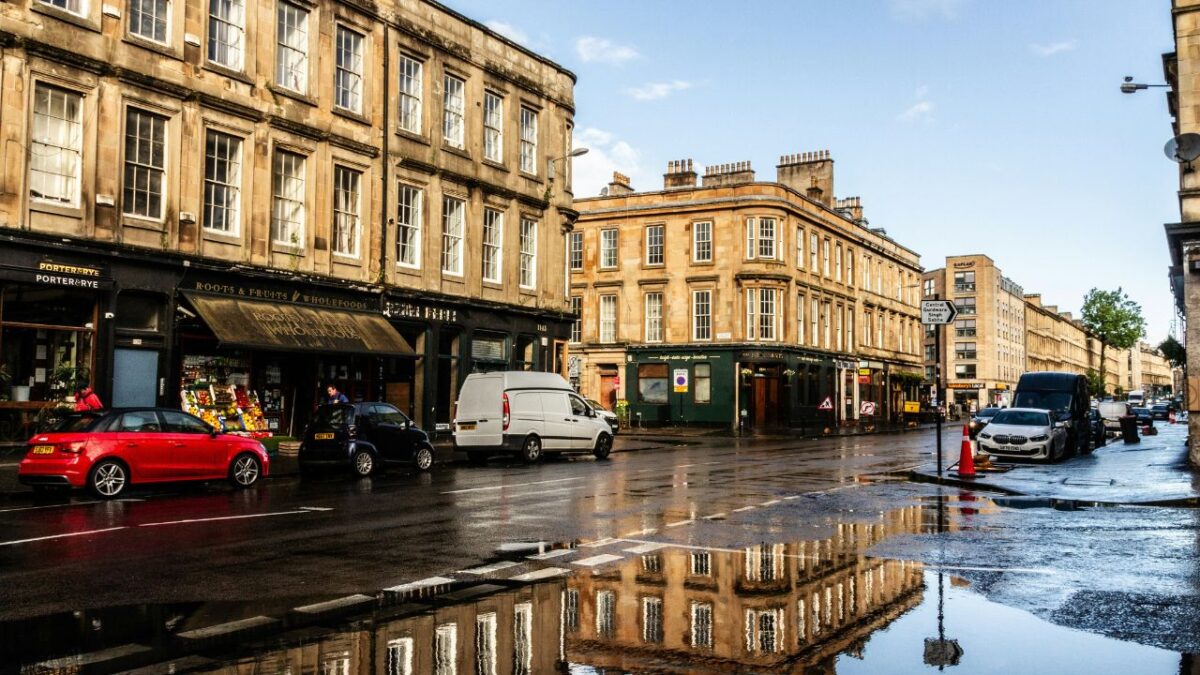
It’s Monday, the tail end of spring, with temperatures hitting 24 degrees Celsius in Glasgow, Scotland. The sky is blue. It’s a bank holiday, and Kelvingrove Park is teeming with activities. Kids are on their bikes. Couples are basking in the sun like lizards. Some are roasting skewers, kebabs, sausages, and meat on tiny grills. The air is so thick with joy you could cut it with a blunt blade.
I had arrived at the Queen Street train station earlier, one of the hubs that feeds the railway arteries into the belly of Scotland. Paved, safe, walkable paths and wide, clean roads made my walk to Kelvingrove an easy breeze. Even though I’ve lived in this country for some time, the demands of life as an expatriate living away from home can get in the way of smelling the flowers. But today I left my laptop bag at home, wore my sports shoes and shorts, and with a sling bag across my chest, decided to make time for myself. I’m on a mission to visit the University of Glasgow, an iconic school that has been producing some of the world’s notable thinkers since 1451.
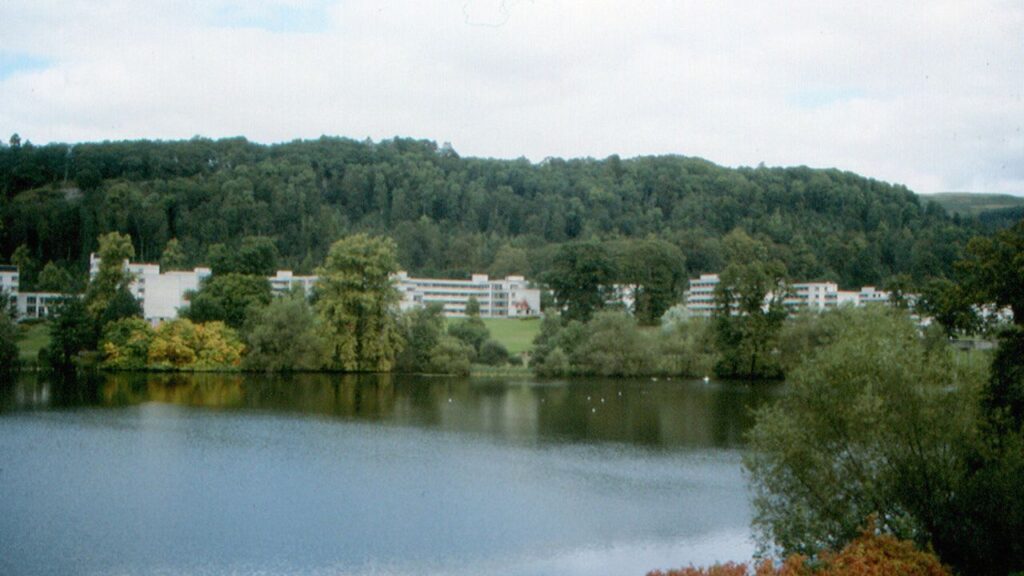
Kelvingrove is a well-designed free park with a state-of-the-art tennis court, a children’s playground, an outdoor gym, and tarmacked walking and cycling lanes. The River Kelvin runs through it, and there is a museum here too. It’s safe. There are no heaps of garbage, no flies, no cops with guns, and no council askaris.
People are sitting on the grass unbothered. An elderly man is on a bench, reading. A little further away, a wheelchair user and a three-legged dog are moving through the park with the same ease and entitlement as everyone else. Nobody is staring. Nobody is making way out of pity. The city was simply built to include them, and so they are included. Children are running freely.
Kelvingrove has been here since 1852, built as a public recreation ground, not for royalty or the well-connected but for the people of Glasgow. It is 85 acres of a public good, and it is not even the biggest in this central Scotland city. Glasgow, a city of 650,000 people, has over 90 such parks and gardens. I am not naive about how empires accumulate wealth. I know what Glasgow’s merchant past looks like. But somewhere along the way, someone in this city decided that part of the wealth, however it arrived, would be spent on the people who lived here. On parks. On benches. On cycling lanes. On museums that anyone can walk into for free.
Looking at how they are savouring this moment in this public amenity, I feel a tinge of jealousy. I want to stay in this moment. But something keeps pulling me back.
As I walk in this city, I notice the statues, the names on the buildings, and the stories carved in stone. I notice that Glasgow decided long ago, and baked it into its laws and its architecture, that the people who shaped how the city thinks are worth remembering. I stopped at one statue, and then another. I saw a pattern; this city memorializes its thinkers. A city is not just its roads and buildings, but the philosophy that decided what the physical infrastructure was for.
But the contradiction, which I didn’t know was so obvious, did not delay its arrival. There’s a statue of Field Marshal Frederick Sleigh Roberts, a British colonial commander who spent his life extending an empire that believed some people were meant to rule and others were meant to be ruled. Yet a few steps away is the intellectual legacy of Adam Smith, he of The Wealth of Nations, and David Hume, men who asked the hardest questions about human nature and how societies organize themselves.
Some might argue there is no contradiction here. That the gun and the idea of capitalism were always two arms of the same empire, one conquered through violence and the other through markets. And they would not be wrong. The city chose to remember both. The humanist and the imperialist. The rebel and the administrator. In the same park. On the same tarmacked path. Remembered equally in stone.
I kept walking as more questions flowed into my mind.
Because Scotland knows what it means to be on the wrong end of power. This is not a country that arrived at its current social justice-leaning posture without cost or in a straight line.
It all came to a head at Stirling Bridge on September 11, 1297, when William Wallace and Andrew Moray, together, led a ragged rebellion that, against every rule of war, defeated a far larger and far superior English army. On either side of it, guerrilla raids tore from Lanark all the way up into northern England. They didn’t just win the war; they broke the spine of English occupation.
And when Wallace was captured, brought to London, hanged, disembowelled, beheaded, his body cut into four pieces and sent to different corners of the kingdom, a message written in flesh said, “This is what happens to people who believe they deserve to determine their own fate.” But the English made the mistake that empires always make: Kill the man, kill the movement. It failed spectacularly.
Robert the Bruce picked up where Wallace fell. He stumbled, compromised, and even briefly submitted to English authority before finding his footing again. And at Bannockburn in 1314, outnumbered and fighting on home soil, the Scots routed the English army so completely that the question of Scottish sovereignty, which had been a question of if despite years of rebellion, suddenly shifted to when. By 1328, the Treaty of Edinburgh-Northampton formally recognized Scotland as an independent nation.
But even with independence, the Empire’s appetite for neocolonial control did not end. The Gaelic language was choked out. Kilts were criminalized. Entire Highland communities were systematically burned off their ancestral lands to make room for sheep, leaving the vulnerable to perish in the ashes of their own history.
But the irony is not lost on me that, even after independence, the people who carried out the Highland clearances were not only English. They were largely Scottish landlords. Lowland Scots who had abandoned the Gaelic culture, adopted the ways of empire, and turned the machinery of dispossession on their own kith and kin. They had absorbed the logic of power so thoroughly that they began to administer it against their own. The Highlander became to the Lowlander what the Highlander had been to the English. A problem to be cleared. A people too inconvenient to accommodate.
I walked slowly, pausing to reflect, Google, and refine these questions because I instinctively know that pattern. I have lived inside it, and the trauma of it is woven into my body. I know what it means to come from a place that powerful people in your own country have decided is expendable. To come from Kisumu, from the lake. To have endured over 50 years of profiling, tear-gassing, dead bodies, and economic exclusion not sanctioned by a foreign power but by Kenyans in power. The elites, who at independence bought up the very lands the colonizer had carved out as the White Highlands after displacing local communities, and with those acres, swallowed the colonial blueprint whole, turning it against their own countrymen and women. That’s how the idea that some Kenyans are more Kenyan than others came about. That some regions deserve roads and hospitals, and others deserve suspicion and bullets.
The Scots had their Highlands. We have our Coast, North-Eastern, Ukambani, some regions of the Rift Valley, and those areas that were declared non-productive through Sessional Paper Number 10.
I’m not sure about what held the Scots together despite such a brutal history. Perhaps we can glean part of the answer from the historian John R. Kellett, who, writing in 1967, described the Glasgow tradition as one of sturdy independence. That the most fruitful use of leisure was to learn. That Lord Kelvin, Joseph Lister, and Adam Smith himself were largely self-taught. That the fields they founded barely existed when they began. Private curiosity becoming public good. Individual restlessness becoming collective legacy.
Did they survive because they protected the insistence that thinking matters? That ideas outlast empires? That a people’s story, told in their own voice, is the one thing that cannot be confiscated?
I walked on toward the Adam Smith building with two thoughts wrestling in my mind for attention. What are we building back home that will still be standing when we are gone? What stories are we telling about ourselves that our grandchildren will be able to walk through?
Irn Bru
After my visit to the university, I found an Iraqi takeaway café and ordered a chicken wrap and a cold Irn Bru, one of Scotland’s best hidden inventions. I sat on a bench by the road and ate slowly. There is something clarifying about eating alone in a foreign city. The noise of everything you carry goes quiet for a moment. You are just a person on a bench with a wrap and a cold drink and the afternoon sun.
When I was done, I took the path through the same park where I found a less populated path next to River Kelvin, and I stopped.
I grew up next to Nam Lolwe, what the colonizers called Lake Victoria, the largest lake in Africa, the largest tropical lake in the world, and the principal reservoir for the Nile River. I am a son of the lake; water has never been just water to me. Growing up in Kano, the lake was not a backdrop. It was a presence. It had moods and secrets. It had swallowed people whole, given some back, and kept others forever. The people of the lake and the fishermen who went into it to make a living knew this. They did not go to the lake casually; they negotiated with it. So when I stand next to any body of water, something in me goes quiet and starts to listen.
The Kelvin is modest and unhurried, moving through the city slowly. But it is clean. And that cleanliness is not an accident. It is a decision that someone made a long time ago about what this city owes the people who live in it. A clean river running through the middle of a city is a philosophy made visible in water.
Like nature, water carries history the way nothing else does. It was here before the city. It will be here long after. It has watched everything. The decisions made in rooms it could not enter but whose consequences shaped the state of its existence. Standing there, watching it move, I felt something loosen in my chest.
I thought about Kano. About the lake. About how water has always been the place I go to when I need to find myself. And the person I most wanted to talk to in that moment was my mother. I grew up telling her about my dreams. Living in Kano plains, in Kisumu, I told her I would travel the world and change home. Despite people projecting their own doubts onto my dreams, I kept at it with a childlike idealism. I knew I wanted to be a storyteller. I instinctively knew there was a bigger world out there to explore.
When she took the call, I was grateful to be in a safe, dignified city thousands of miles from home. We talked for long, amidst shouts of “Iwinja?”, Can you hear me? Because even this developed country still suffers bad connections. We reminisced about a difficult childhood, how things had looked bleak, how far we have come. I told her that sometimes I’m so focused on the future, I forget to sit with how far I’ve already travelled. “Gratitude my son. Remember to be always grateful,” she told me.
It’s always good to talk to her. But even those calls can remind you why home is the mouth of a shark.
They had not had electricity for two weeks. In the last week, when I spoke to my sister, she too had not had power for two weeks. These are people living almost 350 kilometres apart, one in a rural area, the other in one of Nairobi’s estates.
I have not experienced a power cut since I came to this country. Not once. Not for an hour. The lights come on because that is what lights are supposed to do. It is not a miracle here. It is not something anyone is grateful for. It is simply a country that decided its people deserve to have their lights on.
It almost feels like I am at a banquet, and a buffet has been laid before me. The food is good, the room is warm, and the lights have never gone off. But there’s a rule; you cannot carry any of it home, even though you know your people are surviving on a steady diet of hope and prayers.
My nervous system is resting in someone else’s country while the people I love cannot rest at all. No matter what Scotland gives me in this moment, I cannot be fully at peace.
I feel a certain type of way being in this country, while 99 per cent of the people I love are in Kenya, battling a vicious cycle of dysfunction. It’s unfair. I wish my mother were here with me. I wish my father were here so I could show him Glasgow through my eyes. I wish I could have my siblings, my nieces and nephews, close by so we could enjoy this together.
The grief of having a big heart for home in a foreign land, of loving a country that isn’t yours while aching for the one that is, is a complex type of grief. It’s the grief of unrequited love. A love that is so strong but is bound within the confines of abuse.
In that moment, I ask myself this question: how did the Scots do it?
They were pressed too. Colonized. Brutalized. Their language taken. Their fight for dignity cost generations. It cost Wallace his body in four pieces, and cost Bruce and many others years of desperate guerrilla survival in caves and on the run. But they did not let themselves be erased; they held. It is a story not very different from the story of Kenya.
It is the philosophy that an idea whose time has come cannot be executed. That resistance, once it finds its shape, does not end with the death of one man or woman. It can be driven underground, but it will always regroup, finding the next Wallace, the next Bruce, the next Kimathi, the next Raila, the next Ottenyo, or Mekatilili, or Gacheke, or Olal, or Wanjira… and it keeps moving.
The Scots protected the thing that could not be confiscated. The insistence that their story was worth telling. That their thinkers were worth remembering. That their city was worth building into something inside which their children could rest centuries later. I am walking through the proof of that insistence right now.
We are not tourists in this story; we are one of the chapters that they wrote.