|
Getting your Trinity Audio player ready...
|
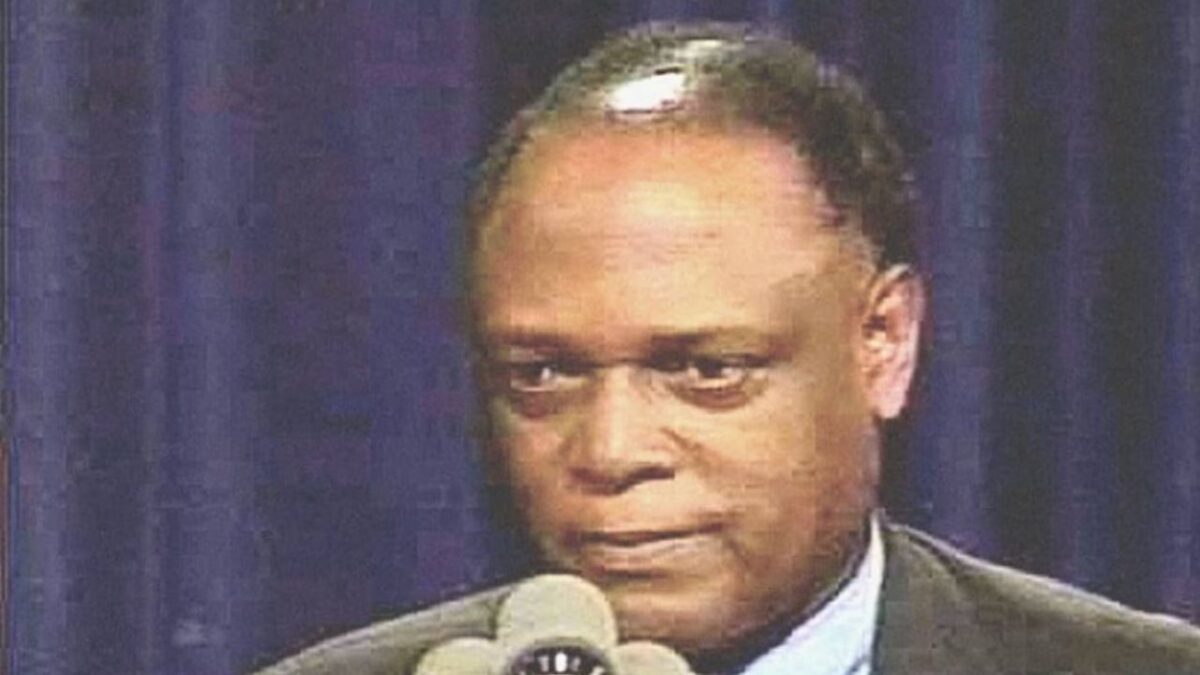
I owe Andrew Mtagwaba Kailembo, who has died at the age of 92, a debt of gratitude. News of Andrew’s death on 6 March 2026 took me back to early 1990, when I got my first permanent and pensionable job with the Brussels-based International Confederation of Free Trade Unions (ICFTU), as it was then known. The entry-level position had been advertised in the Belgian French-language daily Le Soir, and, out of college and in want of a job, I had applied.
Andrew – for we all called him Andrew – was then Head of the Africa Desk, and one of only three Africans in this international trade union organization with a diverse staff from Europe, Asia, the Americas, and Australia. He interviewed me, I got the job, and became the fourth African member of staff at the ICFTU.
Those were heady days to be working for the international trade union movement; the Berlin Wall had just come down, Lech Wałęsa’s Solidarność had come in from the cold behind the Iron Curtain, Apartheid was in its death throes, and Nelson Mandela’s release was imminent. Over the almost five years I would be with the organization, I would learn everything I now know about trade unionism and workers’ rights, much of it from Andrew.
Almost a decade before he joined the ICFTU in 1962, Andrew had co-founded the Buhaya Native Authority Employees Association in his native Tanganyika in 1954 and would become its first General Secretary. Fresh out of high school and unable to further his education for want of funding, Andrew had been recruited in 1952 as a junior officer by the Native Authority of Buhaya Council, a position that opened his eyes to the plight of the Council’s workers; their harsh and inhumane treatment under the traditional chiefs through whom the British exercised indirect rule. Brought up in the Catholic faith and educated under the Catholic White Fathers, Andrew’s social justice outlook was greatly influenced by the church’s social teachings, and this would be much in evidence throughout his career as a trade unionist.
The BNAEA formulated grievances that would for many years go unheeded by the Native Authority despite Andrew’s persistent entreaties, and, for six long years, nothing would change – except the membership of the association, which would continue to grow, from just 203 at its founding to 2,013 by 1959. Andrew would soon find himself sacked for “laziness” and “gross neglect of work,” but, undeterred, he would carry on with his activities as General Secretary of the BNAEA, preparing and organizing his membership for a strike in the face of the Native Council’s intransigence.
The strike began on 1 October 1960 amidst worker intimidation and rumours that the union leadership would be jailed but by 30 October, an arbitrator had been named by the government to study the demands tabled by the workers and make a ruling. The arbitrator ruled in favour of the union and, in typical Andrew fashion, he would observe that a bell had been rung above the beds of “those who pretend to not have known the use of the union and its functions” and they must now “awaken to a new dawn”.
Despite the workers’ victory, Andrew was not reinstated to his position with the Native Authority. However, an opportunity presented itself, and he soon found himself leaving Tanganyika for further studies at Oxford University. Andrew left for the United Kingdom in November 1960 and, with that departure, he would take the fight for African workers’ rights to the international stage.
Andrew’s time at Oxford afforded him the opportunity to visit the British Trade Union Congress, learn about workers’ councils, and the role of trade unions in the cooperative movement. Andrew began to see more clearly the role that he could play in the development of trade unionism on the African continent, and his persona as a trade unionist first and foremost was shaped during this time.
A job advert in a British newspaper, just as he was finishing his studies at Oxford, would lead Andrew to the door of the ICFTU secretariat in Brussels. The confederation was looking to hire someone to handle African workers’ issues, and the post required knowledge of the trade union movement, industrial relations, and economics. Andrew applied and was offered the position, which he took up, joining the organization as an African trade unionist with the support of the Tanganyika Federation of Labour, of which his union, the BNAEA, was a member.
Andrew joined the confederation in July 1962, overseeing workers’ activities in English-speaking Africa – workers’ education, collective bargaining, working conditions and safety, trade union activities, and human rights – and keeping the General Secretary abreast of social, political, and economic developments within the confederation’s affiliate organizations in Africa. He brought the benefit of his international experience to bear on the fledgling African trade union movement by providing consultancy services to national federations across the continent.
Trade union movements had joined in the nationalist struggle for independence from colonial rule, but as the wave of independence swept through the continent, the political leadership of the newly independent African states now sought to bring trade union organizations under their control and exclude them from actively participating in the process of nation-building and economic development. In this, Tanzania, under President Julius Nyerere, was no exception; the Tanganyika Federation of Labour was disbanded on the pretext that its leadership had been involved in fomenting a mutiny, its officials were detained, and the state-sanctioned National Union of Tanganyika Trade Unions was created to replace the federation.
However, it was Andrew’s strongly held view that trade unions should be involved in the planning of economic development programmes, but that this cooperation with government should be free of coercion. He said,
“If political independence is to receive more than the transfer of power from one group of people to another, and if economic development is to mean not the enrichment of a few, but prosperity for all, it is imperative that voluntary organizations be allowed to exist as independent institutions providing the checks and balances for a democratic society.”
Andrew was inevitably involved in the struggle to maintain the independence of trade unions, including in his own country; from his position within the ICFTU, he advised the organization to withhold cooperation with the newly created NUTA and, for a while, was unable to visit his country because of threats of arrest.
As human and trade union rights came under increasing threat with the rise of one-party states across Africa, Andrew mobilized legal and relief aid within the ICFTU to come to the assistance of trade unionists facing persecution on the continent, even organizing a high-level ICFTU representation to Ethiopia to plead with the Military Council for the release of jailed trade unionists following the overthrow of Emperor Haile Selassie in 1974.
But it is in the fight against Apartheid in South Africa that Andrew’s strengths as a campaigner and mobilizer were put to the test. In Andrew’s view, as the edifice of Apartheid rested on the exploitation of black labour, the ICFTU’s campaign and mobilization would be predicated on trade union rights. Speaking before the UN Special Committee on Apartheid in 1971, Andrew called for disinvestment in South Africa, discouraging white immigration, and isolation of the country, proposals that were adopted and implemented. Following the 1974 annual conference of the International Labour Organization (ILO) at which Andrew argued for the creation of a special ILO Conference Committee on Apartheid, the Financial Mail of Johannesburg described him thus:
“Put together an incisive mind, an almost Encyclopaedic knowledge of South African labour affairs, single-minded devotion to his work and a touch of almost Machiavellian cunning and you have Tanzanian-born Andrew Kailembo, head of the Africa section of the International Confederation of Free Trade Unions… Kailembo is a tough anti-apartheider and from his Brussels base is helping orchestrate ICFTU’s campaign to affix and tighten thumbscrews to European companies with interests in South Africa.”
Andrew also played a key role in organizing South African mineworkers. With funding from the ICFTU, current South African president Cyril Ramaphosa organized the mineworkers into the National Union of Mineworkers of South Africa, one of the most powerful unions in the nation’s history.
Africa was the only region without a fully fledged ICFTU regional organization. This would change in April 1993 when Andrew was elected to the position of ICFTU-AFRO General Secretary. He would influence the choice of Nairobi as the seat of the organization, maintaining a vigilant eye on human and trade union rights in Africa at a time when African workers were faced with the effects of structural adjustment programmes (SAPs), liberalization, and globalization, amidst the wave of democratization sweeping across the continent.
Hardly had Andrew taken up office, but he clashed with the Kenyan government when he protested the ouster of Joseph Mugalla as COTU General Secretary and his replacement with Joseph Ogendo. Andrew mobilized international pressure against the government, which the Weekly Review reported thus:
“Kailembo’s criticism of the current COTU leadership was at its sharpest, with the ICFTU representative constantly reminding all and sundry that the COTU national officials had come to hold their positions by way of a suspect and unacceptable election.”
Andrew prevailed, and the ousted officials were reinstated.
Andrew was elected for a second term as ICFTU-AFRO General Secretary in 1997, staying with the organization and guiding it to the historic merger with the Democratic Organisation of African Workers’ Trade Unions in 2007, which birthed the African Regional Organization of the International Trade Union Confederation (ITUC-Africa). Andrew stayed on for another year, acting as advisor to the General Secretary of the new organization, before returning to his home in Bukoba, where it had all begun over half a century earlier, leaving an indelible mark on Africa’s trade union movement.
As for me, wishing to expand my experience within the field of international development cooperation, I resigned from the ICFTU in the mid-90s and joined the Centre for Industrial Development, later renamed the Centre for the Development of Enterprise, an organization supporting SME (small and medium-sized enterprise) development in the member countries of the African, Caribbean and Pacific (ACP) Group of States. There did I come face to face with the abuse of workers’ rights that Andrew had been fighting against for over three decades by then.
Together with a colleague who had lived through the social and economic upheaval among the British working class in the wake of Margaret Thatcher’s assault on British trade unions and her neoliberal policies in the ’70s and ’80s, we set about unionizing the organization, achieving near-100 per cent membership, a complete overhaul of the staff regulations, and permanent and pensionable terms of employment in lieu of the renewable five-year contracts that management held over our heads.
Staff unionization and the union’s membership of a European trade union federation would a few years later prove salutary, enabling staff to negotiate acceptable exit conditions when the European Development Fund decided to withdraw funding and force closure of the organisation, a decision that was announced from Nairobi during an ACP-EU Council of Ministers meeting in June 2014.
Andrew Mtagwaba Kailembo was laid to rest at his ancestral home in Bukoba, Tanzania, leaving behind a family with ramifications in Kenya and as far away as Côte d’Ivoire, the United Kingdom, the United States, and Belgium.