|
Getting your Trinity Audio player ready...
|
Kenya’s education crisis, marked by a startling decline in student retention under the Competency-Based Curriculum (CBC), is not merely a bureaucratic failure; it is a symptom of a ruling class fundamentally detached from the nation’s future. With over 150,000 learners vanishing from the system between Grade 3 and Junior School, the state’s inability to grasp this catastrophe reveals an intellectual bankruptcy at the heart of our public life. This social and political class, which manages the country, has become its greatest liability.
The political class operates within a theatre of performance, prioritising image over substance. Like the recurring, hollow “launches” of stalled infrastructure, where officials pose before commemorative plaques at sites devoid of machinery, the elite’s engagement with governance is performative. Much like the Nyayo-era schemes that manufactured artificial energy shortages to profit from misery, today’s “maendeleo-democracy” masks a predatory extraction. This is a “bureaucratic bourgeoisie” that has hijacked the means of election, engaging in a form of capitalism without industry, where the public purse is the only raw material being harvested.
This class is the modern manifestation of a “stay-behind” operation, a colonial legacy designed to sabotage the promise of independence. As Frantz Fanon observed in The Wretched of the Earth, this “national bourgeoisie” is essentially an intermediary class. Born of colonial facilitators who traded in human lives before providing the “respectable” face of anti-colonial agitation, they remain, as Fanon argued, “senile at birth.” Bereft of vision and originality, they are mere mimics who hold the nation hostage within gilded colonial cages, chanting sovereignty while hawking it to the highest bidder.
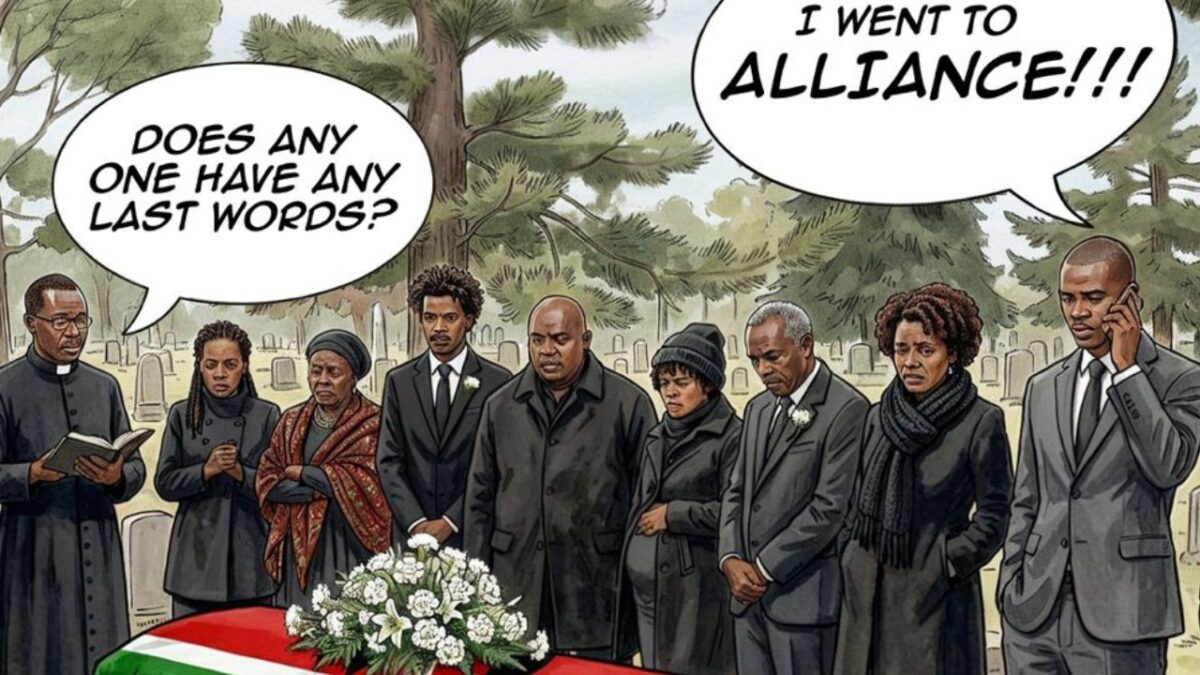
In the Kenyan context, this malaise is codified by the “I Went to Alliance” badge, a smug shorthand for an elite marooned in mediocrity. Six decades post-independence, the logic of this elite architecture remains intellectually lazy, refusing the burden of true adulthood or innovation. They occupy a reality of four-wheeled fortresses and shrieking sirens, policing borders they cannot transcend, while their intellectual vacuum chokes the nation’s potential. Fanon’s verdict remains the most damning: the bourgeois phase in postcolonial countries is a useless, parasitic interlude.
Yet, this cast is inherently self-consuming. Driven by a venality that devours its own foundations, the architects of our decline are trapped in a cycle of contradictions that is inevitably imploding. As Mordecai Ogada and Oby Obiero write, institutions such as “National” schools were never meant to foster education; they were designed to perpetuate colonial rule and intellectual decay. Elsewhere, Tony Mochama, Reginald Oduor, Wandia Njoya, Arkanuddin Yasin, Joyce Nyairo, and Kalundi Serumaga trace the manifestations of this disorder into the present day. Together, they map the devastating consequences that elite vacuity has wrought upon the nation at this pivotal stage of Kenya’s development. Their analysis assembles a portrait that is at once grim and biting, exposing the profound intellectual bankruptcy at the heart of our public life. Confronting this history is the first step in torching the euphemisms that shroud our reality.