|
Getting your Trinity Audio player ready...
|
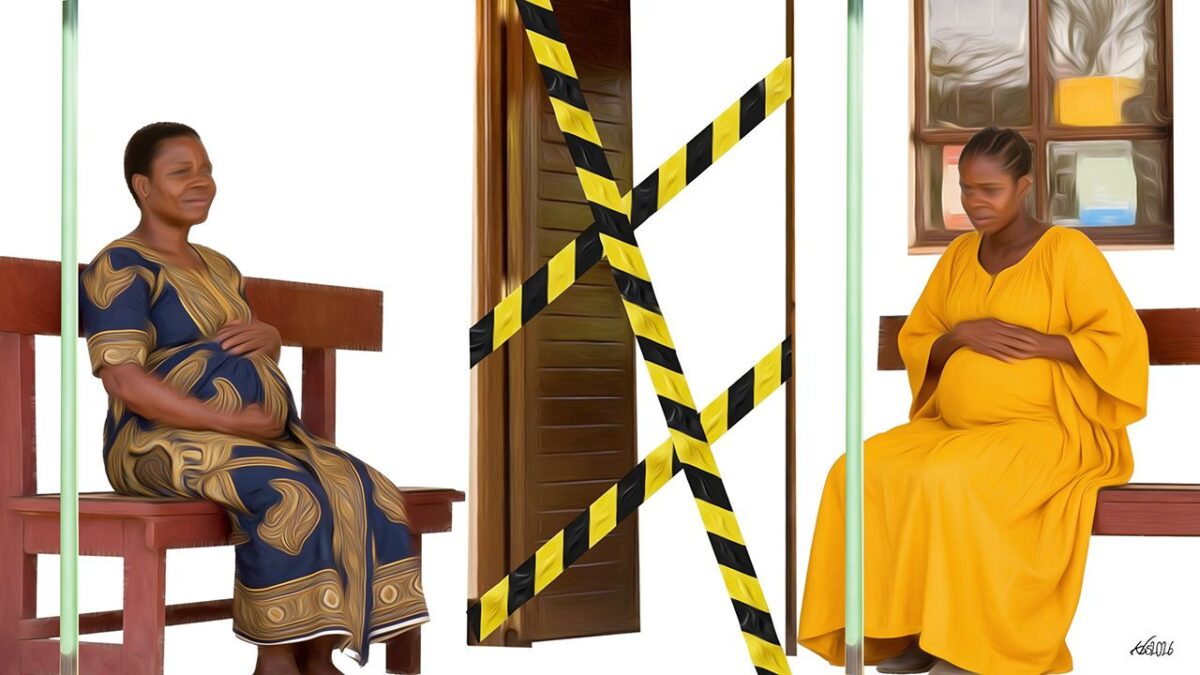
At first light in Dagoretti, two women arrive at the maternity ward carrying very different versions of the same hope.
One is nineteen, quiet, and heavily pregnant with her first child. She has come alone, clutching a folded clinic card in one hand and a small polythene bag in the other containing a leso, baby clothes, and bottled water. She has taken two matatus from Kabiria because labour pains began before dawn, and there was no one at home to accompany her.
The other woman is thirty-eight, a mother of four, arriving in the back seat of a taxi with her husband beside her and her youngest child asleep against her shoulder. She knows this road well. She knows the rhythms of contractions, the calculations of timing, the silent prayer every woman makes as her body crosses that threshold between danger and delivery.
In the maternity ward, their lives briefly converge under fluorescent lights and the practised hands of midwives who have already been on their feet for hours. One woman is anxious because everything is unfamiliar. The other is anxious because nothing is. And this is the truth Kenya must confront: maternal health is not one story.
It is not a single statistic, nor a uniform experience, nor a policy phrase that can flatten the vast differences between women’s realities. Maternal health is the teenager giving birth before she has finished becoming herself. It is the experienced mother hoping this delivery will not bring the complication that nearly claimed her life last time. It is the woman in a rural village travelling fifty kilometres for emergency care. It is the urban mother in Nairobi who reaches a clinic in time, but still fears whether there will be enough staff, enough blood, enough oxygen, enough urgency when urgency is needed.
And it is in these layered, unequal, deeply human realities that the true state of a nation’s maternal health system is revealed.
A few weeks ago, together with DJ Soxxy, I visited Midhill Hospital, nestled in the heart of densely populated Dagoretti, where the rhythms of everyday life press closely against the walls of one of Nairobi’s busiest maternal care facilities. Women arrive there from every kind of circumstance: on foot, by boda boda, in taxis, sometimes in the back seats of family cars, all carrying the same hope: to make it safely through childbirth and return home alive with their babies in their arms. It is a place where new life begins every day, but also where the fragility of that journey is impossible to ignore.
Every day in Kenya, women are still dying from causes we already know how to prevent. The numbers are staggering in their familiarity, maternal mortality remains far too high, and behind many of those deaths are two complications that should no longer be stealing lives so routinely: postpartum haemorrhage and preeclampsia. One is sudden and dramatic, the other can build up quietly and invisibly, but both can turn fatal with terrifying speed when care comes too late, or not at all. What struck me most is that these are not rare or obscure medical mysteries. They are known emergencies. We understand them. We know how to treat them. And yet they continue to claim mothers across the country.
That reality stopped feeling abstract when a midwife at Midhill told us, with the calm steadiness of someone who has seen too much, how quickly a normal delivery can become a fight to save a life. One moment a mother is holding her newborn, the next, a room is moving urgently around her to stop bleeding, lower blood pressure, stabilize a body in crisis. Listening to her, I realized how fragile the line can be between joy and tragedy in childbirth, and how much depends on timing, skilled hands, functioning systems, and whether the right care is available at the exact moment it is needed.
As a mother, I left Midhill thinking about how many people must get everything right for one safe birth to happen, the nurse monitoring vital signs, the midwife noticing danger signs early, the stocked blood bank, the ambulance that arrives in time, the partner who recognizes when something is wrong, the health worker who has not yet burned out from carrying too much for too long. That is why maternal health should matter to all of us, because no woman should lose her life giving life from causes we already know how to prevent.
What Kenyan women are owed is more than survival. They are owed the quiet confidence of knowing that when the moment comes to give life, the system around them will hold. Because motherhood, for all its beauty, should not demand that women wager their lives in exchange for bringing life into the world. The women I thought about as I left Midhill Hospital, the first-time mother arriving alone before dawn, the experienced mother returning once more to that fragile threshold between danger and delivery, deserve more than courage in the face of risk. They deserve to be met by a country that has chosen, deliberately and urgently, to make childbirth safer, gentler, and more just. Until then, maternal health will remain one of the clearest mirrors reflecting what we value, and what we still have failed to protect.
***
If you had told me some years back that I would one day be writing about maternal health, I would probably have laughed and asked what exactly qualifies a man like me to speak on something so profoundly shaped by women’s bodies and experiences. For many of us men, childbirth has long been framed as a space we orbit from the outside; we wait in corridors, pace hospital floors, receive the phone calls, but rarely imagine ourselves as part of the deeper conversation. Maternal health is often treated as a women’s issue alone, when in truth, the lives, families, and futures built around motherhood belong to all of us.
My education in this began at home. Long before I stepped into Midhill, maternal and reproductive health had already entered our lives in ways that changed me. My wife Anne and I walked a long and difficult road through infertility after learning that she had Polycystic Ovary Syndrome, a diagnosis that brought with it years of uncertainty, disappointment, and questions with no easy answers. What I remember most from that season is not only the medical appointments or the waiting, but the helplessness of watching someone you love carry so much of the burden in her own body, the physical strain, the emotional exhaustion, the quiet grief that often goes unseen by everyone else.
That journey taught me something many men are never encouraged to understand: reproductive health is not a private burden for women to shoulder alone; it is something that shapes entire relationships, entire families. I learned that being a husband in that space was not about standing on the sidelines offering sympathy, but about showing up fully in the uncertainty; listening, enduring, and learning how deeply women’s health experiences are woven into the emotional fabric of family life. By the time I walked into Midhill Hospital in Dagoretti a few weeks ago, I was not entering as an outsider to this conversation. I was entering as a husband, a father, and a man who has seen firsthand how profoundly these journeys affect us all.
When Kambua and I visited Midhill Hospital in Dagoretti a few weeks ago, that understanding deepened in ways I had not expected. Midhill is not the kind of place that makes headlines or appears in polished national campaigns, yet it is exactly where the real story of maternal health in Kenya is written every day. Tucked away within one of Nairobi’s most densely populated communities, it began in 1989 as a modest two-room clinic founded by the late Dr Priscilla Gateri and her husband, Peter Gateri, and today that founding vision lives on through their daughter, Dr Ciru Kinuthia, who now leads the hospital. Today, it is a 28-bed accredited facility with two delivery rooms, a fully equipped theatre, and a team that delivers over 1,600 babies a year from one of Nairobi’s most underserved corridors – families in Dagoretti and beyond, many living in single-room homes, many arriving by matatu or boda boda because it is the only way they can get there.
That is the Kenya that Midhill holds up every single day. Not the Kenya of policy frameworks and investment cases. The Kenya of real women arriving in labour, navigating a system that was not designed with their dignity as its first concern. And yet in that clinic, dignity is exactly what we saw being offered, not because the resources were abundant, but because the people doing the work had made a decision about what that kind of care means.
What I was not prepared for were the conversations with the midwives and nurses. These are people carrying enormous emotional weight, absorbing the grief of complications, of losses that families will carry for the rest of their lives, doing it in high-pressure environments without the psychosocial space to process any of it. Burnout among healthcare workers is not just a human resources problem. It is a patient safety problem. When a midwife is emotionally depleted, the quality of care she can offer a woman in labour is diminished. That is a truth the system has not been willing to sit with honestly, and it has to. We speak about quality of care as though it is purely a function of equipment and training, as though the emotional state of the person delivering that care is a secondary concern. It is not secondary. It is the foundation on which everything else rests. A system that sends midwives home carrying unprocessed grief, with no debrief and no support, and expects them to return the next morning and offer dignified care, that system is not just failing its workers; it is failing every woman who walks through the door after them.
The frameworks exist. The strategies are named. The community health promoters have been deployed. And fifteen mothers are still dying every day. What that gap tells us is not that Kenya lacks plans, it is that Kenya lacks accountability for whether those plans land where they are needed most. Accountability is not a vague aspiration. It means naming the county, the facility, the year, the official responsible. That gap cannot be closed by health workers alone. It requires governments, NGOs, researchers, policymakers, and yes, people with platforms, not as messengers for campaigns handed down to us, but as genuine participants in rebuilding the trust that the system has, in too many communities, squandered. That is the mechanism by which better information reaches the mother searching the internet at midnight, afraid and alone. It is how the stories of women navigating fertility crises in silence get told with the dignity and accuracy they deserve.
We are asking Kenya to answer a harder question: who is accountable when the plan does not reach the mother? Not in theory but by name, by county, by facility. Until that question has an answer, the number will not change. Fifteen mothers. Ninety-two newborns. Every day.